At 18, She Was Given—Still a Virgin—to a Widowed Rancher With Three Children… By Summer, the Whole County Would Learn What He Had Really Bought
THE DEAL IN THE BLIZZARDMontana Territory, January 1884.
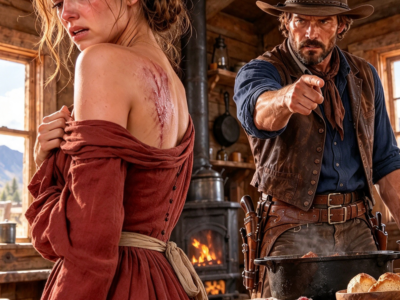
Hannah Reed was eighteen years old when her uncle sold her for fifty dollars and a breeding bull.
By morning, she would be living under the roof of a widowed rancher with three children, a dead wife’s memory, and a reputation that made even hardened men lower their voices.
But what frightened Hannah most wasn’t the stranger who had purchased her.
It was the terrible realization that nobody had tried to stop him.
“She’s eighteen, untouched, and stronger than she looks,” Uncle Cyrus announced, using the same satisfied tone he employed when bargaining over hogs and whiskey. “You won’t find a better deal between here and Miles City.”
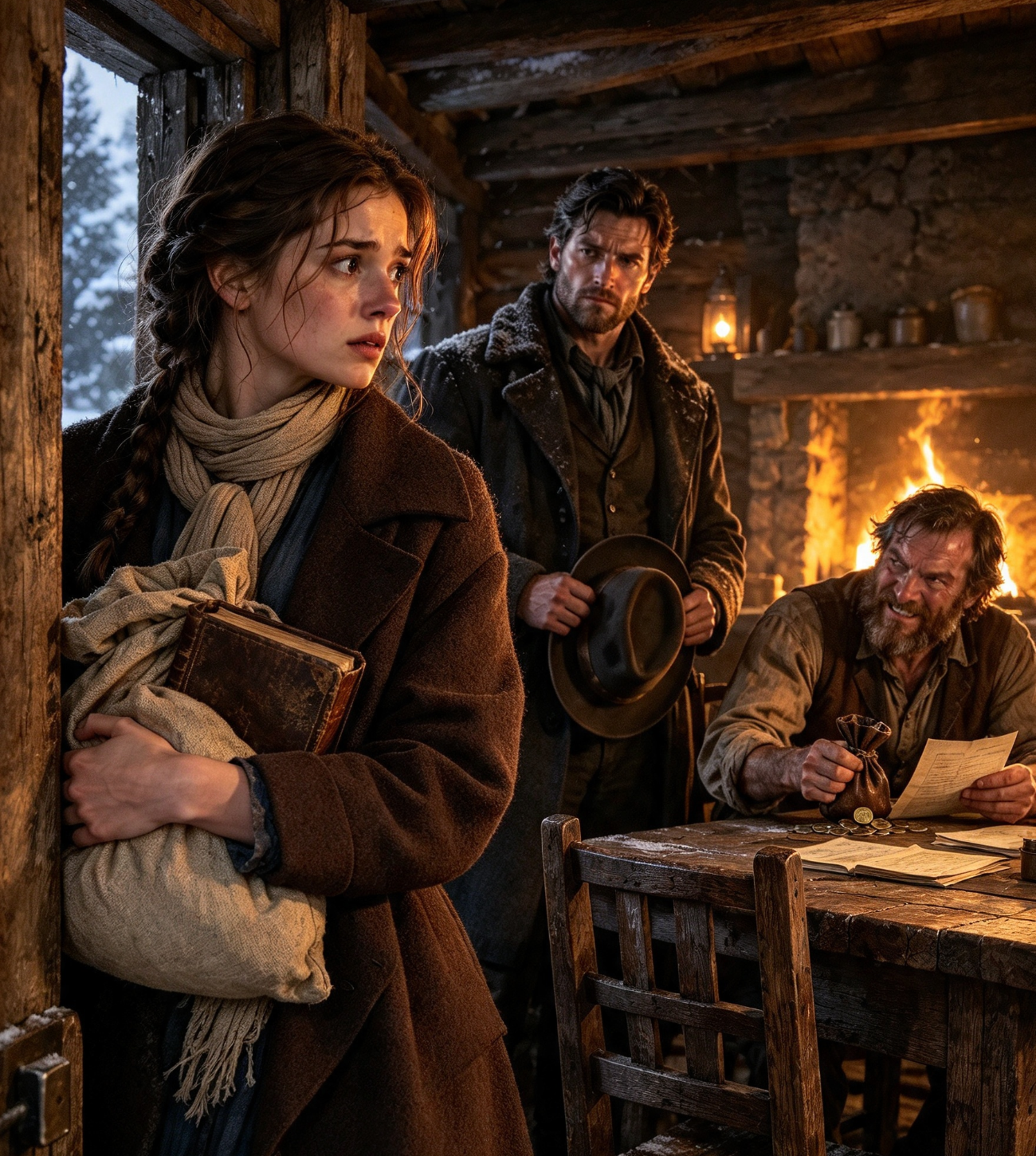
The January wind struck the cabin with such force that the walls trembled. Snow hissed through cracks around the windows, and the fire struggled against the cold.
Hannah stood beside the door, wearing her faded blue dress and a shawl so thin it barely deserved the name.
She kept her hands clasped tightly in front of her.
She had learned long ago that fear could make people cry, scream, or beg.
For Hannah, fear meant becoming perfectly still.
Across the room stood the man who might soon determine the rest of her life.
Mr. Mercer.
He was tall and broad-shouldered, with snow melting against his dark coat. His weathered face was stern, his jaw shadowed with stubble. Gray eyes stared into the fireplace beneath a heavy brow.
He held his hat between both hands.
He looked like a man who had survived terrible winters and buried something far more precious than cattle.
He had lost his wife.
Everyone knew that much.
Everyone also knew he had three children waiting at a remote ranch, and that no woman had managed to remain in his household for long.
Hannah wondered whether those stories were true.
She wondered what kind of man would come through a blizzard to bargain for a young woman.
And she wondered whether he would be crueler than the uncle she was leaving behind.
Cyrus spat into the hearth.
“I raised her after my sister died,” he said. “Fed her, clothed her, put a roof over her head. Six years of my own money spent keeping her alive.”
Hannah stared at the floorboards.
Six years.
Six years of hauling water before sunrise.
Six years of washing clothes until her knuckles cracked and bled.
Six years of cooking, cleaning, splitting kindling, and enduring Cyrus’s drunken temper.
He had never called those things payment.
Only duty.
“She owes me,” Cyrus continued. “And you need someone to cook, scrub floors, wash clothes, and look after those three little ones of yours.”
His mouth twisted into a grin.
“Not to mention keeping your bed warm.”
Hannah felt her stomach tighten.
Mercer’s fingers closed around the brim of his hat.
For several seconds, he said nothing.
Then he slowly lifted his eyes.
For the first time, his gaze met Hannah’s.
She expected hunger, amusement, perhaps the same ugly calculation she had seen on men at the mercantile.
Instead, she found something harder to understand.
Exhaustion.
A deep, almost unbearable weariness that seemed older than the lines in his face.
“How much?” Mercer asked.
The question struck Hannah harder than a slap.
She had known this might happen. She had overheard Cyrus talking about her usefulness for months.
Still, hearing a price requested aloud made the room seem to tilt beneath her feet.
Cyrus straightened eagerly.
“Fifty dollars cash,” he declared. “And the bill of title to that Durham bull you’ve been boasting about.”
Mercer’s expression barely changed.
“That bull is valuable.”
“So is a healthy young woman,” Cyrus replied. “Especially one who hasn’t been spoiled.”
Hannah pressed her fingernails into her palms.
She wanted to scream.
She wanted to tell them she wasn’t a horse, a cow, or a piece of property to be exchanged across a kitchen table.
But Cyrus had taught her what happened when she spoke against him.
And outside, the storm had swallowed the road.
She had no money. No horse. No place to go.
Mercer looked toward the fire again.
Something flickered across his face, too quickly for Hannah to identify.
Then he reached inside his coat.
A small leather pouch landed on the table. Coins struck the wood with a heavy, unmistakable sound.
Hannah watched Cyrus’s eyes brighten.
Mercer unfolded several papers and placed them beside the money.
“The bull’s title,” he said.
Cyrus snatched up the documents and examined them. His grin widened.
“Well, I’ll be damned.”
He counted the coins twice, biting one between his yellowed teeth. Satisfied, he shoved the money into his vest.
“We’re square.”
Mercer nodded once.
The transaction was finished.
Just like that.
Eighteen years of living, breathing, dreaming, and hoping had been reduced to a pouch of silver and an animal Hannah had never seen.
She swallowed hard.
The fire snapped.
Outside, a shutter slammed against the wall.
Nobody asked what she wanted.
Nobody asked whether she agreed.
Then Mercer turned toward her.
“You can bring a bag,” he said.
His voice was low and rough, the voice of someone unaccustomed to speaking more than necessary.
Hannah searched his face.
Was that all?
No apology?
No promise that she would be safe?
Not even a word about the children she was expected to raise?
Cyrus laughed.
“Don’t stand there like a stump, girl. You belong to Mr. Mercer now.”
Something hot and violent surged through Hannah’s chest.
For one terrifying instant, she imagined grabbing the iron poker beside the fireplace and striking Cyrus until that satisfied smile disappeared forever.
The thought was so vivid that she actually glanced toward the hearth.
Then she forced herself to look away.
Violence would not give her freedom.
It would only leave her helpless in a worse way.
Without speaking, Hannah walked into the narrow room at the back of the cabin.
It had once been a storage closet.
After her mother’s death, Cyrus had cleared enough space for a narrow cot and declared it suitable for a growing girl.
The room was freezing.
Moonlight filtered through the small window, illuminating her few possessions.
Two dresses.
A wooden comb.
A pair of stockings patched so many times that little of the original fabric remained.
She gathered them into an old flour sack.
There was nothing else worth taking.
Then she noticed the Bible.
Her mother’s Bible.
It rested beneath a folded blanket, its dark leather cover cracked with age.
Hannah lifted it carefully.
For a moment, she could almost smell lavender and woodsmoke, the familiar scent of the woman who had once brushed her hair and whispered prayers beside her bed.
Her mother had died six winters earlier.
The world had been colder ever since.
Cyrus had once tried to throw the Bible into the fire, claiming they needed kindling more than useless books.
Hannah had snatched it away before the flames could catch.
It was the only thing she had ever openly defied him to protect.
Now she pressed it against her chest.
“I wish you were here, Mama,” she whispered.
From the front room came Cyrus’s impatient shout.
“Hannah! That man isn’t waiting all night!”
She slid the Bible into her sack.
Then she heard something that made her stop.
Mercer’s voice.
Quiet.
Controlled.
But edged with a coldness she hadn’t heard before.
“Don’t call her that again.”
A silence followed.
Hannah moved closer to the doorway.
Cyrus gave an incredulous laugh.
“Call her what? She’s my niece. I’ve called her whatever I pleased since she was twelve.”
Mercer did not raise his voice.
“That ends tonight.”
The wind roared against the cabin.
Hannah stood frozen, one hand gripping the flour sack.
For six years, nobody had spoken to Cyrus that way on her behalf.
Nobody.
Then Cyrus said something that made her blood run cold.
“You’d better remember what you paid for, Mercer. Once you take her out that door, don’t come crawling back when you discover she’s more trouble than she’s worth.”
A chair scraped sharply across the floor.
Hannah hurried toward the front room.
Mercer was standing inches from her uncle.
His hat lay on the table.
His broad shoulders blocked the firelight, leaving his face half-hidden in shadow.
Cyrus’s grin had vanished.
And when Mercer finally spoke, his words were so quiet that Hannah almost missed them.
“You seem to have made one very serious mistake, Cyrus.”
Her uncle’s eyes narrowed.
“What mistake?”
Mercer slowly reached for the folded papers still lying beside the empty leather pouch.
Hannah noticed something she hadn’t seen before.
There was another document beneath the bull’s title.
A document bearing her name.
Mercer placed one finger upon it.
And then he said—
“Before this girl walks out of here, there’s something you need to understand about what I actually paid for.”
Cyrus blinked. “What is this? Some kind of legal trick?”
“It is a deed of guardianship,” Mercer said, his voice steady as stone. “Signed and filed with the county clerk three days ago. I did not come here to buy a wife. I came to take Hannah away from a man who has treated her like property long enough.”
Hannah’s sack slipped from her hand. It hit the floor with a soft thud.
Cyrus’s face turned a mottled purple. “You—you tricked me!”
“I paid what you asked,” Mercer said. “The money is yours. The bull is yours. But Hannah is not. She never was. You had no right to sell her, and you know it. Your sister’s will named no such power. You were guardian only until she reached majority—which she did three months ago.”
The truth hung in the air, heavier than the snow pressing against the roof.
Hannah stood trembling. For six years she had believed she belonged to Cyrus—that her life was his to do with as he pleased. And all that time, she had been free. She simply hadn’t known it.
“Then why—” Cyrus sputtered, clutching the pouch to his chest. “Why come like this? Why bargain?”
“Because I knew you would never let her go otherwise,” Mercer said. “I knew you would find a way to make her stay, to drain every last drop of work from her until there was nothing left. So I gave you exactly what you wanted. And in return, you handed over the only thing that was truly mine to claim: acknowledgment that she leaves with me of her own free will.”
He turned to Hannah, and the hardness in his face softened—just a little.
“Get your things,” he said, more gently now. “We leave in five minutes. The storm is worsening, but if we wait, the roads will be impassable until spring.”
Hannah stared from one man to the other. Cyrus looked as though he might explode—his hands clenched, his chest heaving—but he said nothing. He had been outmaneuvered, and he knew it. The money was in his pocket. The papers were signed. There was nothing more he could do.
She bent and retrieved her sack. Her fingers brushed the leather cover of her mother’s Bible, and she drew strength from it. She walked to the door without looking back at the uncle who had made her childhood a burden.
The cold hit her like a physical blow when she stepped outside. Snow fell in thick, blinding sheets. Mercer pulled a heavy wool cloak from his saddle and draped it around her shoulders. It smelled of horses, pine, and rain—clean, earthy scents that felt like a promise.
“Stay close,” he said, helping her mount a sturdy bay mare tied to the porch rail. “The trail is hidden in places. Trust the horse—she knows the way better than I do.”
They rode for hours. The wind howled through the pines, drowning out every sound but the crunch of hooves in fresh snow and the steady thud of Hannah’s own heart. She had never left the valley where her mother had died. She had never seen more of the world than the narrow stretch of road between the cabin and the general store. Now the world was nothing but white—endless, rolling white that swallowed horizon and sky alike.
Mercer rode ahead, his broad figure cutting a path through the drifts. Several times he stopped, dismounting to check landmarks beneath the snow, his breath pluming in the freezing air. He did not speak of the children. He did not speak of the wife he had lost. He did not speak of why he had gone to such lengths to rescue a girl he had never met.
And Hannah—shivering, exhausted, still half-convinced she would wake and find herself back in the storage closet—did not dare ask.
By late afternoon, the sky had turned the bruised purple of coming twilight. The wind had died down, leaving a silence so profound it felt as though the whole world held its breath. It was then she saw it: a cluster of buildings nestled in a sheltered hollow, smoke curling from stone chimneys, lights glowing faintly through the falling snow.
“The ranch,” Mercer said, as if reading her thoughts.
As they drew closer, the main house emerged—a substantial log structure, larger than any she had seen, with wide porches and a roof weighted down with snow. A light burned in nearly every window.
He helped her dismount. Her legs were so stiff she could barely stand. He steadied her with a hand at her elbow—firm, careful, nothing more.
“Inside,” he said. “It’s warm. And they are waiting.”
The door opened before they reached it. A woman stood in the entryway—middle-aged, apron stained with flour, face lined with worry. But when she saw Hannah, her expression softened into something like relief.
“Thank the Lord,” she said. “We’ve been watching the road all day.”
“Mara,” Mercer nodded. “This is Hannah.”
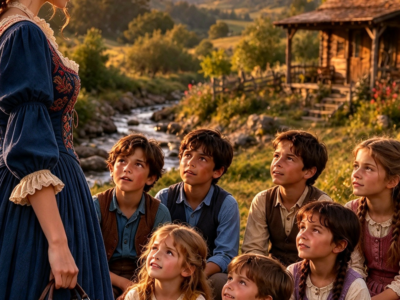
Hannah stepped over the threshold. The air smelled of cinnamon, woodsmoke, and baking bread. A fire crackled in a massive stone hearth, casting golden light over plank floors and hand-carved furniture. And seated around the table near the fire—three small heads turned in unison—were the children.
The oldest could not have been more than seven. Dark-haired, solemn-eyed, with a smallness to his shoulders that spoke of carrying too much weight too soon. Beside him, a girl perhaps five, with the same dark hair but eyes the color of spring sky, clutching a ragged cloth doll to her chest. And between them, a boy of three or four, wide-eyed and curious, his thumb hovering near his mouth.
They stared at her. No one spoke.
Mercer removed his hat and coat. “Hannah,” he said gently, “these are my children. Elias, Maeve, and little Sam.”
The names settled in the room like snow. Elias—named for his father’s father. Maeve—for a grandmother. Sam—simple, sturdy Sam.
“They have been without a mother for nearly a year,” he continued, his voice steady but quiet. “They have seen women come and go—women who saw only work, who did not stay. But I did not bring you here to be another in a long line of housekeepers. I brought you here because I knew you would understand what it is to be alone.”
Hannah’s throat tightened. She looked at the children—their watchful faces, their quiet waiting—and understood. He had not rescued her out of kindness alone. He had seen something in her—a loneliness that matched his own, and theirs.
Elias spoke, his voice small but clear. “Will you stay?”
It was the question Mercer had not asked. The question Cyrus had never imagined anyone would ask.
Hannah looked from the boy to his father—to the gray eyes that had watched her with such weariness, such careful hope. She thought of the cabin, of Cyrus counting coins while her mother’s Bible gathered dust. She thought of the ride through the storm, of the cloak around her shoulders, of a fire that waited for her.
“I will try,” she said.
Maeve slid from her chair and took one hesitant step forward. “Mama used to sing,” she whispered. “Do you sing?”
Hannah’s eyes stung. “Sometimes,” she said. “When I think no one is listening.”
Sam pulled his thumb from his mouth. “Will you sing for us?”
She looked at Mercer. He gave a small, almost imperceptible nod.
She set her flour sack on a chair—her mother’s Bible heavy inside—and began. It was an old lullaby, one her mother had sung, soft and low, about stars and safe harbors. The children did not take their eyes off her. By the second verse, Maeve had edged closer. By the end, Sam was leaning against her skirt.
Mercer stood in the shadows, watching. And for the first time since she had met him, Hannah saw something other than exhaustion in his face. She saw grief—raw and deep—but beneath it, a fragile, rising hope.
That night, she was given the room that had once belonged to their mother. A fire was laid in the grate. The bed was made with soft linen and a quilt stitched in star patterns. On the nightstand sat a vase of dried lavender.
She stood by the window, watching the snow fall, and pressed her hand to the glass. Somewhere out there, Cyrus was counting his money. Somewhere out there, the world was cold and hard. But here—here, the air was warm. Here, three children were asleep dreaming of songs. Here, a man had paid a fortune not to own her, but to give her a place to belong.
She opened her mother’s Bible to the first marked page. In faded ink, her mother had written: Home is not a roof. It is the hands that do not push you away.
Hannah closed the book and laid it beside the lavender. For the first time in six years, she slept without curling into a corner.