At 18, She Was Given—Still a Virgin—to a Widowed Rancher With Three Children… By Summer, the Whole County Would Learn What He Had Really Bought
THE STORM OF WORDSThe whispers began before the week was out.
It started small—a glance at the general store, a pause in conversation when Hannah entered, a woman turning away with a cold nod. Mercer had told her to stay close, but there were things needed from town, and one afternoon when Mara was unwell, Hannah went alone.
She felt the weight of it immediately. The clerk did not meet her eye. Two men by the door fell silent as she passed. When she left, she heard their voices rise behind her—low, sharp, words she could not make out but understood perfectly.
On the road home, she met Mrs. Hale. The minister’s wife. She had known Hannah’s mother.
“Hannah,” she said, stopping her wagon. Her tone was not unkind, but it was heavy. “I knew your mother. She was a good woman.”
Hannah’s throat tightened. “Yes, ma’am.”
“Then you must understand why people are concerned,” Mrs. Hale said. “The things being said… it isn’t right. A young woman alone in that house… it gives the wrong impression.”
“What impression?” Hannah asked, though she knew.
“That you are there as more than a caretaker,” Mrs. Hale said gently. “That Mr. Mercer took you in because your uncle offered you—well, as a wife.”
“And if he did not?” Hannah said. “If he took me in because I had nowhere else to go?”
Mrs. Hale looked at her a long moment. “I want to believe that. Truly. But your uncle has told his story to three different families. And he speaks with such certainty… it makes people wonder.”
“Does he speak of the money?” Hannah asked. “Of the papers he signed?”
Mrs. Hale hesitated. “He says the papers were a trick. That Mr. Mercer outwitted him. That you were never meant to leave that cabin except in marriage.”
“And you believe him?”
“I do not know what to believe,” Mrs. Hale said honestly. “I only know that gossip spreads faster than grass fire, and once it takes hold, it is hard to put out.”
She drove away, leaving Hannah standing in the dust.
By the time she reached the ranch, her mind was made up. She would not be the cause of Mercer’s name being dragged through the mud. She would not be the reason people looked at the children with pity or suspicion.
She began to pack. Not her things—she had so little—but her resolve. She would go to the next town. Find work as a seamstress or a cook. Send word when she was settled. Let the dust settle behind her.
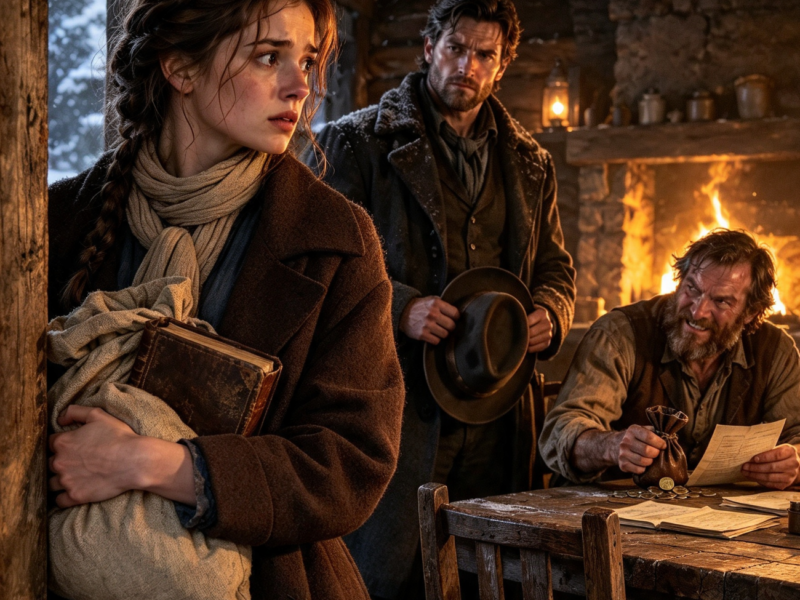
She was standing by the window, her mother’s Bible in her hands, when Mercer came in. He saw the bag on the bed and stopped.
“What are you doing?”
“I’m leaving,” she said, not looking at him. “Before things get worse.”
“Leaving where?”
“Anywhere. Away from here.”
He crossed the room in two steps and set his hands on her shoulders—not holding her, but steadying her.
“Look at me,” he said.
She looked up. His eyes were fierce.
“You think leaving fixes this?”
“I think staying breaks you,” she said. “They’ll say you took advantage. They’ll say I lied. They’ll say the children have no mother and a father who brings strangers into the house—”
“And what of what we say?” Mercer cut in. “Does our truth count for nothing against his lies?”
“It counts with us,” she whispered. “But will it count with anyone else?”
He released her and stepped back. For a moment he looked as though he might say something sharp. Then he breathed out slowly.
“You’re right,” he said. “People will believe what they want. But they will not believe it because you ran away. They will believe it because you stayed silent and let them.”
He walked to the door.
“Tomorrow is market day,” he said. “Everyone will be there. Cyrus will be there. If you leave now, he tells his version unchallenged. If you stay—we tell ours.”
Hannah hesitated. The thought of standing before them all—of being looked at, judged, picked apart—made her stomach turn. But the thought of Cyrus winning, of sitting in some tavern bragging that he had driven her out, was worse.
“What do we do?” she asked.
Mercer’s jaw set.
“We go to town,” he said. “Together.”
The next morning dawned bright and clear. The road to town was crowded—farmers, families, wagons loaded with produce. Mercer hitched the horses early. Hannah dressed in her best, her mother’s Bible tucked into her bag. Elias watched from the porch.
“I’m coming,” he said.
Mercer looked at him. “It might be hard, son.”
“I know,” Elias said. “I want to be there.”
Maeve and Sam wanted to come too, but Mara took them aside. “You’ll help me watch the house,” she said. “And you’ll pray for them. That’s important work too.”
The ride to town was quiet. Mercer did not speak, but he reached over once and covered her hand with his. It was rough, calloused, warm.
When they arrived, the square was already busy. People turned as they pulled up. The whispers started immediately. Hannah saw Cyrus near the general store, holding forth to a small crowd. He saw her, and his eyes gleamed.
Mercer helped her down. “Stay close,” he said. “Say your piece and nothing more.”
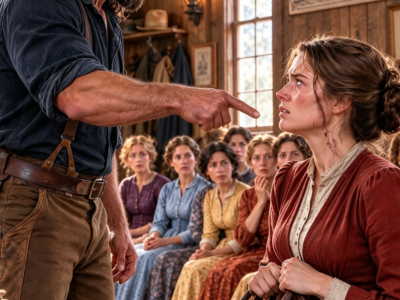
They walked across the square. The crowd parted like water. Cyrus stepped forward, his voice loud and carrying.
“Here she is!” he called out. “The girl sold under false pretenses! Taken from her home, from her kin—”
“Taken,” Hannah said, her voice clear and steady, “from a home where I was worked from dawn until dark, given no wages, no kindness, and no choice.”
Cyrus faltered. “You—you’re a child—”
“I am eighteen,” she said. “Old enough to know what was done. Old enough to speak the truth.”
She pulled the guardianship paper from her bag. Mercer had made a copy. She held it up.
“This document was filed with the county clerk three days before I left,” she said. “It states clearly that my uncle had no right to sell me. My mother’s will gave him no such power. Mr. Mercer did not buy me. He paid Cyrus what he demanded only to ensure he would stand aside and let me leave freely.”
“Lies!” Cyrus shouted. “Trickery!”
“Then read it,” Hannah said, holding it out. “Read it aloud to them all.”
No one stepped forward to take it. Cyrus looked from face to face, his bluster fading.
“She’s been turned against me,” he muttered. “He filled her head with stories—”
“I needed no stories,” Hannah said. “I lived it. Six years since my mother died. Six years of silence. Six years of believing I had no worth beyond what work I could do.”
She looked at the people around her—at Mrs. Hale, at the storekeeper, at the men who had looked away.
“I did not come here to shame him,” she said. “I came to say simply: I am not property. I am a girl who has found shelter in a house that treats me with respect. If that is wrong, then I do not want to be right.”
She folded the paper.
“I will not leave because someone tells me I do not belong,” she said. “I will stay because I have been welcomed. I will stay because I am needed. And I will stay because I have as much right to be here as any of you.”
A long silence followed. Then Mrs. Hale stepped forward.
“I saw the papers,” she said quietly. “The clerk showed them to me when I asked. They are legal. They are true.”
One by one, heads began to nod. A farmer who had stood listening gave a short, approving nod. Another stepped away from Cyrus, shaking his head.
Cyrus realized then that he had lost. He sputtered one last accusation, but it sounded thin, desperate. Then he turned and pushed through the crowd, back to his wagon, and drove away.
Mercer stood beside her, his hand resting lightly on her shoulder.
“Thank you,” he said.
But the day was not done.
As they prepared to leave, a woman approached—quiet, well-dressed, with eyes that held a sadness Hannah recognized.
“I am Clara’s sister,” she said. “I’ve heard things. I came to see for myself.”
Hannah braced herself. “And?”
The woman smiled. “Clara always said the right person would come when the house was ready. She said it would be someone who knew how to love them, not just manage them.” She looked at Hannah. “I believe you are that person.”
She reached into her purse and pressed something into Hannah’s hand—a small locket, with Clara’s hair inside.
“Welcome,” she said, “to the family.”
On the ride home, Elias sat beside her, his shoulders straight, his head high.
“You were brave,” he said.
Hannah looked at the locket in her palm. “I was scared.”
“That’s what brave is,” he said. “Being scared and going anyway.”
Mercer glanced at them in the mirror. His eyes were bright.
“He’s right,” he said softly.
The road stretched before them, long and golden in the afternoon light. The worst of the storm had passed. But Hannah knew—they all knew—that Cyrus would not be gone forever. He would return, or he would send word, or he would find some other way to make his grievance known. But for the first time, she did not dread it. She had faced him once. She could face him again.