At 18, She Was Given—Still a Virgin—to a Widowed Rancher With Three Children… By Summer, the Whole County Would Learn What He Had Really Bought
THE HARVEST THAT SUMMERThe season turned, soft and sweet, into the longest, warmest summer Hannah had ever known.
June brought clover and honey. Bees hummed in the orchard. The garden grew lush and heavy—tomatoes swelling red, corn rising tall, beans climbing the poles she had helped drive into the earth. Every morning, she woke to sunlight streaming through her window and the sound of children laughing somewhere outside. Every evening, they gathered around the table, full and tired, sharing the small triumphs and troubles of the day.
Elias took to farming with a passion Mercer said reminded him of Clara. He could name every bird, identify every weed, tell you which way the wind would blow before the clouds even gathered. Hannah worked beside him, planting, thinning, harvesting. He taught her the names of things; she taught him that being serious did not mean never laughing.
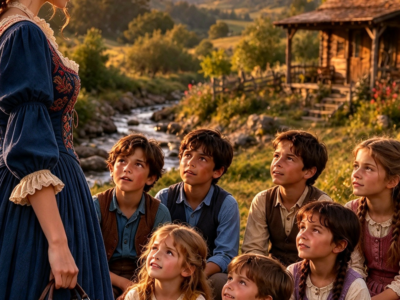
Maeve made a garden of her own—wildflowers, mostly, and herbs she picked from the hillside. She wove crowns for Hannah’s hair and pressed blooms between the pages of the big Bible on the parlor table. She sang while she worked, and Hannah sang with her, until the house was filled with music from dawn to dusk.
Sam followed wherever he could follow—into the barn, down to the creek, up the hill to watch the sunset. He brought Hannah stones and acorns and smooth pieces of glass, his face glowing with pride when she placed them on the shelf by her bed.
Mercer watched them all, and slowly the lines of grief around his eyes began to soften. He did not forget Clara—he never would—but he learned to live again beside her memory, not trapped inside it. He and Hannah talked late into the evenings sometimes—of their childhoods, of their hopes, of what it meant to build something new from broken pieces.
He never pressed her. Never spoke of marriage, never hinted at a future bound in law. He simply gave her space to grow, to choose, to become the woman she was meant to be.
But word traveled fast. By mid-July, the story of the girl who had spoken up in the town square had spread through three valleys. Strangers began arriving—not to judge, but to see. Women from isolated homesteads, girls with the same quiet fear Hannah had carried, men who admired courage in any form. They brought gifts—eggs, cloth, jam—and stayed to talk.
Cyrus was not forgotten. News came that he had sold his land and moved south. Some said he was ashamed. Some said he was running from debts. Whatever the truth, he did not return.
August brought the first harvest—heavy, golden, abundant. The barn filled with grain. The root cellar bulged with vegetables. The larder was stacked high with jars of preserved fruit and pickles. It was the richest harvest the ranch had seen in years, and everyone in the county knew it.
One evening, as they sat on the porch watching the sun set, Mercer turned to her.
“They’re saying I have you to thank,” he said. “That the land itself has responded to your care.”
Hannah smiled. “The land responds to anyone who loves it.”
He was quiet a moment. Then he said, “Do you know what I paid Cyrus that night?”
“Fifty dollars,” she said. “And a bull.”
He shook his head.
“That was what I let him think,” he said. “I paid him with something far more valuable.”
Hannah looked at him. “What?”
“Hope,” Mercer said. “Hope that he could take what he wanted and leave you behind. Hope that money would fill the empty space in him. But it never does. It never has.”
He turned fully toward her.
“What I truly bought that night—what I paid every penny and then some to secure—was the chance for you to find your own life. Not a life given. Not a life sold. But a life you choose.”
Hannah’s heart swelled. She looked at the children chasing fireflies in the grass, at the golden light spilling over the hills, at the man who had seen her worth when no one else had.
“And have I chosen well?” she asked softly.
Mercer reached out and brushed a strand of hair from her face—gentle, sure, no hesitation.
“You chose us,” he said. “And we chose you. That is the only bargain that ever truly matters.”
The summer deepened. The whole county learned, as the title promised, what he had really bought. It was not a servant. Not a wife. Not property of any kind.
He had bought her freedom.
And in return, she had given them something greater still: a home.
One evening, as the harvest moon rose huge and golden over the valley, Hannah took her mother’s Bible from the shelf. She opened it to the page where her mother’s handwriting ended. Beneath it, in her own hand, she began to write:
Home is not a roof. It is the hands that do not push you away. It is the voices that call your name when you are lost. It is the choice to stay, even when it is hard. I have found it here. I have found it now.
She closed the book and laid it beside Clara’s locket on the shelf. Outside, someone called her name—Sam, from the garden—laughing, bright, alive.
She went to them.
THE END