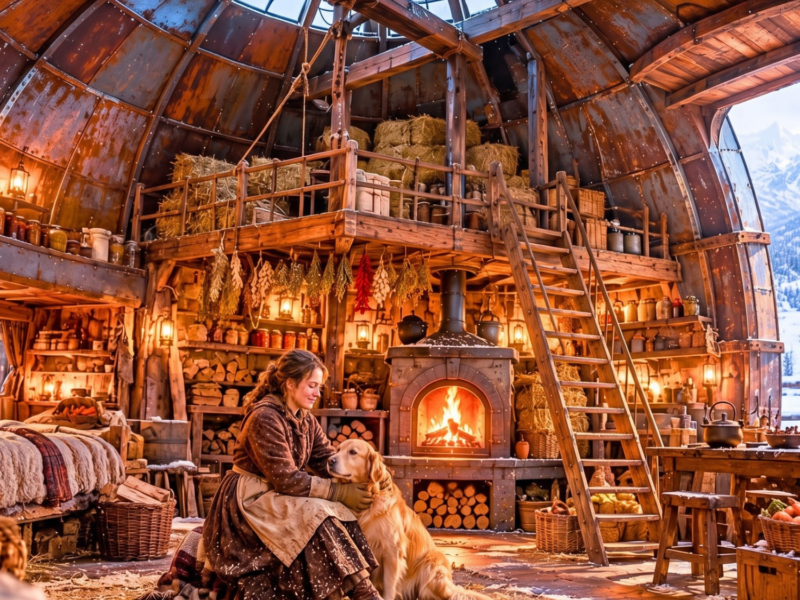
A Widow Built Her Home From Scrap Copper — Then 22 People Needed It to Survive the Blizzard
The Sound of the Wall
The first storm was not the worst storm. Nell knew this later. In the moment, she thought it was going to kill them.
The wind picked up all night. By dawn, it was screaming. By noon, it was throwing snow sideways. Nell went outside once briefly to check the drainage trench she and Kaia had dug around the foundation. She could not see her own feet. She came back in with snow packed inside her collar and her eyelashes frozen.
“Bad,” Kaia said. “Bad.”
They spent the day inside. Micah and Ellis’s coat by the fire. Kaia cross-legged on the floor, mending a torn place in her sleeve. She did not look up when Nell wrote, but when Nell set the pencil down, she said: “Wind speed, sound of the copper, temperature inside 38.”
“Temperature at midnight when she checked, 41. Fuel used since morning: three logs.”
Nell wrote it twice because she could not believe it. In the old stone house on a day like this, Ellis would have been feeding the fire every twenty minutes.
Ka sat cross-legged on the floor beside the stove, mending a torn place in her sleeve. She did not look up when Nell wrote, but when Nell set the pencil down, she said, “The curve.” “What?” “The curve is what holds the heat and sheds the snow and breaks the wind. The curve does everything.”
Nell nodded slowly. Ellis knew that. She said somehow he knew it before he could have known it.
Ka kept stitching. “Some men know things before their minds do. Samuel was like that. He knew he was sick a whole year before the coughing started. He never said it, but he began writing letters he did not send. He began giving away his knives one at a time to boys he liked. He knew. He knew.”
Nell closed the notebook, looked at the fire. Outside, the wind hit the copper and the whole house sang a low, steady note. Micah was already asleep, curled up on a blanket on the floor, his mouth open, one small hand still clutching the sleeve of Ellis’s coat.
Nell got up quietly, went to the boy, pulled another blanket over him, tucked it around his shoulders. When she straightened up, Kaia was watching her.
“You will keep him.” Not a question. “Yes.” “Good.”
Ka went back to her stitching. Nell went back to the table, picked up the pencil, wrote at the bottom of the page: November 4. First real storm. Roof held. Boy named Micah Bell arrived. He will stay.
Then she wrote in smaller letters at the bottom: Micah found it. Not me. It took a child’s hand to reach where mine could not.
She closed the book, blew out the lamp, went to bed with Ellis’s paper folded against her heart under her nightgown. Outside the copper house, the wind picked up, but it did not sound angry anymore. It sounded like something waiting.
Act IV: The Gathering at the Door
Chapter 14: The Twenty-Two
The storm broke on the second morning. It did not fade; it stopped the way a train stops, and the silence that followed was so absolute that Nell woke from it.
The absence of sound was more startling than sound would have been after two days of continuous noise. She lay in the dark, listening to the silence for a full minute. Then she got up.
By the time the sun cleared the eastern peak, she had eaten, checked the thermometer (minus seven—workable), coiled the first rope over her shoulder, taken a shovel in her right hand, gone to Edmund’s journal, and written the date on the top of an empty page: March 14th, 1881.
She left it open on the table.
Edmund appeared from the sleeping room, dressed, a shovel already in his hand, his breath visible in the cold air of the main room. He looked at the open journal. He looked at her. He said nothing.
She tied the first rope to the anchor ring nearest the ledge edge, threw the coil over, watched it unroll down the cliff face, and then she went over.
The descent was controlled, methodical, not fast—because fast on a rope over ice-filmed sandstone in the dark was an equation with one outcome. Her boots found purchase in the small irregularities of the cliff face, the places she’d noted over three years of looking at this rock from above.
Forty seconds to reach the snowpack surface.
She stepped off the rope onto the snow, and her boot did not sink. The surface was exactly what she’d estimated: compressed crystalline holding weight without yielding. It reflected the early sunlight in a way that was almost blinding.
She’d brought no eye protection—an oversight she filed for future reference without dwelling on it. She took three steps away from the cliff base, feeling the snowpack’s density through her boot soles, calculating load-bearing capacity with the part of her mind that never fully stopped doing calculations.
Edmund reached the surface thirty seconds behind her. He looked at the valley, the flat white expanse where a town had been, with an expression that had no precedent in any situation they’d previously shared.
“Where do we start?” His voice was low, as if the silence deserved some respect.
She was already scanning. The thin wisps of smoke from still-active hearths were the obvious guides, but she was looking for something more specific: the subtlest threat of vapor, barely distinguishable from cold air rising, that might indicate a location where fire still burned very low, where fuel was nearly gone, where the people inside were closest to the edge.
Her eye caught a smear of gray from the north-central section of the former Ore Street. There.
She started walking. Her footsteps on the snowpack made a sound like boots on packed dirt—firm, decisive, leaving almost no impression. Edmund walked beside her, slightly behind, the second shovel over his shoulder. The distance from the cliff base to the first smoke source was perhaps two hundred feet.
They covered it in silence, the only sound the compression of snow under their weight.
When they reached the area, she knelt, pressed her palm to the snow surface, felt nothing useful, then began probing with the shovel handle downward until it struck something solid—not stone. Wrong depth. Wrong resistance. Wood, a roof line.
She oriented herself relative to the building she knew to be in this section of Ore Street. The smoke was coming from approximately six feet to her left, which meant the hearth was on the building’s south wall, which meant the family inside, if they were following elementary survival logic, had retreated to the room closest to the fire.
She moved to the spot directly above the hearth location, planted her shovel, began digging.
Edmund dug beside her without needing to be directed. They’d been married long enough that the practical coordination happened without language.
Four feet down, the shovel hit a surface—roof decking intact. She moved laterally, found the edge of it, went over the side, and dug down along the exterior wall until she was standing at minus eight feet relative to the snow surface, with a wall of packed snow on three sides of her and the building’s north wall directly in front.
She found the window. It was intact, shuttered from the inside.
She knocked on the shutter with the shovel handle three times. Deliberate—the rhythm of something intentional rather than accidental.
From inside, a sound, then movement, then—muffled by the shutter and the snow and the fourteen feet of cold air between her position and Edmund on the surface above—a voice: Alive.









