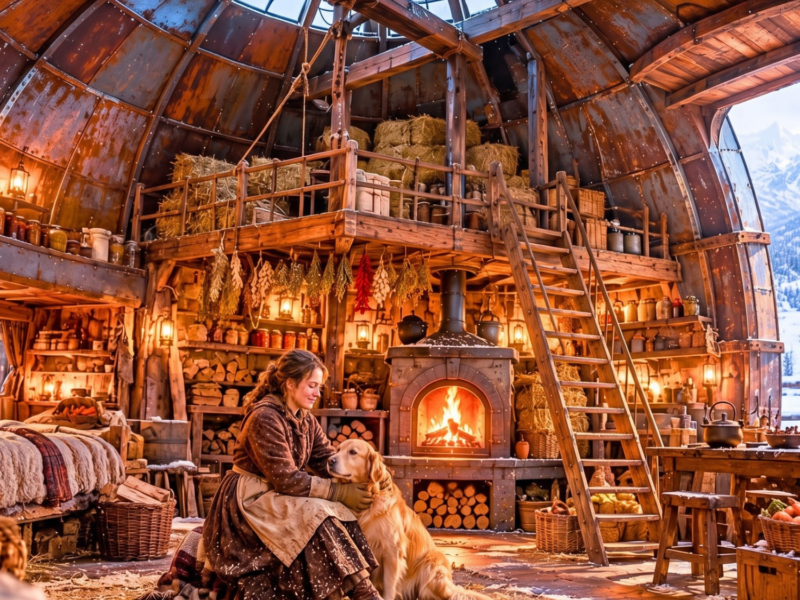
A Widow Built Her Home From Scrap Copper — Then 22 People Needed It to Survive the Blizzard
The Transformation of Dunore
Silus Dunore recovered in stages.
The frostbite on his cheekbones and the backs of his hands was serious, but not catastrophic. Doc Finch told him on the second day that he’d keep all his fingers, which she delivered as information rather than reassurance, because she’d assessed him accurately as a man who preferred facts to comfort.
His legs regained their full function by day three. His voice, roughened by smoke and cold, returned to something approaching its normal register by day five.
What did not return on any schedule Vera could observe was the version of Silas Dunore who had existed before the storm.
He was not destroyed by what had happened—she would not have respected that, the complete collapse of a person under pressure. He was altered in the specific way that certain materials are altered by extreme force: not broken, but permanently changed in their internal structure, their response to subsequent loads different from what it had been before.
He spent the first days of his recovery in a quietness that was not depression, but recalibration, sitting against the warm stone of the main room’s interior wall with his children pressed against him, watching the activity of the ledge with the careful attention of a man learning a language he should have studied earlier.
On the fifth day after the storm broke, he got up. He went to Edmund, who was at the table with his calculations, and asked what work needed doing—not what he could contribute money to, but what work needed doing.
Edmund looked at him for a moment, assessing the question’s sincerity, finding it genuine. He told him the water channel Vera had carved needed a secondary basin to prevent overflow during peak snow-melt hours. It was chisel work—straightforward for someone with guidance.
Dunore had never held a chisel. He said so directly. Edmund showed him the grip, the angle, the rhythm.
Dunore worked for two hours on the secondary basin, his large hands finding the motion slowly, the stone resisting him with the impersonal resistance it offered everyone who hadn’t learned to read it. He broke one chisel handle and gouged the work surface twice in the wrong direction. He stopped, examined the damage, asked Edmund what he’d done wrong.
Edmund showed him. He began again.
By the end of the two hours, the basin was rough, but functional. Dunore looked at it with an expression Vera had not seen on his face before: not pride, which she’d seen plenty of, but something more uncertain, more open—the expression of a person encountering competence they’d never developed in themselves.
“It’s not square,” Vera said from across the room, not unkindly, simply accurately.
“No,” Dunore looked at the basin. “だけど it holds water. That’s the more important quality.”
She went back to what she’d been doing. “We’ll work on square later.”
He heard the will. She saw that he heard it.
Act V: Build Accordingly
Chapter 18: The Meeting in the Open Air
The town meeting convened in the open air at the base of the South Cliff on the first day of April 1881.
There was nowhere else to hold it. The assay office—the only intact building—was serving as Doc Finch’s expanded treatment space now that the ledge was slowly returning toward its population of two.
People stood in the cold, their breath clouding in the morning air on ground that was still patchy with snow in the shadow of Iron Wall Ledge above them. Forty-nine survivors. Nineteen deaths, most of them in the storm’s first three days before the rescue operation could reach anyone—people who had been in buildings at the valley’s far northern end, the section most exposed to the wind-driven accumulation, where the snow had reached critical load before anyone understood what was coming.
Three more had died in the period between the storm’s end and their excavation: two from hypothermia, one from smoke inhalation.
Vera stood at the meeting’s edge, not at its center, which was a choice that registered clearly to anyone paying attention. She was not performing modesty; she had no interest in the symbolic architecture of the moment. She was there because people had asked her questions and she had answers, and that was sufficient reason to be present.
Dunore spoke first, which surprised most of the people standing there. They’d expected him to step back, to defer, to manage from the margins in the way powerful men sometimes did when their power had been publicly compromised.
Instead, he walked to the center of the group and turned to face them with the directness of a man who had decided that the performance of confidence was no longer worth its cost.
“I built the largest building in this valley,” his voice carried clearly in the cold air. “I spent nine thousand dollars on it. I hired skilled men to assemble it from materials I’d chosen for their quality. I believed that was wisdom—that money spent carefully bought safety.”
He stopped. “I was wrong about that in a way that contributed to how badly this town was hurt. I’m not going to say that once and move past it. I want you to understand that I understand it.”
The silence that followed was not the hostile silence of people withholding forgiveness; it was the silence of people who were still too exhausted, too altered by what they’d experienced, to perform any response they didn’t genuinely feel.
A woman near the back, Katherine Harwick, her infant against her chest, spoke: “What do we do now then?”
This was the question Vera had been waiting for. Not because she’d prepared a speech, but because she’d been thinking about the practical answer since day three of the storm, when she’d understood that whatever came after would require a different kind of decision-making than whatever had come before.
She moved from the edge of the group to somewhere closer to its center—not the exact center; she left that space open, belonging to no one in particular.
“We don’t have to rebuild the same town,” she said. “We’re not required to put the same buildings back in the same positions because that’s what was there before. The valley floor is a difficult place to build in this climate. We know that now with a certainty we didn’t have in 1878.”
She let the group absorb that. A few faces showed resistance—the instinct of people whose property rights, however damaged, were still recorded in Roy Becker’s filing system.
“The cliff faces on both sides of this valley are sandstone. The south face you already know something about.” She didn’t gesture up at the ledge; everyone knew it was there. “The north face has formations that would work differently—more limited solar access in winter, but protection from the spring floods that come down the east drainage every melt season. There are positions on both faces that could be built on within the next twelve months that would shelter families through any winter this valley delivers.”
“You’d have us all living in caves,” a man near the front said. His tone wasn’t hostile; it was genuinely uncertain—the voice of someone who wasn’t sure if he was objecting or asking.
“I’d have you living in places that are still standing in 1891,” Vera said. “What they look like from the outside is a separate question from whether they work. I built Iron Wall Ledge to work. It works. You were inside it for eleven days. You know what it felt like.”
No one disputed that.
Thomas Harwick, seventeen years old, his arm still carrying the specific kind of tired that came from four days of sustained excavation work, raised his hand with a directness that made several of the older men nearby look at him: “Will you teach us how to do what you did?”
The question landed in the group differently than any of Dunore’s careful statements had. It came from a boy who’d spent four days with a shovel on the snow surface, who’d carried people up a cliff path in the dark with a lantern, who had earned his standing in this conversation through physical work rather than property or history. The question had a different weight because of that.
Vera looked at Thomas for a moment. Then she looked at the broader group—the faces of people who had been three years ago amused by the woman who bought a cliff for four dollars. The faces were different now, not humbled in the way that people sometimes described as if surviving something terrible was primarily an experience of the ego, but changed in a more fundamental way: the way stone changes under enough pressure, its grain reorienting, its capacity for bearing load shifting in directions the original formation hadn’t anticipated.
“Yes,” she said. “I’ll teach anyone who wants to learn. The stone doesn’t care whether you understood it last year. It only cares about what you do with it.”









