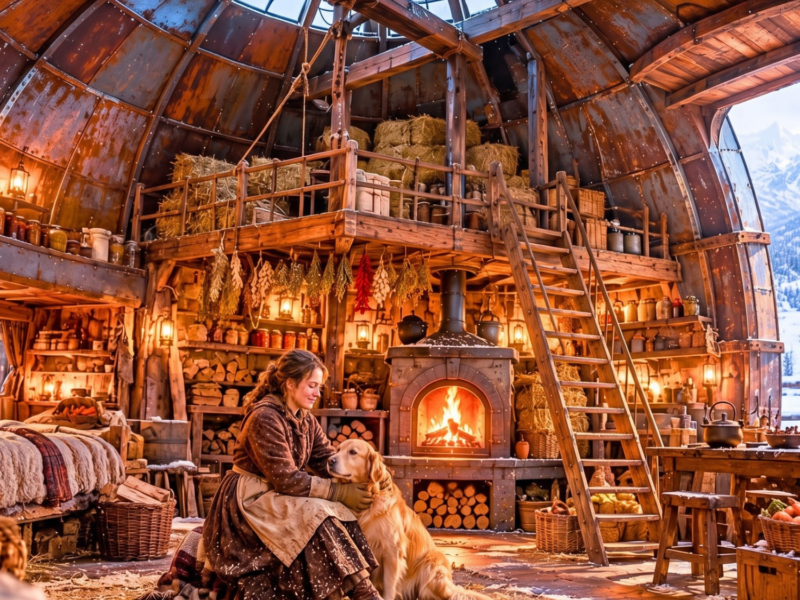
A Widow Built Her Home From Scrap Copper — Then 22 People Needed It to Survive the Blizzard
The Sunday Pew
Word got into town. The story spread the way stories spread in small places.
The widow Witcom had turned down good lumber. The widow Witcom was building a house out of scrap metal from the copper mine. The widow Witcom had a Crow woman working with her, sleeping there—some folks said more than sleeping, some folks said less. Nobody actually knew, but everybody had an opinion.
Reverend Holloway heard the stories at the store. He heard them at the post office. He heard them from his own wife, Judith, over supper on a Wednesday night. She said he should say something from the pulpit; she said it was unseemly, a Christian woman living out there in the sage with a pagan.
Reverend Holloway had said nothing because Reverend Holloway owed Everett Cain forty-seven dollars borrowed in June for the new roof on the parsonage—the one Cain had installed himself at cost because he was a generous man when it suited him. And Everett Cain had come to the parsonage the previous Sunday, sat in the front parlor, drank a cup of Judith’s coffee, and said, casual as weather, that the Witcom woman was building a fire trap out there and somebody ought to say something.
Reverend Holloway had nodded. Cain had smiled and said, “Just a thought.” The Reverend had walked him to the door, watched him ride away, come back inside, and sat at his desk staring at a blank page of sermon paper until Judith called him for supper. He had written nothing. He would write nothing. That was his weakness, and he knew it, and he hated it, and he did nothing about it yet.
The letter came on a Tuesday, two weeks after Kaia turned the frame.
A rider from the county seat brought it out to the claim: a boy of maybe seventeen, sunburned, nervous, who would not get down off his horse. He just held the envelope out to Nell at arm’s length like it might bite her.
“For you, Mrs. Witcom.” She took it. “Do I need to sign?” “No, ma’am.”
He wheeled his horse around and rode off before she could offer him water.
Nell opened the letter standing right there in the yard. She read it twice. She folded it, put it in her coat pocket, walked back to where Kaia was sitting on a stump sharpening a knife.
“What is it?” Kaia said. She had not looked up. “A hearing.” “For what?” “The land. Everett Cain filed a challenge. Says the copper house doesn’t count as a permanent dwelling. Says I’m not really occupying the claim. Says the whole thing is a hazard.”
Ka stopped sharpening. Looked up. “When?” “February the fourth.”
Kaia set the knife down on her knee. “You will need proof.” “I know.” “You will need to show you lived here all winter, every day.” “I know.” “You will need to write it down.”
Nell reached into her coat—not the pocket with the letter, the other one. She pulled out Ellis’s notebook, held it up. “I have already started.”
Kaia looked at the notebook, then at Nell, then at the frame of the copper house rising behind them in the September dusk. “Then we work faster.” “Yes.” “And we do not stop.” “No.”
Kaia picked up the knife again and started sharpening. The rasp of the blade against the stone was the only sound in the clearing for a while. Then she said, quiet: “He does not know you yet.” “Who? Cain?” “No.”
Nell almost smiled. “He’ll learn.”
Act III: The Copper Skin
Chapter 11: The Boy from the Ridge
November came in on a Wednesday. Nell knew because she had marked it in the notebook. Every day since October, she had written the date at the top of a page, then the temperature at dawn, then the wind direction, then whatever else the day gave her.
That Wednesday, she wrote: November 3. 29 degrees. Northwest wind. Sky clear. First hard frost on the creek.
Then she put the pencil down, blew on her hands, and went outside to finish the roof. The copper house was almost done. The ribs stood. The lower sheets were nailed in place, overlapping downward the way water flows. The insulation walls were half-packed with Kaia’s sweet mother grass. The little cast-iron stove sat in the northern end where the wall was low, its chimney pipe rising through a copper collar Nell had cut and hammered herself. Only the crown was open—a round hole at the top of the curve, waiting for the last three sheets.
Ka was already up on the frame when Nell came out with her coffee. She was straddling a rib, feet braced against the wood, a hammer in her belt. She looked down late. “Sorry, wind is coming.”
When Ka pointed at the ridge, there was a thin gray line above it: long, flat, moving east. Tonight.
Nell set down the coffee. “Then we finish today.”
They were nailing the second-to-last sheet when the boy appeared. Nell did not see him first; Kaia did. She stopped hammering, sat up straight on the rib, looked past Nell’s shoulder toward the clearing. Nell turned.
At the edge of the grass where the wagon track came in from the south, a small figure stood very still, hands at his sides, wearing a coat two sizes too big and a wool cap pulled down almost over his eyes. A boy of maybe eight years old. Hard to tell, because he was so thin.
Nell climbed down. Walked toward him slow—the way you walk toward a rabbit you do not want to spook. “Hello.” The boy did not answer. “You lost?” The boy did not answer.
She got closer. Close enough to see his face. His cheeks were red from the wind. His lips were cracked. His eyes were the color of wet slate, and they were watching her with a kind of intense attention that did not belong on a child.
“What’s your name?” “Micah,” a whisper. “Micah what?” “Bell.”
Nell went still. She knew that name—not the boy, the father. Thaddius Bell had worked at the copper mine before it closed, had come back to Antler Bend after, had married a girl from over in Deer Lodge, had taken a job driving freight on the north road, and had died last spring when his wagon went off the ice on the Missouri crossing.
The wife, the mother—Nell did not remember her name, but she remembered hearing at the store in July that the woman had taken sick. And she remembered hearing in September that the woman had died. And she remembered thinking somebody ought to take that boy. She had not thought further than that.
“How did you get out here?” “Walked from town.” “Then why?” “My ma’s house fell down.”
Something in Nell’s chest went quiet. “Not the roof?” “The roof was fine,” Micah said very quick, like he was defending it. “It was inside. She fell down inside and then she did not get up.”
Nell closed her eyes for one second. Opened them. “Are you hungry, Micah?” He nodded. “Come with me.”
She held out her hand. He looked at it. Then he took it, and his fingers were so cold she almost gasped.









