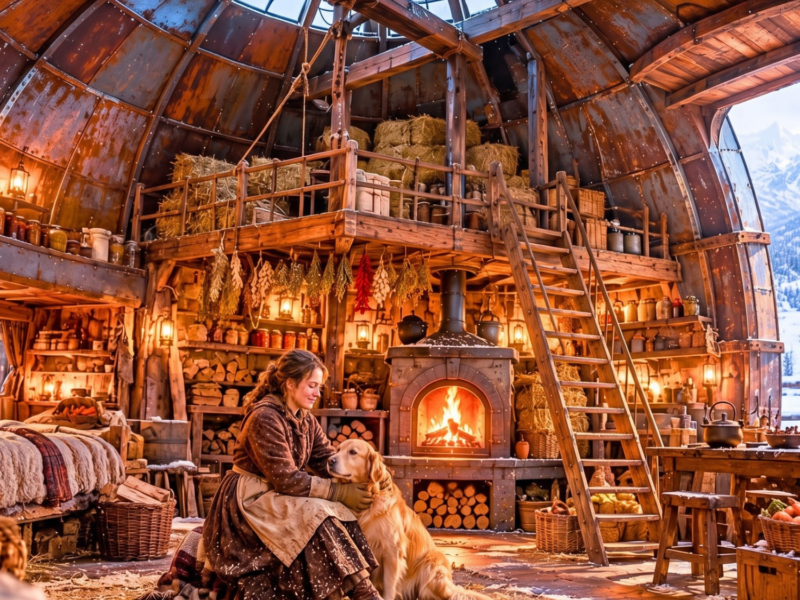
A Widow Built Her Home From Scrap Copper — Then 22 People Needed It to Survive the Blizzard
Page 31
Ellis’s notebook lay open on the packing crate beside her bedroll. Nell had read it a hundred times since March—not for the words, for the handwriting, the way he crossed his sevens, the little sketch of a bird in the margin of page 11 that he had never explained.
But that night, sitting in the dugout she had scraped beneath the foundation of the old house, with the wind pulling at the canvas above her head, she turned to page 31, and she stopped.
Because there in Ellis’s careful pencil was a drawing: a house, not a rectangle, not a square—a half-moon, curved on the top, flat on the bottom, higher on one side, lower on the other. Below it, he had written three words: South catches sun.
Nell stared at the page. Her breath came out slow. She had never seen this drawing before. She did not know when he had made it. She did not know why, but she knew what it was. It was the house she was building. He had already built it in his head two years ago, maybe three.
She closed the notebook, pressed it against her chest, and for the first time since March, she let herself cry. Not much, just a little, just enough to know she still could. Then she blew out the lamp, and she went to sleep with the notebook under her pillow, Ellis’s bird in the margin dreaming beside her.
Act II: The Ribs of the Whale
Chapter 6: Bending the Ash
Nell did not know how to build a curved roof. She had built chicken coops. She had built a lean-to for the goats. She had helped Ellis raise the corner post of the old house when they first came out. But this—this was different, so she made it up as she went.
She soaked long strips of ashwood in the creek, let them sit until the fibers went soft. Then she bent them slowly around wooden forms she hammered into the ground. She waited. She held her breath. She waited some more. The first three snapped; the fourth bent. She sat down on the dirt when it worked, put her hands over her face, and laughed—a short, cracked, ugly laugh because she had done something. She had actually done something.
The ribs went up one by one, curved, lashed at the crown with wet rawhide that would tighten as it dried. It looked like the skeleton of a great overturned wagon, or the ribs of a whale washed up in a place where there was no ocean.
Neighbors rode by. They slowed down. They stared. They rode on. Some of them laughed. Nell kept working. Her hands blistered, split, blistered again. She wrapped them in strips of Ellis’s old shirt and kept working. She slept in the dugout at night, ate cold beans from a tin, drank creek water, and woke before the sun.









