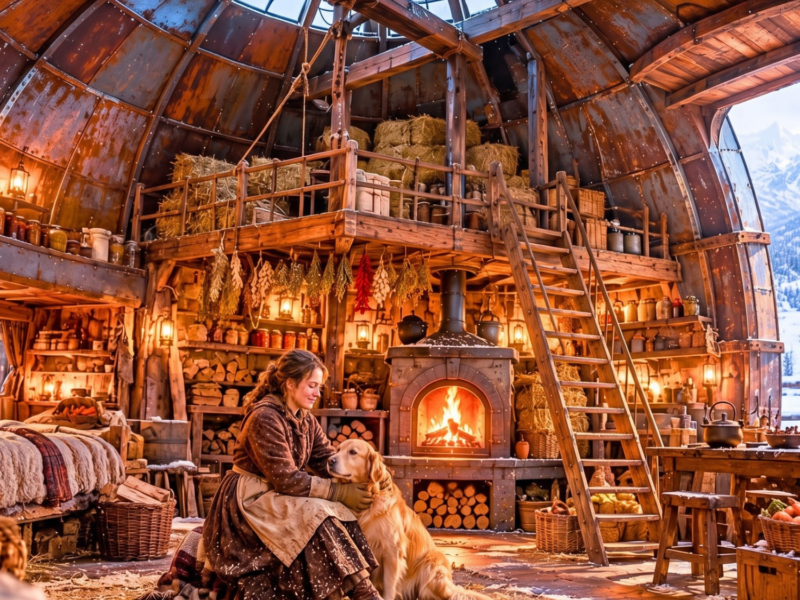
A Widow Built Her Home From Scrap Copper — Then 22 People Needed It to Survive the Blizzard
Build Accordingly
The Ashton Method was not something Edmund named intentionally. It appeared in a letter from the foreman of a construction project in Hartwell Creek, Wyoming, written in the summer of 1883 to acknowledge receipt of the notes Edmund had sent at that community’s request: We have been studying what the boys here are calling the Ashton Method and expect to begin site assessment on the North Canyon wall next week.
Edmund read the letter to Vera over breakfast. She turned it over in her hands, reading it herself.
“They’re calling it a method,” she said. “It is a method. It’s just how you build when you pay attention.” “Most people don’t pay attention. That’s why it needs a name.”
Edmund took the letter back. “I’m going to write it up properly. All of it. Not just the construction notes—the reasoning, why each decision, what we learned from the Pueblo structures, what the first winter confirmed, what the storm made obvious.”
She looked at him over her coffee cup. “That sounds like a book.” “It is a book.”
He picked up his pen with the particular decisiveness of a man who had been circling a decision long enough. “It’ll take me through the winter.”
It took him through two winters. The manuscript went to a Denver printer in late 1884, coming back in January 1885 as a bound volume of forty-four pages: The Ashton Method: Building with Stone in Mountain Country.
Edmund had written it in a prose plain enough to be useful to someone who had never read a technical document—specific, concrete, organized around decisions rather than descriptions. He sent copies to every mountain community he could find an address for. He charged nothing for them, which the Denver printer had thought was eccentric, until Edmund explained that the purpose of the book was not to generate income, but to prevent the specific kind of catastrophe that had occurred in Calder’s Bend in March of 1881.
The printer, who had lived in Denver through his own difficult winter in 1875, did not argue with this. He printed three hundred copies.
The group from Hartwell Creek, Wyoming, arrived in June 1884 on a Thursday morning: seven men on horseback carrying the particular alert posture of people who have traveled a distance for a specific purpose. Their leader was Robert Kane, a large, practical man in his forties who had the manner of someone accustomed to managing groups of other large, practical men—direct, low on ceremony, high on specificity.
Vera was working on the new extension when they came up the cliff path—a third room she was adding to the northeast side of the ledge structure, a space that would serve as a proper library for Edmund’s expanding collection of books, many of them on architectural history, many of them sent by colleagues who’d heard about the ledge through channels Edmund had carefully maintained.
She was in the middle of a cut that required sustained concentration, following a fracture line in the sandstone that had to be understood before it could be used. She heard the footsteps on the path, kept working.
Kane stopped at the top of the path and looked around the ledge: the south-facing window, the overhang clear of snow in the June warmth, the carved stone of the entrance frame worn smooth where thousands of hands had touched it over six years of regular use. He looked at the woman working the stone face with a chisel, her back to him, her movements unhurried, her attention completely on the rock.
“Mrs. Ashton.” Kane’s voice was respectful but not tentative. “Robert Kane, out of Hartwell Creek. We read your husband’s book. All of it, twice. We’ve got a canyon wall I think could work the same way, and some questions I was hoping you could address in person.”
Vera finished the stroke she was in the middle of. Examined the result. Set the chisel down. Turned.
She looked at the seven men, looked at Kane, read his posture, his hands, the specific quality of his attention—the way he had already noted the construction details of the entrance frame rather than looking only at her face. He was serious. He’d done his preparation.
“Sit down,” she said. “Watch first. Questions after.”
Kane sat on the stone bench Edmund had carved into the ledge wall three years earlier, specifically for this purpose: visitors who needed somewhere to sit while Vera worked. The other six men found positions along the ledge, settling with the patience of people who understood that watching an expert was its own form of learning.
Vera picked up her chisel, turned back to the wall, began again.
For an hour, no one spoke. The sound of chisel on stone carried out over the valley below, where Calder’s Bend was visibly, permanently different from what it had been before the storm dwelling stepped up. Both cliff faces. The valley floor rebuilt more sparsely, lower, with wider spacing between structures. The community hall’s entrance was visible on the north face, its carved stone stairway descending in even treads. The assay office had been rebuilt in stone. Even the buildings on the valley floor, the ones that couldn’t be moved to the cliff faces for practical reasons, were built lower, with heavier frames, with wide-eaved roof lines designed to shed load rather than accumulate it.
A different town, the same valley—the valley unchanged in different, patient, in its geological way.
Epilogue: Build Accordingly
The years that followed were not dramatic in the way the storm had been dramatic. Drama compresses time; ordinary life expands it, filling each day with the accumulation of small decisions whose significance only becomes visible from sufficient distance.
Vera worked. Edmund wrote. The ledge was home.
She took on students in small groups every spring, teaching through the construction season when the stone could be safely worked without the complications of frost in the mortar joints. She developed over the course of a decade a fluency in teaching that she’d never sought, but that emerged from the sustained necessity of translating what she understood intuitively into language that someone encountering it for the first time could follow.
She wasn’t patient the way teachers in stories are patient. She had a directness that occasionally startled people—a habit of interrupting incorrect technique mid-stroke rather than letting a student finish before correcting them. But she never made anyone feel foolish for not knowing something they’d had no reason to know yet. Ignorance was simply a condition that learning addressed. There was no moral valence to it.
William Dunore became the kind of stoneworker by his mid-twenties that other stoneworkers came to watch. He had his instinct refined by years of practice into something that could now be passed on. He began teaching his own small group of students in 1889—the first person in Calder’s Bend to teach the method who had not learned it directly from Vera.
She attended one of his sessions without announcing herself, sat on a rock at the edge of the group, watched him correct a student’s chisel angle with exactly the right pressure—firm, specific, and personal—then stood up and left without speaking to him.
William found out she’d been there from one of his students. The knowledge sat with him differently than a compliment would have. It was more like confirmation, which was what he’d actually been working toward without fully knowing it.
Silas Dunore’s later years were quieter than his earlier ones, which suited him. He’d rebuilt his personal finances cautiously, lending money for construction projects he now understood well enough to evaluate with the same rigor he’d once applied to land values. He lived in a stone house on the north-face cliff—modest by the standards of Dunore Manor, three rooms cut into the sandstone with a southwest exposure that caught the afternoon light.
He’d built it himself with William’s help on the sections he couldn’t manage alone over the course of two summers. It was not a perfect structure. The east room had an angular irregularity that any trained eye would catch. He decided to leave it uncorrected as a permanent record of his own learning curve.
On an afternoon in October 1890, he came up to Iron Wall Ledge to return a book he’d borrowed from Edmund—a volume on Roman thermal engineering that Edmund had thought might interest him, given his current project of designing a more efficient hearth configuration for the community hall.
He found Vera alone, Edmund having gone down to the valley to meet the monthly supply delivery. She was sitting in the deep chair by the south window, not working, not reading, simply sitting in the afternoon light, the way the stone sat in it—receiving it, holding it, giving nothing particular back.
He set the book on the table, looked around the room, which he had not entered in nearly three years. The water basin still flowed quietly in the corner. The walls held their warmth. The floor held the particular golden-brown color of sandstone that had been lived on for twelve years, polished by the passage of feet to something approaching smoothness.
“Do you ever think about leaving?” His voice carried genuine curiosity, not the kind that wanted a particular answer.
Vera looked at the south window where the October light was going amber. Outside, the valley below was beginning its autumn colors: the scrub oak on the talis slopes turning, the creek glinting.
“I’m part of this rock now,” she said. “You don’t leave something you’ve become part of.”
He considered this. “The rock doesn’t know that.”
“No.” Her voice held something that wasn’t quite a smile, but was close to it. “That’s what makes it honest.”
He left the book, walked back down the path to the valley floor, his footsteps steady on the worn stone steps.
Edmund carved the inscription above the entrance in the spring of 1882, working from a template Vera had drawn in pencil on the sandstone, her lettering as precise as her chisel work. He used a small, flat chisel, the kind suited for fine detail, working slowly over three days, cutting just deep enough that the letters would hold shadow in any light.
The inscription read:
THE STONE DOES NOT FORGIVE OR CONDEMN. IT SIMPLY ENDURES. BUILD ACCORDINGLY.
People asked sometimes why accordingly rather than something more obviously instructive—wisely, perhaps, or with care. Vera’s answer, when she gave it, was always brief: “Wisdom is about what you know. Accordingly is about the relationship. I’m more interested in the relationship.”
The inscription outlasted everything built in Calder’s Bend in the years before the storm of 1881. It outlasted the rebuilt Ore Street below and the second generation of cliff dwellings that replaced the first when those grew too small for expanding families.
It outlasted Edmund, who died on a warm night in August 1912 with his last journal open on the table beside him. Its final entry: a brief note on a modification he thought might improve the water channel’s winter flow. Not a valediction, not a summation, just the next thing he’d been thinking about. Vera found him in the morning. She sat with him for a long time before she went down the path to tell anyone.
She outlasted him by five months.
She died in January 1913 in the sleeping room carved into the cliff she had chosen in 1878 because it faced the right direction—on a stone floor that was warm even in January, because the cliff had been storing heat since summer in the deep winter silence of a high Colorado valley that she had understood more completely than almost anyone how to live inside of.
The last person to see her before she died was Thomas Harwick, thirty years old now, a stoneworker of considerable skill, one of the first students she’d ever taught. He’d come up the path for a lesson she’d scheduled two weeks earlier, found her in the sleeping room, sat with her through the afternoon.
She didn’t try to talk. He didn’t try to fill the silence. They sat in the particular quiet of two people who had worked together long enough that presence was its own sufficient language.
William Dunore came up the path four days later after the news had reached him. He stood in the main room for a long time, not moving, not performing grief, but simply being in the space: the south window, the water basin, the stone walls holding their warmth in the January cold as they had held it for thirty-five winters.
He ran his hand along the inscription above the entrance on his way out, the letters worn smooth at their edges by thirty years of hands doing the same thing. He’d been one of those hands dozens of times. He didn’t stop. He just let his palm register the shape of the words as he passed—the permanence of them, the quiet accuracy, the way stone remembers things that people forget.
Iron Wall Ledge was declared a historical site by the state of Colorado in 1934, twenty-one years after Vera’s death. The designation came with a small marker mounted on a post at the base of the cliff describing the events of March 1881 in the compressed, careful language of official commemoration.
The inscription above the entrance was not part of the official marker. It didn’t need to be. It was already there, cut into the cliff face at the depth Vera had drawn, and Edmund had carved—filled with shadow in the morning light, catching the afternoon sun in the golden-brown sandstone that had been forming since before there were any humans to read it.
The stone endured.
Build accordingly.









