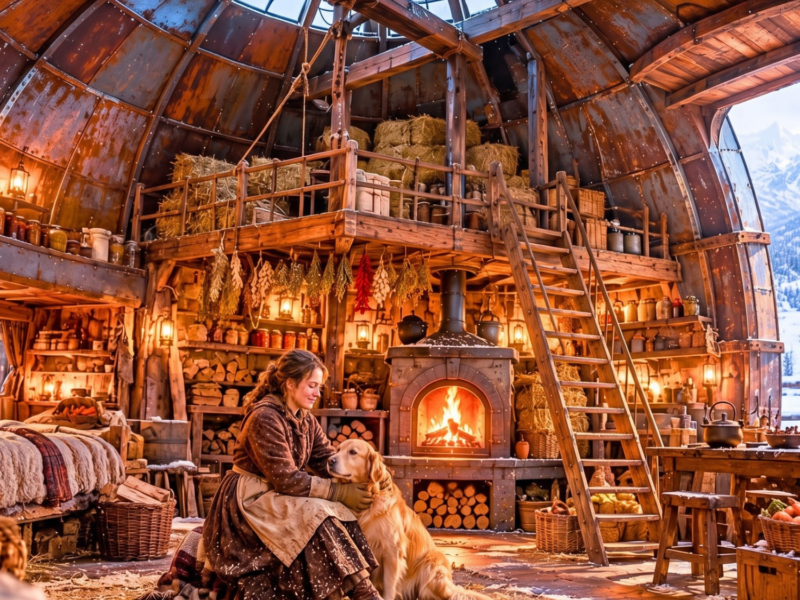
A Widow Built Her Home From Scrap Copper — Then 22 People Needed It to Survive the Blizzard
The Calculus of Survival
The ledge held fifty-two people for eleven days after the storm broke.
This was not a fact Vera tracked abstractly. She tracked the way she tracked everything structural: in terms of load distribution, stress points, tolerance, margins. The stone didn’t care about the number of people pressing against it. The stone had been holding the weight of the cliff above it for thirty million years without complaint.
What the stone could not manage on her behalf was the human arithmetic: the food calculation Edmund revised each morning, the frostbite cases Doc Finch assessed twice daily, the children who cried in the night in a space that had been built for silence, the men who stood at the south window staring down at where their property used to be with a particular stillness of people whose futures had just been substantially revised.
Vera managed all of it by staying in motion. She was the first awake each morning, the last still working each night.
She reorganized the storage passage three times in the first week to optimize the distribution of body warmth among the sickest patients. She carved an additional water channel from the existing spring basin to increase flow—a modification she’d considered doing for two years, but never needed urgently enough to prioritize.
She calculated rope rotations for bringing supplies up from the buried valley floor on days when the rescue team found caches in accessible locations: preserved food, additional blankets, a case of lamp oil from the hardware store excavated on day three of the post-storm operations.
Edmund ran the ledge’s interior logistics with the methodical precision of a man who had finally found the application his historical knowledge had been preparing him for without his awareness. He knew from twenty years of studying how communities survived extreme conditions that the distribution of resources mattered as much as the quantity of resources—that people who believed the system was fair bore deprivation more sustainably than people who suspected favoritism, even when the total deprivation was identical.
He established a ration system transparent enough that anyone could verify it, posting his daily calculations on a piece of board near the entrance where the morning light hit it directly. Nobody questioned the numbers. The numbers were Edmund’s, which meant they were right, which by this point everyone on the ledge understood without needing to be told.
Doc Arlene Finch worked the storage passage as her treatment space with the focused intensity of a woman who had been waiting her entire professional life for a situation serious enough to require everything she knew. She had her bag. She had the warmth of the stone. She had the snow itself as a source of both cold compresses and melted clean water.
Fourteen frostbite cases ranging from superficial to severe. Three cases of respiratory illness brought on by smoke inhalation during the storm’s worst days. One broken wrist from a fall during the surface excavations.
She treated every one of them, improvising where her supplies ran short, documenting everything in the margin of Edmund’s construction notes because she’d run out of her own paper by day four.
The children adapted fastest. Within two days, the five children on the ledge had claimed the warmest section of the main room floor as their territory, organized themselves into a functioning social unit with its own hierarchy, its own games, its own system for determining who got to sleep nearest to the hearth on any given night.
Vera watched this with something she didn’t immediately identify as comfort, then recognized it: children building sustainable systems from scratch. The instinct was older than any education.









