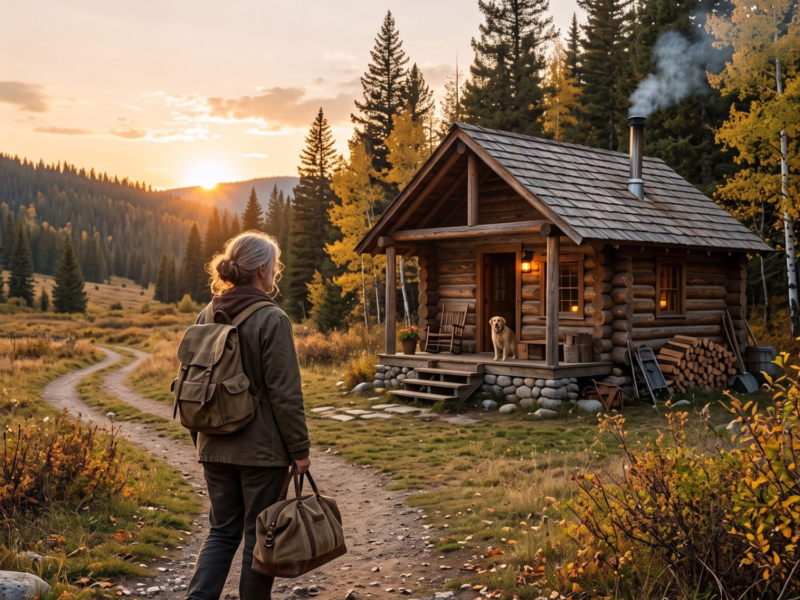
“All You Deserve Is a $50 Log Cabin” Her Family Said… Then They Froze Seeing What She Found Below
“All You Deserve Is a $50 Log Cabin” Her Family Sa…
“All You Deserve Is a $50 Log Cabin” Her Family Said… Then They Froze Seeing What She Found Below
The listing said $50. Not fifty thousand. Just fifty.
It was a log cabin sitting on three-quarters of an acre deep in the hills of southern West Virginia, posted on a county tax-sale auction site with a single, unpromising photograph. The image showed a collapsed wooden porch and a roofline sagging at the center like a tired spine. It was the kind of property that sits in an auction queue for months because nobody wants to drive forty minutes on a winding gravel road to inspect a building that appears to be actively dissolving back into the hillside.
A woman in her early forties bought it.
She was not a builder, not a contractor, and certainly not a real estate speculator looking to flip properties for a profit. She worked remotely, doing freelance bookkeeping from a laptop, and she had spent the last two years living in a cramped, rented room in a shared house. One-bedroom apartments in her previous city had crossed $1,200 a month, and her modest income simply could not stretch that far anymore.
She had found the listing while searching online late at night for cheap rural land in the Mid-Atlantic region. The fifty-dollar price tag represented the accumulated back taxes owed on the parcel. The county wanted the property back on the tax rolls, generating even a trickle of revenue, far more than it wanted to keep holding an empty lot with a condemned structure on it.
Predictably, her family told her it was a waste of time.
Her sister called it exactly what the price suggested it was worth: “All you deserve is a fifty-dollar cabin.” She said it twice—once on the phone and once across the dinner table—as if the repetition somehow made the small-minded cruelty more true. Her brother-in-law chimed in, warning that the property was probably sitting on a contaminated site, perhaps an old coal-mining operation with acidic drainage issues, and that the county was merely offloading a liability. Her mother simply asked if there was even a paved road leading to it.
The answer to the last question was technically yes, though it was a seasonal access road maintained by the county only from April through October. It was a single lane of packed gravel with deep drainage ditches cut into both sides. In the dead of winter, a truck with heavy four-wheel-drive could navigate it; anything less would likely stop at the bottom of the ridge and stay there until the spring thaw.
She drove out on a crisp Saturday in October. The road was exactly as described. The final two miles were steep enough that she could feel the straining grade in her steering wheel, and the loose gravel skittered where autumn rains had washed the fines away.
The property was set back from the road by about two hundred feet, up an overgrown footpath that had once served as a wagon track. She could see the peaked roofline through the thinning autumn trees before she could make out the walls.
The cabin was smaller than the photograph had suggested—maybe six hundred square feet in total. It was a single-story rectangle built from massive, hand-hewn logs. She could trace the individual axe marks on the corners where the heavy timbers had been skillfully notched and stacked in a tight dovetail pattern. The wood was dark, almost black in places from decades of weathering, but the grain was straight and tight, and the surfaces felt hard as iron under her knuckles.
She did not know it then, but those dark logs were American chestnut, a botanical reality that placed the construction of the cabin somewhere in the early twentieth century, before the devastating chestnut blight eliminated nearly all of the American chestnut trees from the eastern forests. By the 1950s, chestnut had become a legendary, irreplaceable building material in Appalachian construction. The wood is dense, straight-grained, and naturally resistant to rot and insect damage in a way that modern, commercially available softwoods simply cannot match.
The porch across the front of the cabin was gone. Not partially standing—gone. The structural support posts had rotted at the ground line over the years, and the entire wooden deck had collapsed and been pulled to one side, dragged away perhaps by a previous owner or simply torn down by gravity and time.
Inside, the floorboards just past the front threshold had rotted through in a section about six feet wide where rain had been pouring in for years through a gap in the roof created by the sagging ridge beam. She could see the damp earth staring back up at her through the hole in the floor.
Yet, past that rotted section toward the back of the cabin, the floor was entirely solid. She stepped on it carefully, testing her weight. It held firm. The boards were thick, handsawn, and tight-jointed.
She pushed on the structural corners where the dovetail joints interlocked. Nothing moved. She walked to the back of the cabin, pressed both hands flat against the rear log wall, and pushed with all her strength. No give.
The building had settled unevenly over the decades, and the deep sag in the roofline was merely the main ridge beam deflecting under its own weight over time—it was not a structural failure in the log walls themselves. The walls were holding. The corners were holding.
The problem was the roof. And the roof, she realized with a rising spark of hope, was entirely fixable.
Related Articles

They Mocked the Widow’s Dirt Cellar—Then the Freeze Left Every Cabin Cold but Hers Warm
They Mocked the Widow’s Dirt Cellar—Then the Freeze Left Every Cabin Cold but Hers Warm…

A Homeless Veteran and His German Shepherd Inherited a Ridge No One Wanted — 35 Feet In, They Found
Chapter 1 / 7 A Homeless Veteran and His German Shepherd Inherit… A Homeless Veteran…

Neighbors Laughed When He Built A Cabin Inside An Old Barn—Until It Kept His Home 35 Degrees Warmer
Chapter 1 / 8 Neighbors Laughed When He Built A Cabin Inside An… Neighbors Laughed…

His Sod House Had No Woodpile in January – Until the Trains Stopped and the Town Came Begging
Chapter 1 / 10 His Sod House Had No Woodpile in January – Until t……

She Built Her Cabin Over the Woodshed and Never Burned Wet Wood Again
Chapter 1 / 8 She Built Her Cabin Over the Woodshed and Never Bu… She…

The Duke Abandoned Her on Their Wedding Day—Years Later, He Discovered What He Had Lost
Chapter 1 / 7 The Duke Abandoned Her on Their Wedding Day—Years… The Duke Abandoned…

He Wedged a Tiny A Frame Into a Crevice Before Winter and His Family Slept at 75°F While Town Hit
Chapter 1 / 7 He Wedged a Tiny A Frame Into a Crevice Before Win……

He Was Too Old to Ride—So He Bought the Ruined Ranch and Found the Room Behind the Fireplac
Chapter 1 / 5 He Was Too Old to Ride—So He Bought the Ruined Ran……

Settlers Laughed at His Underground Heat Recovery Duct — Until It Kept His Cabin 71°F Warmer
Chapter 1 / 9 Settlers Laughed at His Underground Heat Recovery… Settlers Laughed at His…

A Navy SEAL Built a Home Inside a Mountain—Then His Dog Warned Him Before the Storm
Chapter 1 / 5 A Navy SEAL Built a Home Inside a Mountain—Then Hi… A…