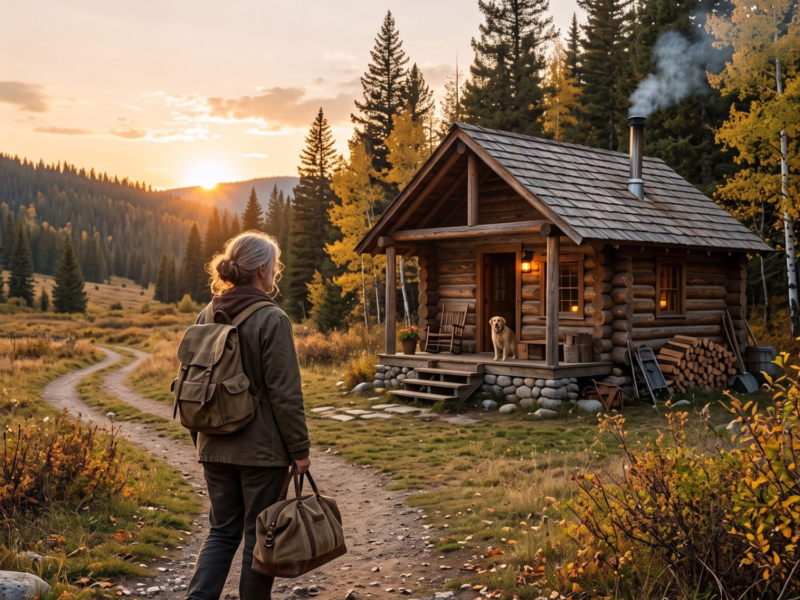
“All You Deserve Is a $50 Log Cabin” Her Family Said… Then They Froze Seeing What She Found Below
The Reconstruction
Over the following months, she executed the restoration in deliberate stages on weekends, utilizing basic hand tools and a modest, carefully guarded budget.
First came the roof. She replaced the rotting ridge beam and snapped rafters with new dimensional lumber purchased directly from a local family-owned sawmill—a small, sustainable operation that cut and air-dried hardwood harvested selectively from the surrounding Appalachian forest. The new ridge beam and eight white-oak rafters cost her six hundred dollars.
She patched the rotted section of the front floorboards using salvaged oak planks scavenged from an old tobacco barn demolition site ten miles down the valley. The barn owner was actually paying someone to haul away the structural debris, so the thick oak planks cost her absolutely nothing.
She sealed the roof completely with twenty-six-gauge corrugated metal roofing panels purchased from a regional building supply store for approximately eight hundred dollars. This permanently closed the gap where rainwater had been entering the structure for years, halting the floor damage in its tracks.
The cabin possessed no indoor plumbing and no electrical service. Rural properties tucked deep into the hollows of southern West Virginia often sit far beyond the reach of utility lines, and the prohibitive cost to extend electrical service from the nearest utility pole can run ten thousand dollars or more per mile.
The property, however, possessed something vastly better suited to its circumstances.
Behind the root cellar, probing deeper into the fold of the hillside, she found a seep spring.
Water was emerging naturally from a fracture in the sandstone bedrock at a slow but steady rate, collecting in a natural stone basin that someone decades earlier had neatly lined with flat flagstones to create a small catchment pool. Seep springs in the Appalachian Mountains are common, fed by rainfall that slowly percolates through the porous sandstone above and emerges wherever a less permeable clay layer forces the water to the surface.
The natural flow rate on this particular spring was modest—estimated at one to two gallons per hour—but over a continuous twenty-four-hour period, that produced roughly twenty-five to forty-eight gallons per day. It was more than enough water for drinking, cooking, washing, and basic hygiene when collected in a proper storage tank and used conservatively.
She installed a gravity-fed water system: a food-grade polyethylene storage tank holding two hundred and seventy-five gallons, positioned carefully at the spring site, which sat about fifteen feet higher on the hillside than the cabin floor.
A line of black polyethylene pipe ran from the storage tank downhill to the cabin, entering covertly through the back wall to supply a single brass faucet mounted securely over a utility sink she installed against the interior log wall.
No pump required. No electricity.
Gravity effortlessly moved the water from the elevated tank to the indoor faucet with enough hydraulic pressure for a steady, functional stream. The total cost of the storage tank, polyethylene pipe, compression fittings, faucet, and utility sink was under three hundred and fifty dollars.
For electricity, she started small and scalable: a single one-hundred-watt solar panel, a twenty-amp pulse-width modulation charge controller, a deep-cycle marine battery, and a four-hundred-watt modified sine-wave inverter. It was just enough power to run bright LED task lights in the evening, charge her laptop for her remote bookkeeping work, keep her phone alive, and run a small DC cooling fan in the summer.
The total cost of the initial off-grid electrical system was approximately two hundred and sixty dollars. It was not an abundance of power, but it was a precise, harmonious match to her actual daily needs.
Her family came back to visit in the spring.
They drove up the steep gravel road in a convoy of two cars, creeping slowly in low gear. They walked up the old wagon track to the cabin and stopped dead in their tracks.
The front porch was completely rebuilt. Four new pressure-treated support posts were set solidly on poured concrete pier blocks. A wide, sturdy deck of thick lumber welcomed visitors. A clean wooden railing was made from locally harvested locust branches gathered right from the property.
The roofline was straight, tight, and covered in gleaming new corrugated metal panels that caught the bright spring sunlight and threw it back toward the trees.
The front door was a handsome, salvaged six-panel wooden door that she had found at a Habitat for Humanity resale store for fifteen dollars, which she had sanded, sealed, and fitted with a gleaming new deadbolt lock set.
Inside, the chestnut log walls were breathtaking. She had brushed them down with a stiff-bristle wire brush to remove decades of soot and grime, and then applied a single, rich coat of boiled linseed oil. The oil brought out the deep, swirling grain of the chestnut for the first time in generations—a dark, reddish-brown hue with tight, straight lines and the distinctive, chatoyant shimmer that only ancient chestnut produces when light moves across its surface at an angle.
A heavy wood stove, purchased used from a farm estate sale for one hundred and fifty dollars, sat proudly in the corner resting on a raised stone hearth she had built herself from flat sandstones gathered right on the property.
Down below, the root cellar was fully stocked with gleaming rows of canned tomatoes, pickled green beans, and spiced apple butter she had put up the previous fall using surplus produce from a newly cleared garden plot she had established in the open clearing behind the cabin.
Her sister walked slowly through the front door, stood in the absolute middle of the room, looked at the chestnut walls, and did not speak for a long time. She reached out and touched one of the massive logs where the individual axe marks from the original pioneer builder were still visible in the hand-planed surface.
Her brother-in-law walked down into the root cellar with a flashlight and stayed down there for several minutes, examining the dry-stacked stone walls and the heavy stone shelving before coming back up and shaking his head slowly.
He said three words: “This is solid.”
Her mother sat quietly in a wooden rocking chair on the freshly built front porch, holding a steaming mug of coffee. She looked out at the thick treeline along the ridge and the valley falling away far below, and said very quietly to herself, “This is yours.”









