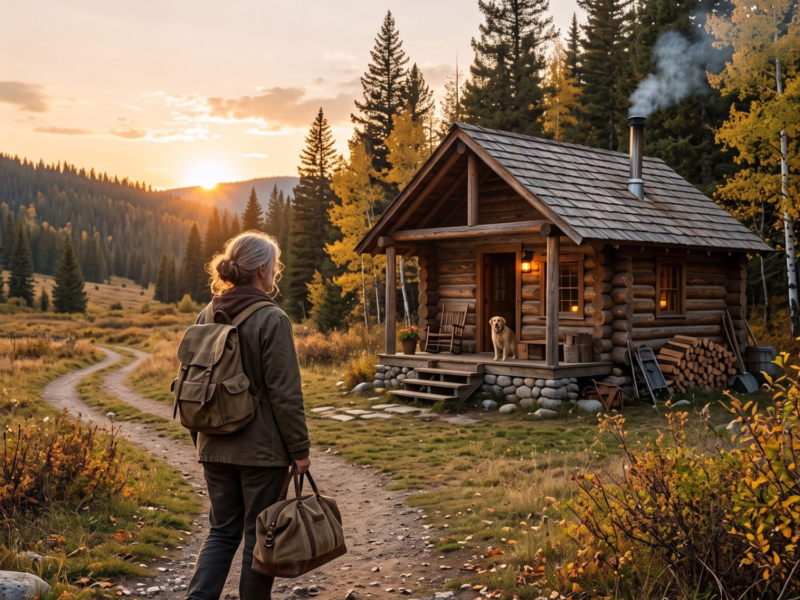
“All You Deserve Is a $50 Log Cabin” Her Family Said… Then They Froze Seeing What She Found Below
The Economics of Autonomy
By her second spring on the property, the local reputation of the woman in the fifty-dollar cabin had shifted from eccentric recluse to curious anomaly, and finally, to quiet neighbor.
Word of her winter bounty had spread through the valley. Marcus at The Ironwood restaurant was now her regular client, purchasing her microgreens, winter lettuce, and heirloom tomatoes twice a week. Two other local restaurants had also approached her, eager for produce that tasted like it had been grown in actual soil rather than forced in a chemical warehouse on the West Coast.
Clare found herself turning down orders not because she couldn’t grow the food, but because she refused to scale up beyond the capacity of her walipini.
“Why don’t you build a second greenhouse?” Marcus asked her one Tuesday morning when he drove out to pick up a crate of spinach himself, wanting to see the operation firsthand. “I’ll sign an exclusive contract. I can buy everything you produce.”
Clare handed him the wooden crate, wiping her dirt-smudged hands on her apron. She looked out over the clearing behind the cabin, where the woods met the edge of her three-quarters of an acre.
“Because if I build a second greenhouse, I have to hire help,” Clare explained, smiling faintly. “Then I have to manage people, file payroll taxes, and worry about scaling revenue to cover overhead. I didn’t move out here to recreate corporate stress in the mud, Marcus. I moved out here to escape it.”
Marcus laughed, hoisting the crate into the back of his truck. “Fair enough. Most people spend their whole lives trying to build a bigger cage.”
“And I spent mine trying to unlock the door,” Clare replied.
That afternoon, she sat on her newly built porch, looking down the valley. Her laptop was resting on the small table beside her, displaying a completed set of books for one of her remote bookkeeping clients. She submitted the file with a click, closed the screen, and listened to the spring peepers waking up in the creek bed below.
She had achieved something the modern economy told her was impossible: she had decoupled her survival from the frantic, endless treadmill of inflation, rent hikes, and corporate whims.
Her monthly expenses were nearly nonexistent. Her food was largely self-produced or bartered. Her energy was free, pulled from the sky and stored in a battery. Her water was a gift from the mountain.
Her sister called her occasionally now, usually with a tone of bewildered caution, asking how things were going “out in the sticks.” The condescension was gone, replaced by a strange, uneasy curiosity. During their last phone call, her sister had casually asked if Clare knew anyone selling cheap land nearby.
“There’s nothing out here for fifty dollars anymore,” Clare had told her, a quiet satisfaction in her voice. “People are starting to realize what they’re looking at.”









