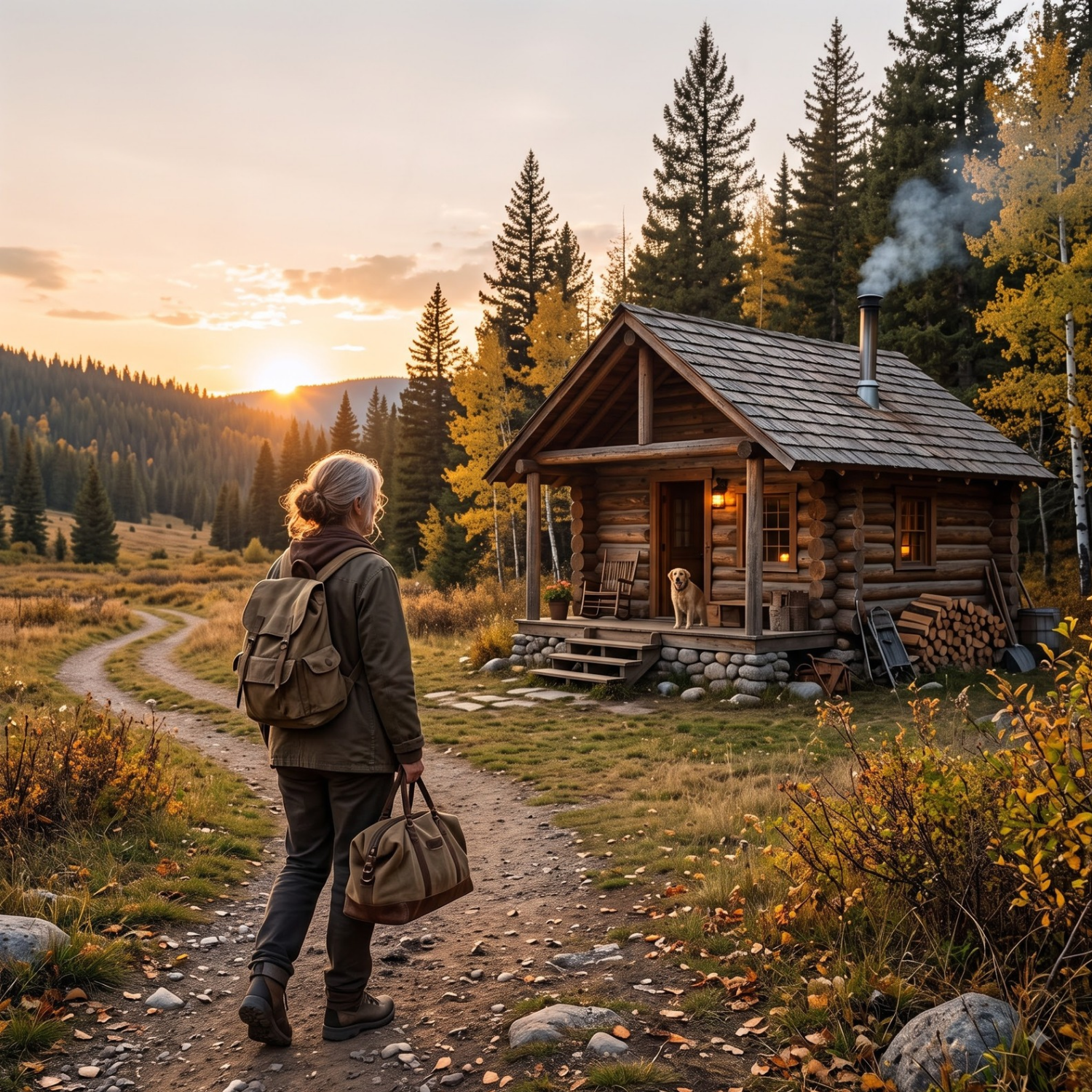
“All You Deserve Is a $50 Log Cabin” Her Family Said… Then They Froze Seeing What She Found Below
The Root Cellar
She came back the following weekend armed with a sharp machete and a pair of loppers. The property had not seen human maintenance in years, and the aggressive brush around the cabin was thick and tangled. Kudzu, wild grapevines, aggressive Virginia creeper, and young tulip-poplar saplings had grown right up against the log walls, trapping moisture against the chestnut wood.
She started clearing from the front, working methodically along the sides, cutting away the dense green growth that was pressing against the cabin.
The real discovery, however, started on her third weekend visit.
She was clearing a dense curtain of kudzu from the rear of the cabin—pulling away vines from what she had casually assumed was just a natural bank of dirt against the steep hillside—when her boot struck something hard. She scraped away the matted leaf mold and dirt to reveal a stone foundation wall extending outward from the rear of the building.
It was not part of the cabin itself. It was a separate structure, partially buried in the hillside, built directly into the slope so that its top was flush with the surface of the ground above.
The entrance was a low, heavy doorway framed in cut sandstone—maybe four feet high and three feet wide—with a massive timber lintel across the top that remained resolutely solid despite its age.
She ducked low through the low doorway, pulled her phone from her pocket, and clicked on the flashlight app.
The space inside was vastly larger than she had anticipated. It was a room roughly twelve feet wide and sixteen feet deep, with a vaulted ceiling height of just over six feet at the center. It was built entirely from dry-stacked sandstone blocks, fitted together without a single drop of mortar. The stones were so expertly shaped and fitted that the walls remained perfectly plumb and stable after what appeared to be a century of standing beneath tons of wet earth.
The floor was laid with flagstone—large, flat pieces of gray sandstone placed edge-to-edge with impossibly narrow gaps between them.
The temperature inside dropped instantly and noticeably. Even on an October afternoon, she later measured it at a steady fifty-three degrees Fahrenheit, which is consistent with the natural subterranean ground temperature at that depth in the Mid-Atlantic region. Root cellars built deep into hillsides in this climate maintain a steady, frost-free temperature between fifty and fifty-five degrees year-round, naturally insulated by the earth on three sides and the thick soil mantle above.
And the cellar was not empty.
Along the back wall, resting on stone shelves that had been built as integral parts of the original dry-stack wall construction—laid right into the masonry as the wall went up—sat rows of glass canning jars.
She counted them later. One hundred and twenty-three jars in total. Mason jars, Atlas jars, some with zinc screw-on lids, others with older glass lids and wire-bail closures. The bail-closure jars were significantly older, predating the modern screw-band and flat-lid system that became standard in the mid-twentieth century.
The contents of the jars had long since oxidized and darkened beyond visual identification, and she wisely did not open them. But the jars themselves—particularly the older bail-closure models and the heavy zinc-lid ones—were highly collectible. Vintage canning jars in good condition sell individually for three to twenty dollars at antique markets and online resale sites. Unusual colors like cobalt blue or amber, or rare manufacturer stampings, can easily bring fifty to one hundred dollars or more per jar.
The collection on those stone shelves, taken as a group, represented somewhere between five hundred and two thousand dollars in resale value. More than she had paid for the entire property ten times over.
Yet, the jars were merely incidental. The truly important discovery was the root cellar itself.
A root cellar of that specific size, properly constructed from dry-stacked stone with fitted corners, a solid flagstone floor, and a hillside providing three walls of natural insulation plus an earth-covered roof, is a structure that costs anywhere from five to fifteen thousand dollars to build from scratch in the modern market. The excavation alone—cutting deep into a hillside and removing tons of stubborn clay and rock to create a twelve-by-sixteen-foot cavity—requires either a small excavator or weeks of grueling manual labor. The stone sourcing and dry-stack masonry requires either a master stonemason or an owner-builder with infinite patience.
This cellar was already built, already proven, and had been operating without structural failure for roughly a century.
Furthermore, the water management system was an absolute work of genius. A shallow drainage trench had been cut into the bedrock floor along the base of all four walls, directing any natural seepage toward a low point near the doorway where it drained safely out of the cellar by pure gravity. The system worked without a pump, without electricity, and without any active maintenance.
She began to truly understand what she actually owned.
It wasn’t just a dilapidated cabin. It was an entire, integrated system.
The cabin above was built of chestnut—a wood species that is functionally unavailable on the commercial lumber market. The American chestnut was virtually eliminated from North American forests by the chestnut blight, a fungal pathogen that killed an estimated three to four billion trees between 1904 and the 1950s.
The only chestnut lumber available today is reclaimed from historical structures: old barn beams, cabin logs, fence posts, and salvaged flooring. That reclaimed material routinely sells for eight to twelve dollars per board foot, and occasionally higher for wide planks with clear grain and original surface character.
A six-hundred-square-foot cabin built from hand-hewn chestnut logs contains a massive volume of this irreplaceable material. She had no intention of dismantling the cabin, but the logs themselves represented an intrinsic material value that far exceeded what any new construction cabin of the same size would cost to build from modern dimensional lumber.
The structure was not less valuable because it was old. It was infinitely more valuable because it was old, because it was crafted from a biological material that no longer exists in harvestable form and can never be replaced.
The root cellar below became the anchor of a deeply practical, long-term plan. She would use the cellar for exactly what it was originally designed to do: subterranean food storage. The consistent fifty-to-fifty-five-degree temperature was the ideal environment for storing root vegetables, winter squash, apples, potatoes, onions, garlic, home-canned goods, and fermented provisions through the harsh winter months.
In a rural location where electrical service was notoriously uncertain, and the nearest grocery store was a thirty-minute drive each way over winding gravel, that cellar was not a quaint historical relic.
It was infrastructure. Functional, temperature-stable, humidity-moderated infrastructure that required zero energy input and had been operating without failure for roughly a hundred years.