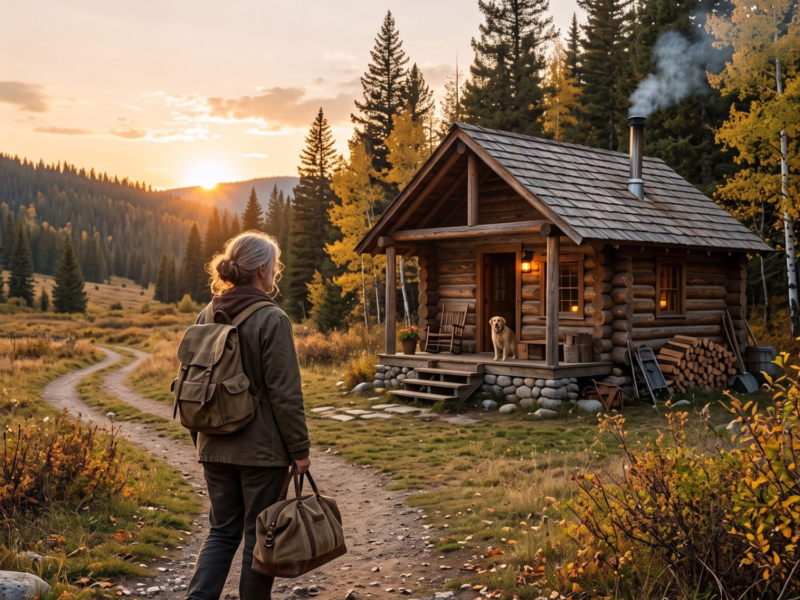
“All You Deserve Is a $50 Log Cabin” Her Family Said… Then They Froze Seeing What She Found Below
The Winter’s Test
The transition from late autumn to deep winter in the southern hills of West Virginia was not a gentle fading. It arrived overnight in mid-November, stripping the remaining stubborn leaves from the oaks and maples and turning the muddy wagon track into a frozen spine of iron and ice.
For the first time in her life, Clare watched the weather change not from behind double-paned city glass or through the blue light of a weather app, but with her skin exposed to the raw air. She stood on her newly built front porch, wrapped in a heavy wool coat, watching the gray breath of the woods roll down the ridges.
Up until now, the cabin had been a project—a series of checkboxes on a spreadsheet of repairs: Roof: Complete. Water system: Complete. Floor: Complete. But winter brought the ultimate audit.
Inside, the transformation was nothing short of miraculous. The wood stove, fed by seasoned hickory and oak she had bought from a neighbor down the ridge, threw a steady, radiant heat that soaked into the chestnut logs. The massive timbers, sluggish to warm at first, absorbed the thermal energy and held onto it long after the fire had died down to a bed of glowing embers. The cabin did not leak heat the way her old urban apartments had, where drafty window srames and thin walls demanded a constant, expensive roar from the central heating.
And then there was the root cellar.
As the ground froze solid above, the temperature down in the stone room remained locked at a dependable fifty-two degrees. Clare went down the sandstone steps each morning with a basket to gather what she needed for the day. The potatoes were firm and free of frost, the winter squash sat heavy and sweet on the stone shelves, and the rows of home-canned tomatoes and green beans gleamed like rubies in the amber glow of her lantern.
She no longer had to brave the thirty-minute drive to the grocery store for fresh provisions, nor did she have to watch her food budget vanish into inflated supermarket prices. The earth was feeding her. The spring was watering her. The sun was powering her lights.
It was an uncanny, grounding feeling—this realization that she was entirely self-contained.
One evening in mid-December, a heavy ice storm moved through the valley. It coated the trees, the gravel road, and the power lines that ran along the main highway in a thick, glittering shell of glass. Branches snapped under the weight, taking down transformers for miles around.
Clare sat at her desk, working on her laptop by the warm glow of her LED task lights, powered silently by the marine battery and the solar array outside. Around 8:00 PM, she noticed the house across the ridge—the only other inhabited homestead within a mile—go completely dark. Then another light flickered out further down the hollow.
The power grid across the county had collapsed under the weight of the ice.
In the city, a power outage meant sirens, alarms, spoiled food in the refrigerator, and a panicked scramble to find flashlights and bottled water. Here, in the hills, Clare simply got up, poured herself a cup of chamomile tea heated on the wood stove, and walked to the front window.
Outside, the forest was a silent, ethereal landscape bathed in the pale, blue-white light of a winter moon reflecting off the ice-encrusted trees. The cabin was warm, smelling of woodsmoke and old chestnut. The water still ran effortlessly from the kitchen faucet, fed by gravity from the insulated tank up at the seep spring. The root cellar below was holding a battalion of food against the dark.
She wasn’t stranded. She wasn’t vulnerable. She was anchored.









