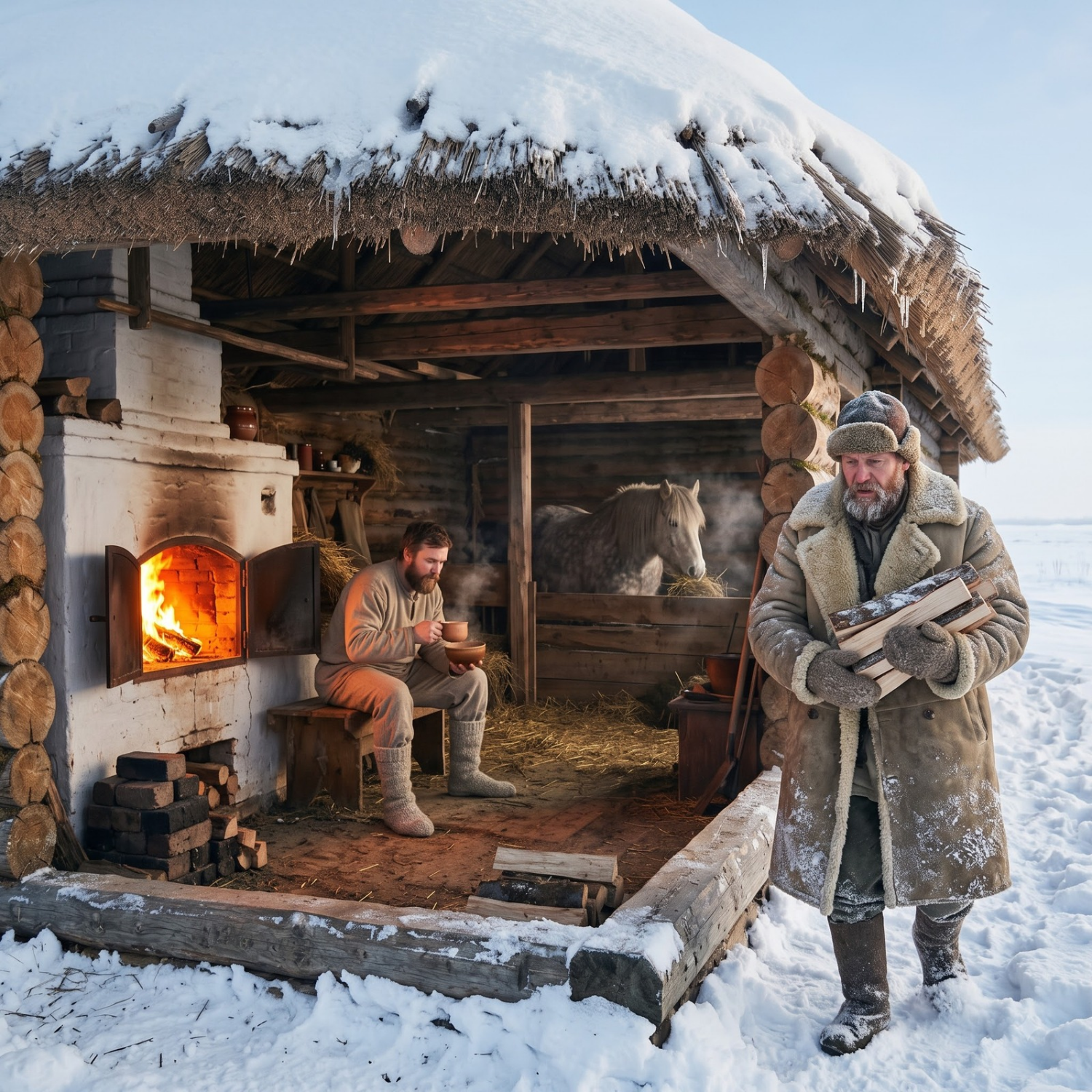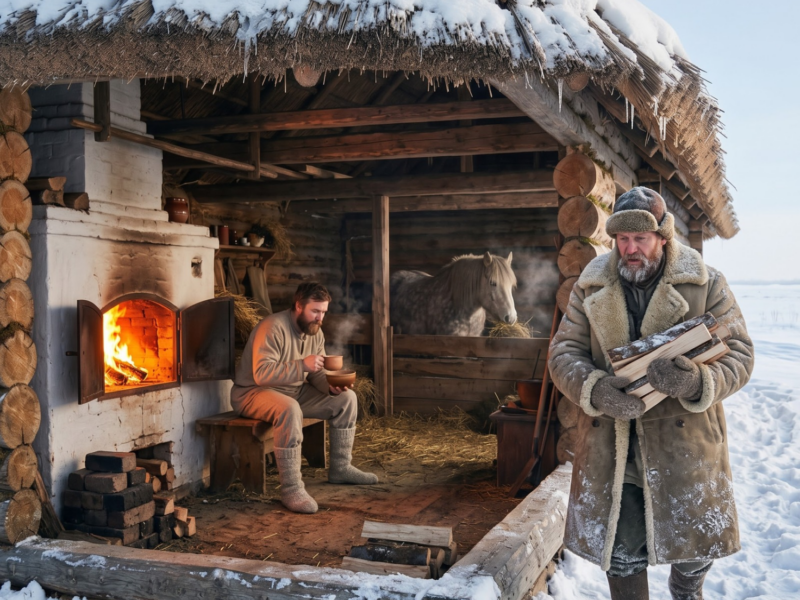
Cow Behind the Wall, Manure in the Stove: At Fifty-Four Below, the Neighbors Came to Get Warm
THE EXODUS OF THE PROTESTANT PEASANTS
The man who owned the longhouse was named Jakob Penner.
He was a Mennonite, part of a distinct Protestant sect that traced its spiritual lineage back to Menno Simons, a Dutch reformer of the sixteenth century. The absolute core of their faith rested upon a single, unyielding commandment: Never take up a weapon against another human being, regardless of cause.
Because of that pacifist conviction, they had been pushed relentlessly from country to country across centuries of European history. Originating in the Netherlands, they migrated to the Vistula River delta in Prussia, where they mastered the art of reclaiming marshes, draining swamps, constructing dikes, and building longhouses where home and stable stood united under one protective roof.
They lived in Prussia for nearly two hundred years. But eventually, the political walls began to close in. Because they refused universal military service, the Prussian state imposed special punitive taxes and eventually forbade them from purchasing new agricultural land.
In 1789, Empress Catherine the Great of Russia invited them eastward. The Russian Empire desperately needed capable farmers to settle and plow its newly acquired southern steppes. The Mennonites were promised fertile land, absolute freedom of religion, self-administered schools, and permanent exemption from military service.
Fifteen years later, they established thriving colonies along the Molochna River, in what is today the Zaporizhzhia region of Ukraine—a vast, windswept steppe possessing almost no natural forests.
They built their villages to a rigid, beautiful plan: one straight, wide street with longhouses lining both sides, gable ends facing the road, and behind every home a narrow strip of garden and orchard. On the bare steppe, the Mennonites became among the very first people to successfully cultivate artificial forests where trees had never grown before.
Yet the steppe taught them the most unforgiving economic lesson of all: Where there is no firewood, you must burn what the farm provides.
Straw, dry weeds, and livestock manure compressed into bricks. In local Ukrainian villages, that humble fuel was called kizyak. And the steppe taught them to build a masonry stove that could store and radiate heat for a full twenty-four hours on that unconventional fuel. Built of solid brick in the center of the house, it warmed every surrounding room evenly.
Winters along the Molochna were harsh, with frost plunging to twenty below zero; but in a house anchored by such a stove, the cold held no terror, and the fuel supply lasted reliably until spring.
Jakob Penner’s great-grandfather had migrated to the Chortitza colony from Prussia. Jakob himself was born in the colony, and until his fortieth year, he plowed the Ukrainian steppe just like his ancestors. His father-in-law, old Gerhard Wiebe, was a master stove builder. Over his lifetime, Gerhard had constructed dozens of masonry heaters across the colonies, knowing every nuance of draft, flue, and thermal mass.
Then, in 1874, the geopolitical ground shifted beneath their feet. The Russian government introduced universal military conscription, unilaterally revoking the most precious privilege the Mennonites possessed: perpetual freedom from the army.
For the Mennonites, forced military service was worse than poverty. Thousands of families immediately prepared for the road.
Fortunately, scouting delegates had already traveled to North America. Canada offered precisely what Russia was systematically dismantling: complete military exemption, self-governed schools, and vast tracts of fertile land. In the summer of 1873, Mennonite delegates toured Manitoba, Dakota, Minnesota, Nebraska, and Kansas. In Canada, they fell in love with the rich black loam of the Red River Valley, and the Ottawa government put every single promise into an official, written statute.
That settled the matter. Nearly seven thousand Mennonites uprooted and moved to Manitoba between 1874 and 1880, while thousands of others relocated to Kansas and Nebraska.
The Penner family set out in the summer of 1875: Jakob, his wife Agatha, their three young children, and old Gerhard, who refused to be left behind alone in the fading colony. They were forced to sell their established farm for a fraction of its true value, knowing local buyers held all the leverage. They packed only what was most vital: heavy oak chests, iron tools, seed grain, and the family Bible.
Agatha walked one final time through the house where her children had drawn their first breaths, laying her palm flat against the warm bricks of the central stove. She was utterly certain she would never possess a stove like that again in the untamed new world.
They traveled across Germany by rail, crossed the stormy Atlantic crammed into crowded immigrant steerage below deck, and journeyed west by train before boarding a wood-burning paddle-steamboat down the Red River. The entire way, old Gerhard clutched a small canvas bag containing his precious stove-building masonry tools directly against his chest.