Cow Behind the Wall, Manure in the Stove: At Fifty-Four Below, the Neighbors Came to Get Warm
THE THERMODYNAMICS OF THE LONGHOUSE
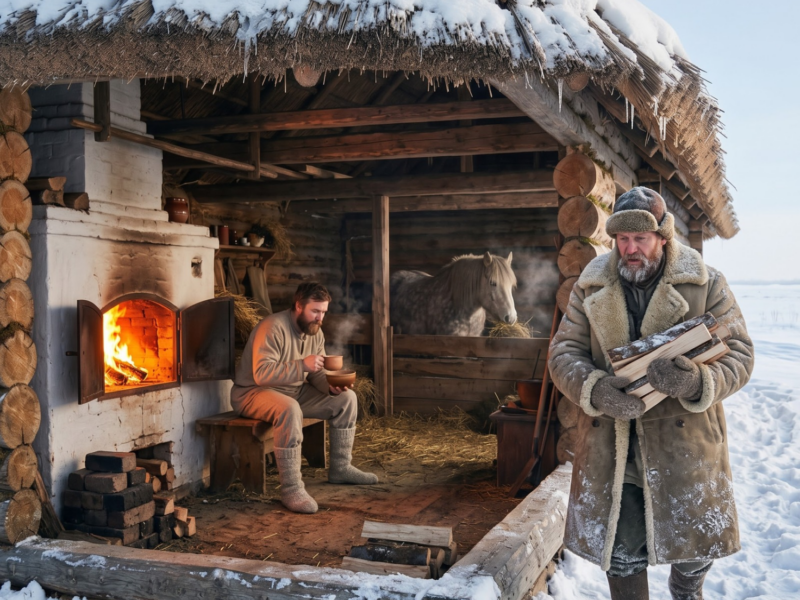
By then, the Penners were actively framing a proper permanent home: a longhouse uniting human quarters and livestock under a single roof, anchored by a massive masonry heater in the center. The Mennonites had built identical structures in Prussia and along the Dnieper. English-speaking settlers would eventually term them house-barns.
Why a single central masonry stove could effortlessly heat an entire sprawling house while McCrae’s thin iron stove struggled to keep a single room habitable becomes obvious once you examine the thermodynamics.
Both stoves burn fuel and release thermal energy. The critical difference lies in where that heat goes and how long it remains inside the building envelope.
An iron stove provides intense heat only while the fire is actively burning. The metal is thin; it radiates its heat instantly and cools down within minutes of the flames dying. Furthermore, an iron stove requires a powerful draft.
Half of the generated heat rushes straight up the metal chimney alongside the smoke, while freezing ambient air is sucked into the room through every structural crack to replace it.
Moreover, standard frame houses possessed zero thermal mass—just thin pine boards and tar paper. Forty degrees below zero outside meant frost coated the interior wall just two steps away from a red-hot stove. Consequently, the iron stove demanded constant feeding throughout the night. Let the wood burn down for thirty minutes, and the room turned glacial.
A masonry stove operates on entirely different physical principles. The fire burns short, intense, and hot, but the smoke is forced to travel through a labyrinth of long, winding channels inside the heavy brick core, transferring nearly all of its thermal energy into the masonry before ever reaching the chimney.
By the time the exhaust exits the flue, it is barely warm. The heat is absorbed by more than a ton of dense brick.
The masonry soaks up thermal energy and releases it sluggishly, steadily, over many hours. That is why the stove only required firing twice a day—once in the morning and once in the evening.
The radiant heat produced by brick is gentle and ambient, mimicking the sun, and doesn’t scorch the air or strip away humidity. Because the fire was needed only for brief intervals, fast-burning fuels worked perfectly: straw, slough hay, and compressed dried dung. In McCrae’s iron stove, those light materials would have flashed away into ash uselessly in sixty seconds; in a masonry core, they were converted into sustained, predictable warmth.
The second masterstroke was the integrated barn. Cows and horses produce substantial metabolic heat, and a barn built wall-to-wall with the house shields the living quarters from prevailing winter gales. A protected interior hallway linked the home to the stable, allowing chores to be performed without stepping out into sub-zero blizzards.
The third masterstroke was the fuel itself, which cost literally nothing. It was harvested directly from the livestock that warmed the house, utilizing leftover straw bedding. A single dairy cow produces several tons of manure annually.
Mixed with fresh straw, spread in a foot-deep layer, packed down by horses, cut into uniform blocks with a spade, and stacked to dry under a shed roof, the resulting fuel bricks were odorless once cured. They burned with a slow, steady, incredibly reliable heat.









