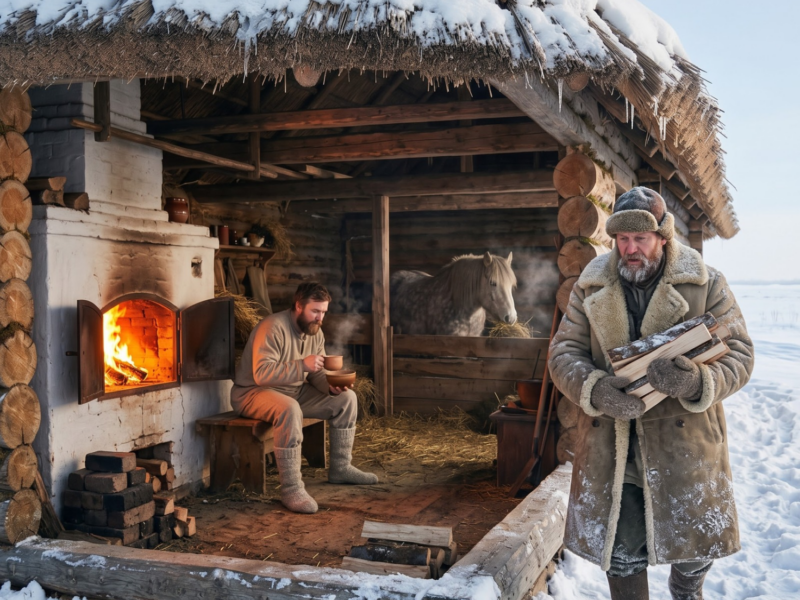
Cow Behind the Wall, Manure in the Stove: At Fifty-Four Below, the Neighbors Came to Get Warm
THE RAISING OF THE WALLS
The Penner longhouse took two full summers to construct. Heavy oak beams were hauled from the hills or purchased in Emerson, while the specialized masonry bricks for the central heater arrived slowly by ox-cart.
The entire village operated as a collective mutual-aid society. The Mennonites worked cooperatively to raise walls and rafters—raising the Penners’ house one week, a neighbor’s the next.
Old Gerhard directed the construction of the masonry heater, duplicating the exact designs of Chortitza. He didn’t lay a single brick without meticulous calculation, mapping the internal smoke channels.
“If a masonry core cracks in the dead of winter,” Gerhard warned the young men, “you cannot rebuild it until the spring thaw.”
The first fires were kindled with extreme caution, building tiny blazes day by day so the wet clay mortar could cure without fracturing under thermal shock.
Meanwhile, Jakob and his sixteen-year-old son Peter labored from dawn until dusk raising the timber frame. They insulated the roof with a thick, three-foot layer of packed straw—straw acting as an exceptional thermal barrier because of the millions of microscopic air pockets trapped within its stalks. They installed small, double-paned windows imported all the way from Winnipeg.
By the autumn of 1878, the Penners moved out of their subterranean Semlin and into the longhouse. For the first time in three years, Agatha applied fresh white whitewash to real, upright plaster walls.
On their first evening in the new home, Agatha fired the central stove, sat down on the wooden bench built flush against the warm brick wall, and fell into a profound, tearful silence.
“Just like back home,” she murmured.
They didn’t demolish the old Semlin; they repurposed it as a henhouse. Inside the new longhouse, old Gerhard claimed the warm wooden bench beside the stove, announcing that for the first time in three long years, his chronic backache had vanished.
Duncan McCrae rode over to inspect the finished longhouse, squinting at the architecture. “It’s nice enough,” he grunted. “But you’ve gone and moved in under the exact same roof as your livestock.”
Jakob answered him with a phrase that would later be recorded in Kansas newspapers: “The Americans burn money. We burn straw.”
Their first winter in the longhouse passed in absolute tranquility. On February 26th, 1879, the mercury dropped to forty-four below zero in Winnipeg, yet the Penner children ran across the pine floors in their bare feet.
The household rhythm remained steady: an armful of straw and a few dry fuel bricks fed into the firebox twice a day, morning and evening.
For the McCrae family across the prairie, however, that same winter proved agonizingly expensive. Their thin iron stove devoured their stacked firewood pile faster than Duncan could replenish it.
McCrae refused to complain, believing it was simply the immutable cost of living in the north. “Winter is winter,” he told himself, hauling high-priced wood from Emerson. That single winter cost him more in fuel than all the lumber used to frame his house.
Yet his frame house remained bitterly cold. The thin board walls froze straight through, and morning brought thick rime frost to every interior corner. The McCrae children slept fully clothed beneath towering heaps of quilts, and Margaret rose hourly throughout the night to throw more logs into the ravenous iron stove.
In the spring, McCrae stopped by the Penner farm to purchase seed grain. He stood by the central brick heater, laid his palm against the warm masonry, and stared in silence.
“It’s a fine stove,” McCrae admitted grimly. “But not for my house. I’m not going to spend my life digging around in dung.” And he mounted his horse and rode away.
That summer, he doubled his firewood-cutting quota, stacking a massive, defensive wall of split logs beside his frame home, confident it would conquer any winter.
Simultaneously, the Penners manufactured their seasonal fuel: Peter driving horses over the manure-and-straw matrix, Jakob cutting uniform blocks, and stacking them high. They purchased zero fuel. Everything required to keep their home habitable was grown directly upon their acreage.









