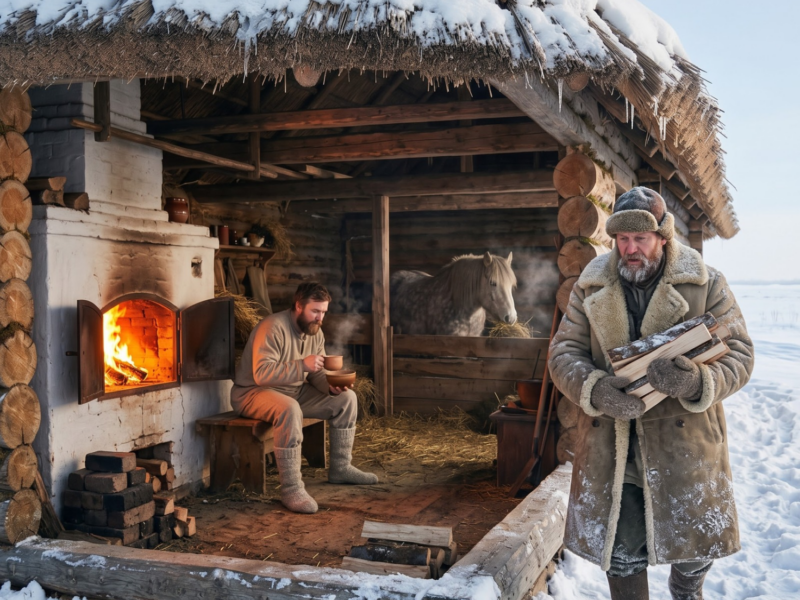
Cow Behind the Wall, Manure in the Stove: At Fifty-Four Below, the Neighbors Came to Get Warm
THE ONTARIO SCOT AND THE JOKE AT EMERSON
The second winter in the Semlins was even more savage. On January 15th, 1877, the temperature dropped to forty-eight below zero in Winnipeg. Again, the earth-house held firm.
Yet the Mennonites had no intention of living in earthen pits forever. In the spring of 1877, new homesteaders arrived at the edge of the reserve—Scotsmen from the forested province of Ontario, led by the McCrae family.
During those years, the Canadian government was practically giving the prairie away. Any settler could claim one hundred and sixty acres of land for a nominal ten-dollar filing fee, provided they lived on the land and cultivated it. Thousands of families abandoned the rocky timberlands of Ontario and pushed west. Many had never in their lives seen a landscape devoid of trees stretching to every horizon.
Duncan McCrae was a capable, hardworking farmer with modest capital. He brought savings from Ontario, a steel plow, a proper iron cookstove, and finished lumber for a frame house. His grandfather had emigrated from Scotland and carved a farm out of the dense Ontario forest; Duncan grew up surrounded by massive woodpiles and could not fathom a human habitation without a roaring wood-fire.
He erected his frame house rapidly within a month—a skeleton of studs covered with thin pine boards and lined with tar paper on the inside. It was the standard architectural template across the Canadian frontier.
The house turned out bright and tall, featuring genuine glass windows. Margaret McCrae was immensely proud of it. Standing next to the low, sunken Mennonite Semlins, their frame house looked like a stately palace.
Curious, McCrae rode over on horseback to inspect his eccentric neighbors. The Mennonites were just finishing their second summer in the earth-houses, and the very first timber longhouses were beginning to rise in the village.
The orderly Mennonite village startled him: one straight, wide street, houses standing gable-end to the road, and young poplar saplings planted along the avenues in military alignment.
“You live in a hole in the ground?” McCrae asked Jakob, shaking his head. “And sleep in the same room as a milch cow?”
Jakob nodded placidly. “In winter, it is much warmer that way.”
McCrae laughed out loud and rode away. Later that week at the general store in Emerson—the nearest trading post on the border—he regaled everyone with tales of the strange foreigners who slept alongside their livestock.
The storekeeper chimed in with a snicker: “And I hear in the deep winter they burn dried cow manure. Give it another month, and those people are going to smell exactly like their cattle.”
The joke circulated around Emerson all through the autumn. McCrae’s first winter turned out remarkably mild—as if by divine coincidence, just to validate his skepticism. The coldest reading that winter, in January 1878, was a mere twenty-four below zero.
His iron stove easily handled the load, and McCrae strutted around town like a victorious hero. “You see?” he proclaimed at the store. “No cows in the parlor, no dung bricks, just good British iron and hardwood. Everybody is warm.”
The men at the counter nodded along. There was no malice in it; to a man raised in the timber-rich forests of Ontario, heating a home with dried manure sounded as absurd as brewing soup out of river stones. Furthermore, the Mennonites kept largely to themselves, speaking Low German, dressing in plain, old-fashioned styles, and never visiting Emerson for social holidays.
Back in Ontario, firewood had been an endless, free resource. Here, McCrae was forced to purchase it in Emerson or haul it himself from the distant Pembina Hills, wasting two full days of labor on every grueling trip.
Agatha heard secondhand about the jokes circulating in town, and they stirred genuine anger within her.
“Let him laugh, Agatha,” old Gerhard counseled calmly. “Winter treats everyone impartially, and it settles its accounts with all of us by the exact same mathematical rules.”
One afternoon, young Peter Penner returned from an errand in Emerson with a flushed, angry face. The local boys had taunted him, calling him “the manure kid.”
His father merely smiled. “Let them talk, Peter,” Jakob said softly. “By and by, we will see which of us comes walking over to ask the other for firewood.”









