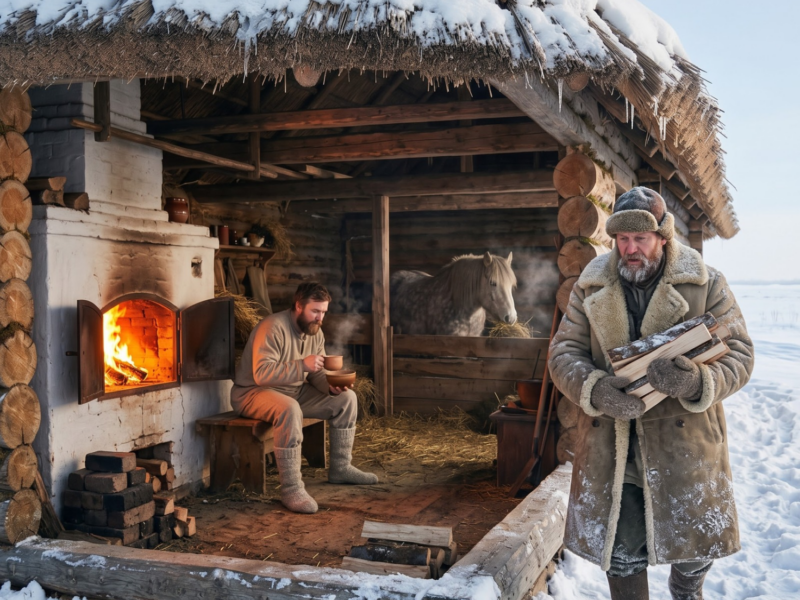
Cow Behind the Wall, Manure in the Stove: At Fifty-Four Below, the Neighbors Came to Get Warm
THE LESSON LEARNED
On the morning of December 25th, the thermometer read forty degrees below zero.
The McCrae children woke to find their holiday plates filled with spiced cookies, nuts, and rosy apples. The masonry stove had cooled only slightly overnight. Agatha fed it a single armful of straw and a handful of bricks; within thirty minutes, the combustion completed, and she closed the iron latch.
“Half an hour,” McCrae murmured, staring at the closed iron door. “And in my house, I burn half a cord of hardwood every single night.” He wasn’t addressing Jakob anymore; he was confessing to his own stubborn ignorance.
The historic cold persisted through New Year’s. On December 29th, Winnipeg registered forty-one below. The McCraes remained sheltered with the Penners for the entire week.
McCrae didn’t sit idle; he mucked out the stables, hauled straw, and closely monitored the fuel input. He was astounded to verify that it required merely an armful of straw and a few dung bricks per firing, twice daily, to maintain a tropical indoor climate.
Two days later, Jakob and McCrae drove over to inspect the abandoned frame house.
The interior was an absolute wasteland of ice: pantry dishes coated in thick frost, cellar potatoes frozen into rock-hard spheres, and the ink bottle on the shelf cracked cleanly in half by expanding ice. A finger-thick fringe of white rime coated every interior wall.
McCrae stood in the center of his silent kitchen for a long time. “I spent a whole year laughing at your manure,” he said quietly, “and today in my own home, I have nowhere to put my children.”
Jakob offered no platitudes. He simply helped board up the shutters, loaded a sack of flour and spare blankets into the sleigh, and drove them back to the warmth of the longhouse.
When the deep freeze finally broke in January, McCrae walked straight to old Gerhard’s workshop. He carried a precious bottle of Ontario maple syrup—the most valuable item in his possession. He set it on the workbench and removed his woolen cap.
“Build me a stove like that,” McCrae requested. “I will pay whatever price you ask.”
Gerhard looked him squarely in the eye. “And will your house support the weight?”
It was a vital engineering question. A masonry heater weighs well over a ton, and the floor joists of a standard frame house are engineered merely to carry light furniture and human occupants.
In the spring of 1880, Gerhard, Jakob, and young Peter drove over to the McCrae homestead. They excavated a deep pit beneath the floorboards where the heater would stand, laying an independent stone foundation directly into the earth.
McCrae wanted an oversized stove to heat his entire building. Gerhard talked him out of it with practical wisdom: “You build a stove to match the house size, not your pride. An oversized masonry heater in a small frame box will roast you out.”
It required two weeks of precise masonry work. Gerhard laid out the internal smoke channels—scaled down slightly to fit the smaller footprint of the Scottish home. McCrae never left the old man’s side, mixing clay mortar, handing bricks, and recording every dimension in a small leather notebook.
When the work was complete, Gerhard refused financial compensation. “You have already paid the proper price for this masonry,” the old man said with a slight smile, “by honestly admitting when you were wrong.”
That very summer, Margaret McCrae cut fuel bricks for the first time in her life, working side by side with Agatha Penner. Though she initially wrinkled her nose, by autumn the faint earthy smell no longer registered.
The McCraes spent the subsequent winter alongside their own masonry heater. Their firewood consumption dropped by seventy-five percent, and the children slept peacefully without winter coats.
When a bitter snap hit on December 27th, 1880—forty-two below zero—the water in the McCraes’ kitchen bucket remained liquid by morning.
McCrae gleefully sold half of his famous winter woodpile to stranded neighbors. “Now I’ve got firewood strictly for social company,” he laughed around town, “and straw for myself.”
EPILOGUE: THE HOUSE-BARNS OF MANITOBA
The historic record set on that freezing Christmas Eve of 1879 has never been broken: fifty-four degrees below zero remains the coldest day in Winnipeg’s meteorological history.
Yet the long Mennonite houses, anchored by their massive central masonry heaters, still stand across southern Manitoba today. The historic village of Niverville and its preserved house-barns have been formally designated as a National Historic Site of Canada.
The Mennonite settlements evolved into thriving communities—Steinbach, Winkler, Altona. Descendants of the families who ascended the Red River on paddle-steemers still farm those very acres today. Provincial museums have painstakingly reconstructed traditional Semlins so modern generations can step inside and fathom how human beings survived sub-forty winters sharing a roof with a milk cow.
The descendants of those pioneers eventually scattered across the globe, establishing colonies in Mexico and Paraguay during the 1920s, yet many still converse in Plautdietsch, the traditional Low German dialect of the Vistula delta.
And the masonry stoves fueled with straw and agricultural biomass—carried from Chortitza and the Molochna—remain a masterclass in thermal engineering. People dubbed them “grass burners,” but modern heating architects still study their intricate internal flues. A stove capable of storing thermal energy for twenty-four hours on a single armful of straw proved to be one of the most efficient heating systems ever devised by human ingenuity.
Duncan McCrae lived out his days alongside his masonry heater, surviving decades of northern winters. Whenever newcomers inquired why a proud Scotsman heated his home using Mennonite technology, his answer never varied:
“Firewood keeps you warm only while it burns,” he would say, tapping the warm brick wall. “This stove keeps you warm as long as it stands. And best of all? The family cow provides the fuel entirely for free.”









