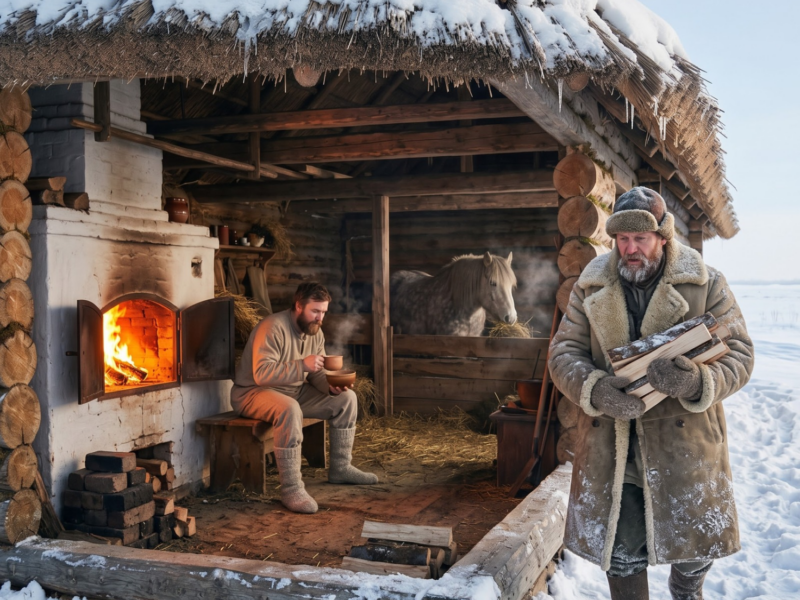
Cow Behind the Wall, Manure in the Stove: At Fifty-Four Below, the Neighbors Came to Get Warm
THE WEST RESERVE AND THE FIRST SEMLIN
There was no transcontinental railway to Winnipeg yet; it would not arrive for another three years. The Canadian government set aside a sweeping tract of pristine prairie for the Mennonites west of the Red River, right on the American border, officially designated as the West Reserve.
When Agatha climbed down from the heavy freight wagon and looked around, her heart sank.
Not a single tree, not a bush, stretched across the landscape in any direction. There was nothing to the horizon except shoulder-high prairie grass and an immense, intimidating dome of sky. It was undeniably one of the most fertile agricultural regions on earth, boasting a foot-deep layer of rich black humus. But it was also one of the most brutally cold, where winter winds regularly plunged forty below and deeper.
“There’s nothing here to burn,” Agatha whispered, staring at the empty horizon. “What are we going to keep warm with when the winter comes?”
Jakob was quiet for a long moment, watching the wind ripple across the grass. Then he answered, “The same thing we burned back home.”
The only available timber grew along the Pembina Hills, dozens of miles away. Hauling it by ox-cart was agonizingly slow and expensive, and a family could never haul enough to survive an entire winter. With only three months remaining before the freeze, they had no time and no materials to construct a traditional timber home.
So the Mennonites resorted to the ancient wisdom of the steppe: they dug their homes directly into the earth.
In their Low German dialect, they called them Semlins—derived from the Russian zemlyanka, meaning an earth house. Using heavy breaking plows, they cut thick ribbons of prairie sod out of the earth. The dense, interwoven root systems held the soil so tightly that each block could be lifted and stacked just like a masonry brick.
They excavated a rectangular pit three feet deep, stacked thick walls of sod around the perimeter, laid stout poplar poles across the top, and layered more sod over the roof.
The Penner family’s Semlin was partitioned into two halves: the human living quarters occupied one side, while the milk cow and the poultry shared the other.
At first, Agatha balked. “I grew up in a house with whitewashed plaster walls,” she protested. “And now I am expected to live in a hole in the ground right alongside a cow?”
“The cow is what will keep us warm, Agatha,” old Gerhard answered gently. The old man knew the thermal math: a cow is a massive, living radiator, generating metabolic heat day and night. In a compact earth-sheltered enclosure, that animal heat warmed the air almost as effectively as an auxiliary stove.
The Penners had managed to purchase a small, flimsy iron cookstove in Winnipeg on their journey west. They set it up in the family’s half of the Semlin, feeding it with tightly twisted bundles of dry prairie grass and slough hay that the children cut all autumn and stacked in towering mounds outside the door.
The first winter arrived with breathtaking fury on February 4th, 1876. The thermometer in nearby Winnipeg plummeted to forty-four degrees below zero.
The Semlin held. The thick earth-and-sod walls completely baffled the frost. The cow radiated steady warmth from behind the wooden partition, and deep snow drifted over the roof like an insulating blanket. The children slept safely on a wooden bench pressed close together. Sometimes, in the dead of night, the cow would sigh softly in her sleep, and within a week, Agatha stopped noticing the stable odor entirely.
Every morning, Jakob’s first task was inspecting the interior walls. The sod never froze through to the inside; while frost coated the exterior, the interior wall remained dry and secure.
The real domestic menace was moisture. When the iron stove burned hot, the warmth melted the underside of the snow roof, causing muddy water to drip relentlessly from the ceiling. They caught it in every available bowl, bucket, and pot.
They spent the endless winter nights working: the men mending harnesses, the women spinning wool and sewing garments, and old Gerhard reading aloud from the Scriptures by the flickering light of a tallow lamp.
The most lethal hazard on the open prairie was the blinding winter blizzard. Snow descended like a solid white wall, and a man who walked twenty paces toward the barn could easily lose all sense of direction and freeze to death yards from his own door. To counter this, they stretched a stout hemp rope from the Semlin door to the barn and the haystack. During a blizzard, nobody stepped outside without keeping a gloved hand locked to that lifeline.
Everyone survived until spring—the people, the cow, and the chickens. And after that grueling test, Agatha never argued about sharing a roof with livestock again.









