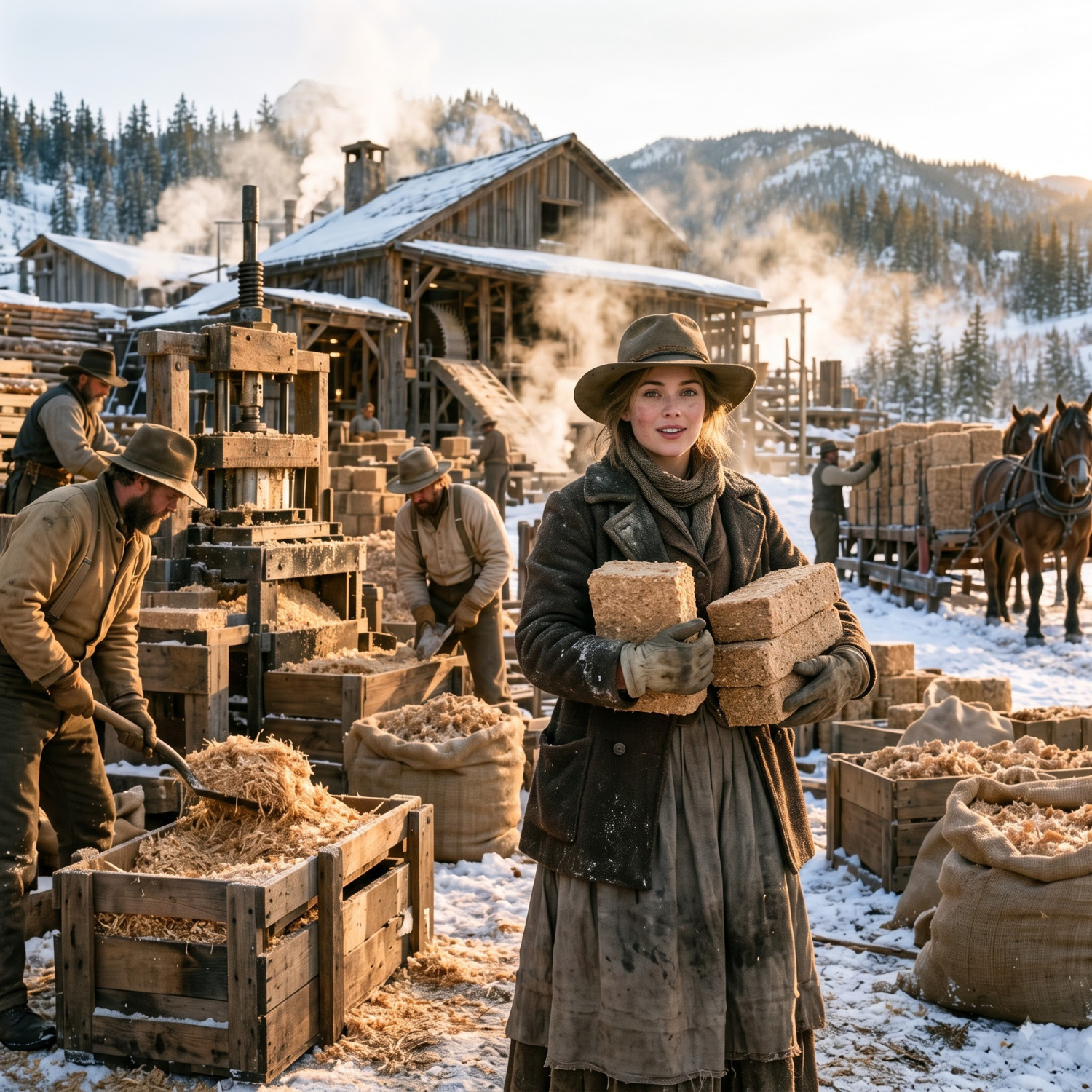
Everyone Saw Waste — She Saw Enough Fuel for the Entire Winter
The Trespass
Before the sled, before the ridge road, before any of it, there had been a night in autumn when the cold came down sudden and mean. It was the kind of creeping cold that slipped under a man’s collar and reminded him exactly how little he had between himself and the weather.
He had found the Weaver ranch the way a stray dog finds shelter: not by choosing it, so much as being drawn toward the only dark shape on the horizon that did not look like it belonged to someone who would turn him away on sight with a shotgun.
The barn had been unlocked. The hay inside smelled sweet and dusty, a ghost of the summer just passed. The horses had shifted in their stalls, blowing warm air at him through the dark. He had curled into the straw, pulling his thin wool coat over his face like a shroud, telling himself he would be gone before sunup. He would leave no sign he had ever been there at all.
She had found him anyway. Nelly Weaver always seemed to find things. Loose boards, a colt favoring a foreleg, a man hiding from his own ruined reputation.
She had stood in the doorway with a kerosene lantern raised high. She had not screamed. She had not run to the main house for a rifle. She had only looked at him the way she might look at a fence post leaning the wrong direction—assessing, rather than afraid.
“You’re on my hay,” she had said. Her voice was flat, carrying no tremor.
He had scrambled up, straw falling from his shoulders, already apologizing, already backing toward the wide double doors with his hands lifted as though the gesture might undo the trespass. “I’ll go. I didn’t mean any harm. I was only getting out of the wind a spell.”
“I didn’t say get off it.” She lowered the lantern a fraction so the light fell on the space between them instead of blinding him. “I said, you’re on it. Question is whether you’re fixing to keep being on it, or whether you’ve got a day’s work in you.”
He had not understood her at first. He thought perhaps she meant to charge him for the bedding, or to hand him over to whoever kept the jail in a town that size. But she only tilted her head toward a stack of raw, green lumber leaning against the far wall. The boards were roughly cut, not yet joined. Nearby, on a makeshift wooden shelf, sat a pile of strange, brown blocks drying in the draft. He could not place them as firewood, or brick, or anything he had seen in his thirty years of living.
“I need crates,” she had said. “To carry those. You look like you’ve held a hammer before.”
“I have.”
“Then there’s a loft up there with a wool blanket in it. And there’ll be supper if the crates get built.”
She had not offered her hand. She had not asked his name, his destination, or his history. She simply turned the lantern back toward the house as though the matter were already a settled contract.
“I’m not paying you to stand there,” she called over her shoulder.
He had looked at the lumber, then at her retreating back, then at the strange dark blocks on the shelf. Something in him—some old, stubborn instinct toward usefulness—had risen up for the first time in weeks.