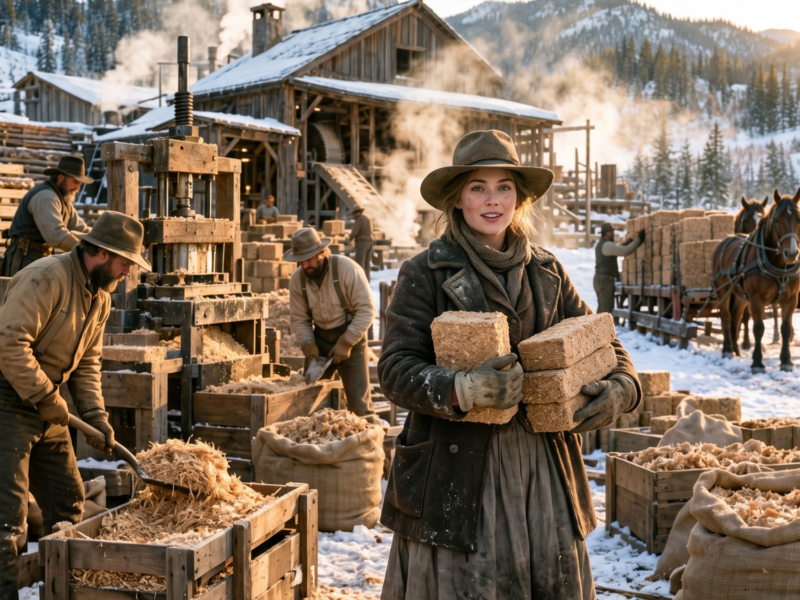
Everyone Saw Waste — She Saw Enough Fuel for the Entire Winter
The White Abyss
Now, in the brutal present, the snow came sideways, driven by a wind that had razor teeth in it. The sled runners cut through drifts that had not existed an hour before. The whole world narrowed to the swinging arc of the lantern light, the heavy, rhythmic breathing of the horses, and the weight of the bricks stacked and roped behind them.
Before they left the yard before dawn, he had insisted on bringing a small canvas roll of tools: a hammer, a heavy chisel, two lengths of strap iron, and a coil of thick wire. Nelly had thought it excessive. She had almost said so, watching him tuck it beneath the wooden seat as though they were driving to a barn raising instead of a delivery. She did not say so now.
The crack came sudden and sharp, a terrifying sound like a rifle shot beneath the sled.
The whole massive load lurched violently sideways into a snowdrift. One of the heavy wooden runners had split clean along an old, hidden knot in the wood, unable to bear the combined weight of the bricks and the freezing temperature.
For a moment, there was only the sound of the horses stamping in panic, the roar of the wind, and Nelly’s own heart beating loud in her ears. The terrible stillness of a cargo that could not sit stranded in cold like this paralyzed her. Not with three remote ranches waiting on it, and the temperature still falling toward zero.
He was already down in the waist-deep snow before she had found her voice. He knelt beside the broken runner, his bare hands working fast despite the killing cold. He felt along the split wood the way a surgeon might feel along a bone fracture—judging its depth, its direction, what the wood would bear and what it would reject.
“Hold the lantern close,” he shouted over the gale.
She scrambled down, crouching beside him, the wind cutting viciously at her collar. She watched him lay the strap iron along the ragged crack. He began working the thick wire through the wood with the chisel’s point, twisting, tightening, using the hammer’s claw to torque the binding. His breath came in short, pale clouds. His fingers went white, then an angry red, and then white again as the frost bit into his skin.
“Will it carry the load?” she asked, her voice trembling.
“It’ll carry it to the Pruitt place,” he grunted, twisting the wire until it bit deep into the grain. “After that, we lighten it for the Hollis run.”
He did not ask her opinion of the plan. He did not need to. She found herself simply nodding, handing him the hammer when he reached for it before he even asked. She leaned her weight against the sled to hold it steady while he drove the last of the wire tight and tested the runner by throwing his full shoulder against it.
It held.
She watched him climb back onto the seat beside her, snow plastered in his hair, his hands raw and bleeding sluggishly. She understood, with a quiet, unspoken certainty, that she was no longer merely grateful for what his hands could do. She had begun, without quite deciding to, to count on him. The way a person counts on weather, or daylight, or the particular steadiness of a foundation that has proven itself more than once.
Ahead, through a scrim of blowing white, the Pruitt place emerged the way all these outlying ranches had been emerging all morning. First, the smoke from the chimney that should have been thick and gray, but wasn’t. Then, the sagging, defeated line of the roof. Then, a woman standing at the door with a thin shawl clutched to her throat, her breath coming out in panicked ribbons.
Behind the house, stacked against a lean-to that had never been built to keep weather out, sat the Pruitt woodpile.
He saw it before the sled had fully stopped. Logs gone the color of a drowned thing. Bark slick and dark, split faces swollen with moisture they would never shed before spring. Somebody had tried to burn a few. The sad evidence sat in a blackened ring near the snowy step—more smoke stain than fire, a failure written plain in wet soot.
“We’ve had nothing but spitting and hissing out of that pile since Tuesday!” Mrs. Pruitt cried out before either of them had climbed down from the sled. Her voice carried the particular, ragged exhaustion of a mother who had spent three sleepless nights feeding a stove that gave back almost nothing. “I’ve got the baby wrapped in every blanket in the house!”
Nelly was already pulling back the heavy oilcloth on the sled.
Beneath it, the W-stamped bricks sat stacked, dry as bone, catching what little light the gray sky offered. Mrs. Pruitt’s hand went to her mouth, the way a hand goes when relief arrives faster than the brain can form the words to pray for it.
He carried the first heavy bundle to the door himself. The rough twine cut a deep line into his palm through his wet glove. He set it down just inside the threshold, where the warmth of the house hadn’t yet fled entirely.
Mrs. Pruitt knelt beside the bundle the way some women knelt at a church altar. She tested the absolute dryness of the brick with her bare fingers. She pressed her thumb into the dense, packed grain of a long-burn block, as though she half-expected it to crumble into the same watery disappointment as the logs out back. It did not yield.
“These will see us through,” she wept softly. She looked up at him directly. It was the way almost no one in Cedar Ridge had troubled to look at him since he had arrived with an empty pocket and a reputation that wasn’t his to carry. “I don’t believe I caught your name, mister.”
It was such a small thing. A simple question any neighbor might ask. But he felt it land somewhere deep under his ribs. The plain decency of being asked, rather than simply tolerated or suspected. For a moment, the howling cold seemed to step back half a pace to let him answer her.
“Elias,” he said. Plain as a nail driven straight. “Elias Thorne.”
He watched her repeat it back to herself, the way a woman tests a new tool before trusting it with real work. “Thank you, Elias.”
Then the sled was loaded again, and the cold remembered its fury, and they moved on to the next gate, the next buried lane, pushing into a white abyss that had forgotten where the road used to be.









