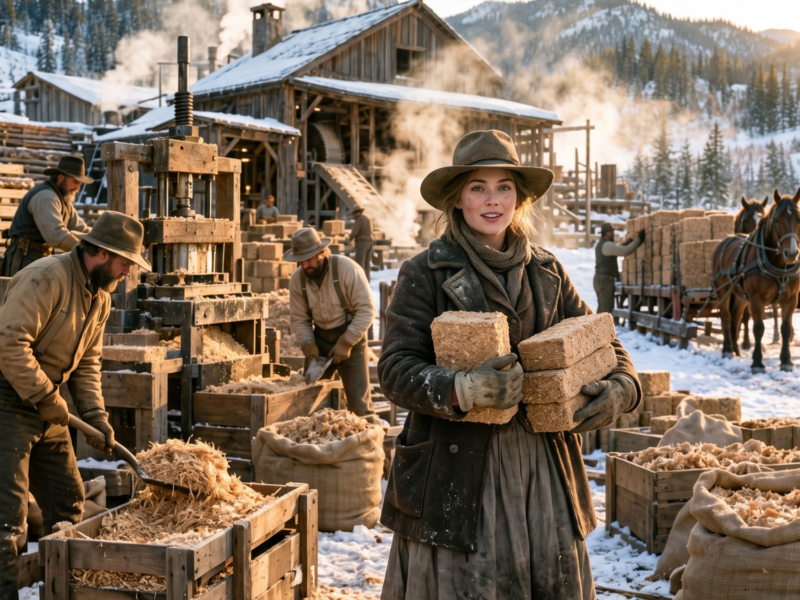
Everyone Saw Waste — She Saw Enough Fuel for the Entire Winter
The Second Plate
The last sled had gone out before the sun finally broke over the ridge. It was loaded with the final bundles bound for the Hollis place, and the two isolated cabins beyond it, where the Pierce family had been burning green pine and praying it would catch.
Elias had walked beside the damaged runner the entire way, steadying the ropes with hands that had learned over months exactly how tight a load could be cinched before the wood split through the canvas.
When they finally returned to the Weaver ranch, the horses were blowing great clouds of exhaustion into the gray morning air. The yard was quiet in the particular way a battlefield goes quiet once the fighting has moved elsewhere. It was not peaceful, exactly, but emptied of its frantic urgency, scoured clean by survival.
Nelly had not said much on the long ride back. She rarely did when there was something large enough that words seemed too small a vessel to carry it.
They unhitched the team, rubbed the horses down in the warm barn, and walked toward the main house.
When they came into the kitchen, stamping snow from their boots and shrugging off their frozen coats, she did not go first to the stove to check the fire, or to the ledger to count the day’s profit, as she had every night that winter.
She went instead to the heavy oak table. From the cupboard, she took down a ceramic plate. She set her own down at the head of the table. Then, she took the second plate and set it directly across from her own.
She did it with a plainness that made the gesture infinitely larger rather than smaller.
Elias stood in the doorway for a long moment, watching her do it. He watched the way a man watches the weather change—slowly, and then all at once.
“Sit,” she said.
When he hesitated, his hand resting on the doorframe, she looked up and said it again. This time, she did not use the word mister riding ahead of it, the way she had for months to keep a polite, employer’s distance. She used the name his mother had given him. She spoke it as though she had been carrying it safely in her mouth for a long while before she finally let it out.
“Sit, Elias.”
He walked to the table and sat in the wooden chair.
“This was never meant to be run by one person,” she said, setting a loaf of warm bread and a knife between them. The familiar, comforting smell of wood paste and fine sawdust still clung faintly to both their clothes. “I built the first ones alone because there wasn’t anyone else. That isn’t the same as wanting to keep it that way.”
He did not answer right away. He looked instead through the frost-rimmed kitchen window.
The pale dawn light was beginning to climb over the roof of the drying shed. It caught on row after row of bricks stacked inside. Each one was stamped with its small, deliberate ‘W’. They were stacked higher and deeper than either of them had dared imagine in that first, desperate autumn of damp sawdust and borrowed flour paste.
“No,” Elias agreed finally, his voice thick with a quiet, overwhelming peace. “I don’t suppose it was.”
Outside, the snow lay unbroken and blindingly bright over the yard, save for where their sled runners had cut long, patient, parallel grooves toward the road. They were tracks leading toward the ranches that would wake warm today because of what had been built here.
It was not born out of charity. It was not born out of a romantic rescue. It was born out of two sets of calloused hands, willing to press something discarded and worthless into something that could carry a whole town through the hardest season it had ever known.
Together. For this winter, and for every winter still to come.









