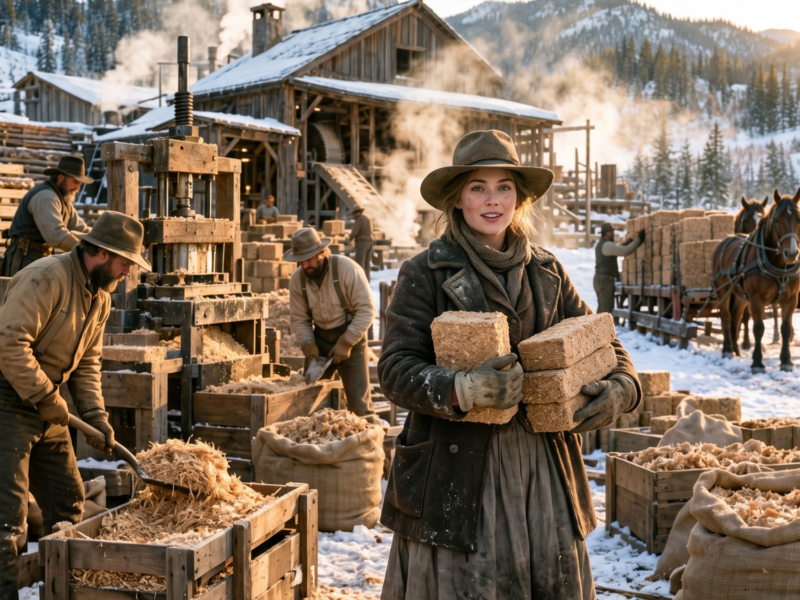
Everyone Saw Waste — She Saw Enough Fuel for the Entire Winter
The Hinge
The sled runners groaned beneath the weight of the load, a high-pitched complaint of iron against packed snow. It had been falling in a fine, merciless powder since before dawn. He leaned his shoulder into the harness traces, ropes he himself had reinforced weeks earlier. He had doubled the leather where the stitching had worn thin and added iron rings he had forged at the town blacksmith’s fire after hours, when the shop stood empty and no one was watching to doubt him.
An ordinary sled loaded this heavily would have foundered an hour back in the drift that swallowed the lower fence line. Its runners would have buried to the crossbar, the horses straining uselessly against a dead weight. But this sled held. He had widened the runners himself, shoeing them with strips of scrap iron scavenged from the sawmill’s discard pile. He had spent three evenings fitting and refitting the pitch until the sled rode atop the snow rather than plowing through it, like a shallow-draft boat finding its current.
Nelly walked beside the lead horse’s head, breaking trail where the drift crested too high for the animal to judge safely. In the gray half-light, she found herself thinking of Hatch, her foreman.
She remembered how Hatch had stood in the yard that first week, his arms crossed over his chest, his hat pulled low to block the autumn sun. He had watched the stranger planing a board with more care than most men gave to prayer.
“A thief playing carpenter,” Hatch had muttered, loud enough to carry across the dirt yard.
She remembered how the words had hung in the crisp air. She had said nothing in reply. Not because she agreed, and not because she doubted the rumor that had trailed the man from the rail yards, but because she had already learned that her silence carried more weight than her argument ever could. Time, given enough of it, argued better than she did.
Now, Hatch was somewhere behind them at the main shed, obediently loading the next sled with the very bricks the “thief” had designed.
The memory shifted. It had been mid-October. The air still held some apology of warmth in the afternoons, and the corral smelled of trampled hay and horse sweat. Hatch had planted himself in front of the main gate, refusing to move.
The hired hands had gathered the way men do when they sense an argument is about to become a performance. They leaned on corral rails, chewing on tobacco, their eyes sliding sideways toward the drifter who had been sleeping in the loft for two weeks and eating at the edge of the porch like a man perpetually uncertain of his welcome.
“Heard you left your last place on account of missing silver,” Hatch had said. It was the kind of voice built for an audience rather than a conversation. “Heard you never proved different.”
The man had not answered. He had crouched instead at the broken gate hinge that had been dragging in the dirt since the spring thaw—the kind of small ruin that accumulates on a working ranch because no one has an hour to spare for it.
He drew the rusted pin. He examined the worn socket with the attention of a man reading a difficult sentence. Then, he set to repairing it with the tools hanging from his belt, acting as though Hatch’s words had simply failed to reach him. It was as though the only conversation worth having was the one between his hands and the iron.
“I’m asking you a question,” Hatch growled, stepping closer.
“You asked it of the hands,” the man said, not looking up. “I expect they’ve got better things to do than wait on my answer.”
It was not defiance, exactly. It was something quieter, and infinitely harder to argue with. It was a kind of patience that assumed its own worth would eventually be plain to see, the way a well-hung gate was plain once it swung true.
He tapped the new pin home. He tested the gate’s swing with one hand. It moved without complaint for the first time in months, the hinge singing a small, clean note instead of its old, grinding protest.
Nelly had been standing at the edge of the yard with a sack of flour balanced on her hip. She had said only, “That gate’s been needing doing since before you came.”
It was not a defense so much as a fact, laid down like a solid plank across a treacherous gap.
Hatch, who had wanted either a tearful confession or a bloody confrontation, and received neither, found he had nowhere left to stand. He spat into the dust and went back to his work. The hands drifted back to theirs. Nothing further had been said that day, because nothing further had needed saying.
The hinge swung. The silence held. The man kept working, as though his worth were a thing to be built, brick by brick, same as everything else.









