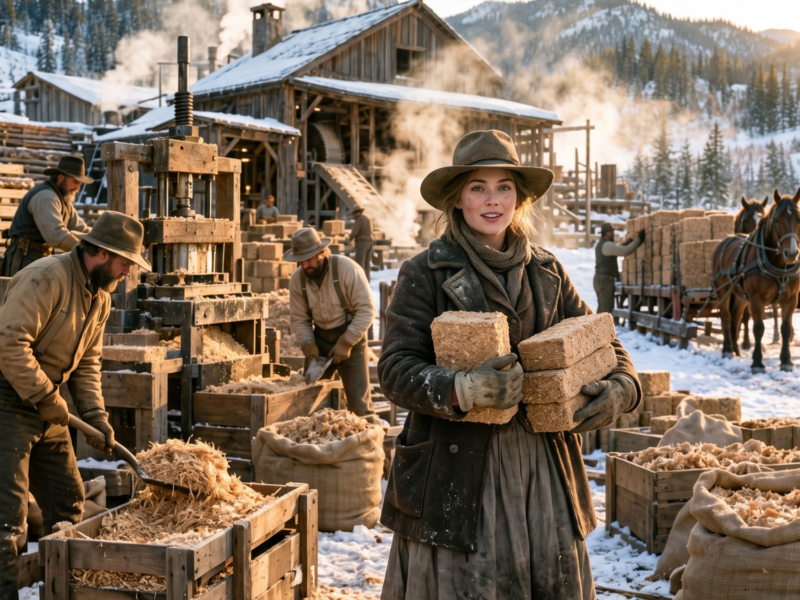
Everyone Saw Waste — She Saw Enough Fuel for the Entire Winter
The Innovation of Fire
The weeks that followed the sawmill agreement were not ones of triumph alone, but of patient, painstaking discovery. The kind of small victories that never found their way into any bank ledger, but shaped the business all the same.
The rain had come first in early November. Three days of it, steady and gray, turning the chopped woodpiles behind every house in Cedar Ridge into something sodden and useless. Pine logs hissed and smoked in the town’s stoves, refusing the flame no matter how much kerosene a man coaxed them with.
He remembered standing under the lean-to roof of Nelly’s drying shed while the rain drummed violently above. He watched the sawdust bricks stacked dry and solid in their neat rows, and he understood, before anyone else in town did, what that dryness was about to be worth.
The orders from the townspeople had come first in twos and threes, then in panicked wagonloads. The little hand-press groaned from sunup past dark, and still could not keep pace with the knocking at the shed door.
He had turned the problem over in his mind the way he turned any broken thing over—looking for where the strain was, and where the strength might be added. One evening, by lantern light, he had set a stick of charcoal to a pine board and sketched what he saw in his mind.
It was a longer frame. A heavier, industrial screw. A massive lever arm that a man’s full body weight could bear down upon, instead of relying on wrist and shoulder alone. Six molds, side by side, that could be filled and pressed at once instead of one.
He brought the sketch to her. Not as a request, but as an accounting—the way he had learned to speak in her house. He listed the material needed, the hours required, and what it would mean for their output if it worked.
She studied the charcoal lines for a long moment. Then, she gave that particular nod—the one she reserved for when she had already decided to trust a thing before fully understanding the mechanics of it.
“Build it,” she said.
Two men from the mill, who had watched him with narrow, suspicious eyes all autumn on account of the theft story, came to help once Silas vouched that the lumber and iron were being put to honest use. They worked beside him through cold mornings, their breath hanging white. The three of them wrestled heavy timber into a massive frame and fitted the giant salvage screw until it bit true.
When the lever swung down for the first time, and six bricks came out of the mold, identical as coins from a mint, something in the millmen’s faces changed. A reservation was quietly set down, like a tool no longer needed.
Dozens of bricks a day became hundreds. The racks filled faster than the weather could slow them.
At dawn, before the mill woke and before the horses stirred in their stalls, the two of them took coffee standing near the roaring stove in the shed. The tin cups warmed their palms against the biting air. In that quiet hour, they talked of wood the way other people talked of town gossip: its grain, its moisture, its stubbornness.
He had learned in years of framing barns that pine gave up its heat quickly in a flash, and poplar held its fire low and slow. He said as much, turning a handful of shavings in his fingers. She listened, and then she tested. She filled the stove with one mixture and timed its burn against the turning of the sun across the shed floor, marking her findings in a notebook gone soft at the corners from constant handling.
Between them, a kind of shorthand grew. It needed fewer words with each passing week. He would nod toward a bin of fine sawdust, and she would already be reaching for the paste pail. She would hold up two bricks of differing color, and he would tell her without being asked which one would catch a flame fastest.
Out of this unhurried collaboration came the three distinct types of brick they settled on.
First, a light, curly-shaving brick that caught almost the instant a match touched it, meant for freezing mornings when patience ran thin.
Second, a denser, long-burning block built mostly from fine sawdust, pressed hard and slow. It was meant to last through a winter night without a man having to wake to tend the stove.
Third, heavier than the rest, was a block meaty with bark fragments and worked for hours under the maximum compression of the screw. It was meant for furnaces and blacksmith forges that demanded steady, punishing heat.
Working it out took the better part of a season. It was a quiet rhythm of trial and correction that neither of them ever called by its proper name—partnership—though it had become exactly that.









