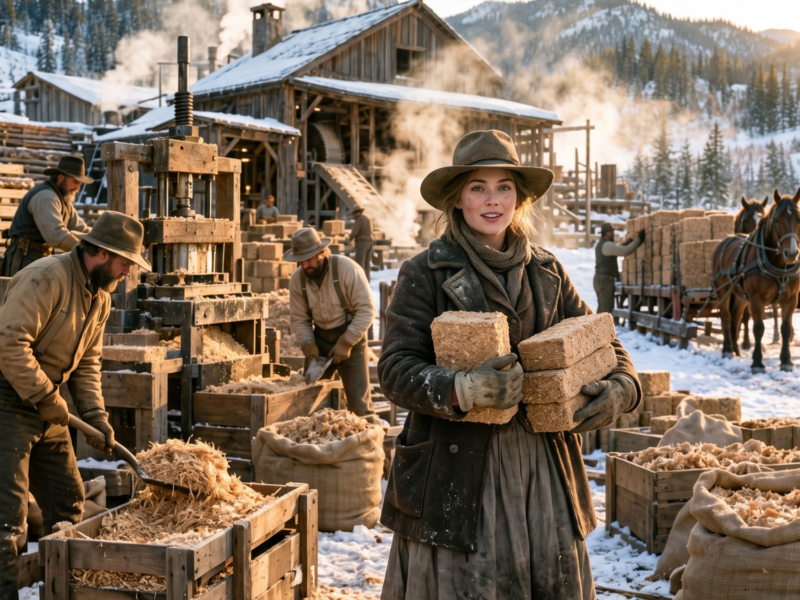
Everyone Saw Waste — She Saw Enough Fuel for the Entire Winter
The Ledger and the Shadow
But the sky that autumn had not yet shown its true, devastating hand, and the past was not done with him.
In the amber stretch of late November, when the shed still smelled more of sawdust than snowmelt, the railroad agent had come down from the depot with a ledger under his arm. He brought a massive freight wagon, large enough to carry half the season’s stock to heat the train station. The order he placed that day made Nelly’s hands shake as she wrote the figures down. It was the kind of order that changed a thing from a desperate experiment into a legitimate business.
But the agent had not come alone.
A man rode with him—a regional freight inspector, down from the exact same rail line the drifter had once worked before his name had been spoken alongside the word theft.
When the inspector stepped off the wagon and saw the man stacking bricks at the press, his face had gone completely still with recognition. He turned to the agent, and then to Hatch, who was standing nearby.
“I know him,” the inspector said, his voice low but piercing. “I remember the case in Cheyenne. Missing silver from the freight cars. I remember the accusation. Nothing was ever proven, but the railroad let him go all the same.”
Hatch’s jaw tightened. The old suspicion, the one that had taken months of hard labor to wear down to almost nothing, flickered up behind his eyes like a coal not quite smothered by ash.
The drifter froze at the press. The brick in his hand suddenly felt like lead. He looked at the open road. The instinct to run, to pack his lint-filled pockets and vanish into the timber before the law could be called, surged through his blood.
Nelly did not hesitate.
She stepped squarely between the inspector and the press. She did not do it dramatically. She did not raise her voice. She moved with the plain certainty of a woman stating a fact already permanently settled in her own ledger.
“He built that machine,” she said, pointing a gloved finger at the great lever and screw frame. “He has kept this operation standing through a wet autumn and the hardest cold I’ve seen in ten years. Whatever happened at his last post is his business, and the railroad’s. Not mine.”
The inspector opened his mouth to argue, but Nelly stepped closer, her eyes entirely devoid of compromise.
“What I know,” she said, her voice ringing like struck iron, “is what I have seen with my own eyes, every day, for months. Now, are you buying the fuel to heat your station, or are you taking your wagon back empty?”
The inspector studied her. He looked past her to the man, and then to the towering stacks of bricks rising neat and uniform under the shed roof, each one stamped with its deliberate ‘W’. Whatever self-righteous warning he had meant to deliver, he swallowed it. He made a sharp note in his ledger about tonnage and delivery schedules, and the matter passed the way a dark cloud passes over a field—darkening it briefly before moving on.
Hatch let out a breath he had not known he was holding. He looked at the ground, ashamed of his own brief relapse into doubt.
The drifter said nothing at all. He only bent back to the press. But Nelly saw the faint, trembling unclenching of his broad shoulders. She saw the way a man’s body remembers relief before his face allows it to show.
She did not speak of it again that day, nor the next. But something in her had settled quietly and permanently, the way deep frost settles into the ground before winter. Not loudly, not all at once, but deep enough to last forever.









