Evicted Before Winter, She Spent Her Last $11 on a Bent-Alder Arch—It Kept Her Firewood Dry All W…
The Geometry of Ruin
Declan Vale was not a desperate man. He was simply a man who had made careful, meticulous plans and watched them unravel through no particular failure of his own. In some ways, he reflected, that was much harder to absorb than outright bad luck.
He had arrived in the valley two years earlier with specialized tools, a solid reputation for sound millwork, and a lucrative contract. That contract evaporated on a Tuesday night when the sawmill owner died of a heart attack during a whiskey-fueled card dispute. The owner’s son, inheriting a mountain of invisible debt, settled every remaining obligation by fleeing to America, leaving the mill to the bank. The workshop Declan had leased vanished in the foreclosure.
His savings had already been sunk into heavy equipment that was now locked behind bank chains. By early October, Declan was reduced to a mule named Fern, a heavy canvas bedroll, a highly prized set of hand tools, and roughly eight dollars. He kept four dollars in his left coat pocket and four in his right, a pragmatic defense against losing everything at once to a pickpocket or a tear in the fabric.
Instead of retreating to the city, Declan camped near the riverbend where the tamarack grew thick and gold. He spent his mornings studying the hillside above the rushing water. He was not looking for gold or timber. He was looking for a geometry of survival—a place where the impending British Columbia winter would be easier to survive than to escape.
He found the ledge on a Tuesday.
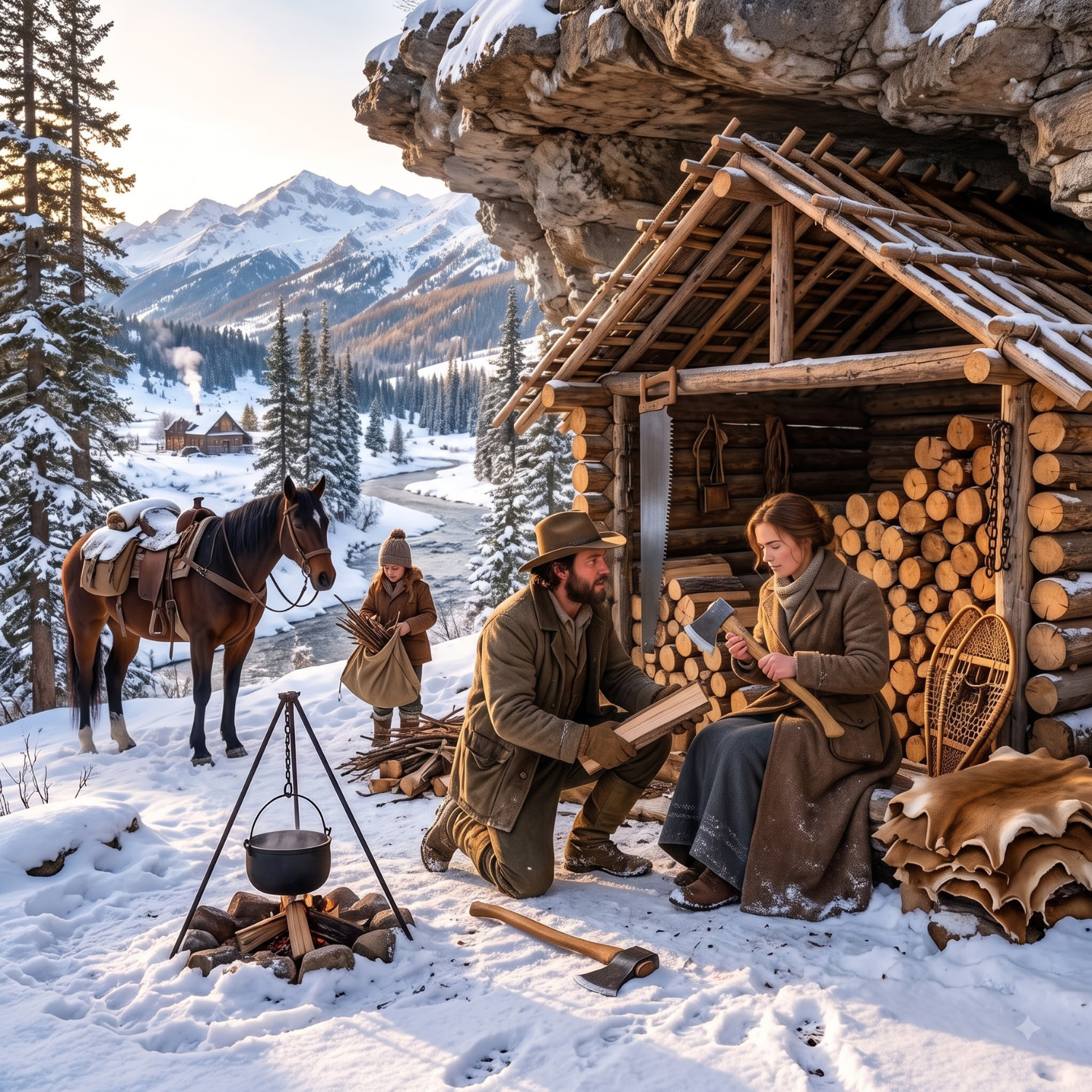
It was a broad, jutting shelf of pale limestone, protruding from the slope at a gentle angle about thirty feet above the valley floor. Below the shelf, the earth curved inward, forming a natural, deep hollow. It was naturally sheltered from the biting northwest wind by a ridge of ancient, dark basalt.
More importantly, the limestone above showed a smooth, scoured scar—a pale streak where decades of previous winters had sent their heavy snowpack sliding cleanly downhill, shedding the weight away from whatever might be stored beneath. The hollow itself was bone-dry. The air inside it sat still, insulated, and clean.
His mule, Fern, stopped voluntarily at the entrance of the hollow and lowered her heavy head, chewing a mouthful of dry grass as if considering the matter settled. That was enough for Declan. He unstrapped his mallet and was driving the first wooden anchor stake into the gravelly earth when he heard the quiet crunch of footsteps behind him.