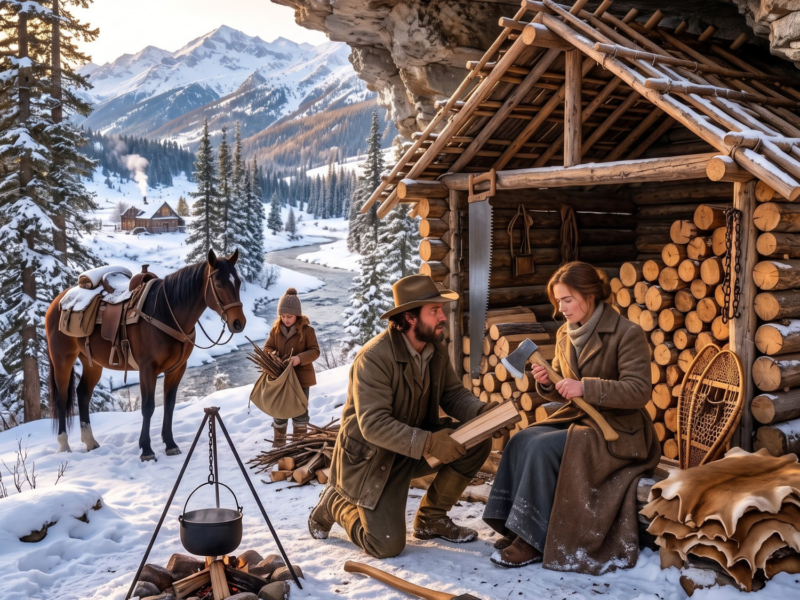
Evicted Before Winter, She Spent Her Last $11 on a Bent-Alder Arch—It Kept Her Firewood Dry All W…
The Silent Treaty
Nadia had found the hollow the exact same morning, having approached by a different route. She and Bess had followed an old, overgrown game trail up from the river bottom, both of them moving in silence, watching the way the land behaved.
Frost had settled unevenly across the hillside that morning. Nadia knew that cold pooled like water—heavy and thick in the depressions, avoiding the slight rises. The hollow beneath the limestone shelf held almost no frost. She had marked this anomaly in a small, black leather notebook she kept in her coat pocket. It was the same notebook she had used for three years to record Garrett’s shift times, the household grocery accounts, and, eventually, the slow, agonizing details of a grief she could not quite bring herself to speak aloud.
When she rounded the basalt ridge and saw the tall, broad-shouldered man with the mule and the wooden stake, she stopped.
Declan straightened, the wooden mallet resting against his thigh. He looked at the woman in the dark wool coat and the solemn child beside her. He did not speak. Bess looked at the mule. Fern flicked an ear and looked back at Bess.
When they finally spoke, they explained their respective situations in the fewest possible words. The frontier stripped away the luxury of small talk.
Nadia unbuttoned her pocket, withdrew the notebook, and showed him the frost patterns she had meticulously mapped along the trail, proving the hollow’s thermal advantage. Declan nodded, turning, and pointed the handle of his mallet up at the pale scar on the limestone, explaining the physics of the snow shed.
For several minutes, they stood in the center of the hollow, two strangers discussing snow load, soil drainage, and wind direction with the hyper-focused practicality of people who knew that getting the answers wrong meant freezing to death.
By the time the sun had moved an inch across the valley rim, they had reached a quiet, unspoken understanding. The hollow was large enough for both their purposes. Nadia desperately needed somewhere to store firewood that would remain bone-dry through the winter—a logistical problem that had consumed her waking thoughts since leaving the company house. Declan needed the same thing, plus a foundational framework he could build upon while he slowly rebuilt his financial standing.
Neither of them made grand speeches about cooperation, community, or shared hardship. They simply drew a line in the dirt with a stick, agreed on a boundary across the hollow floor, and went back to their separate camps to gather what they needed to build.









