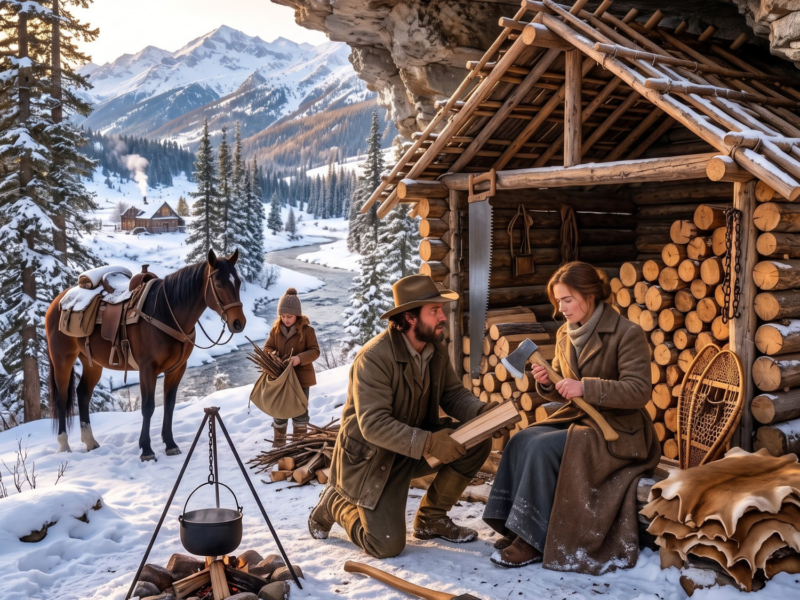
Evicted Before Winter, She Spent Her Last $11 on a Bent-Alder Arch—It Kept Her Firewood Dry All W…
Skin and Breath
The following afternoon, a woman named Agatha Prue marched up the trail. She carried a heavy ash walking stick and possessed a directness of manner that suggested she had been observing their efforts through a spyglass for some time before deciding to intervene.
Agatha was sixty-three years old. She had spent thirty years in the deepest, most unforgiving pockets of British Columbia, following her late husband between boom-and-bust mining camps. She had spent fifteen years on her own after a rockfall took him. She had seen enough improvised, desperate construction in her life to know exactly what Declan was attempting.
She walked around the skeletal frame without saying hello. She pressed her calloused thumb hard into two of the bent alder ribs, testing the tension. Finally, she turned and nodded at Nadia, deliberately bypassing Declan.
“The weaving will shrink,” Agatha said, her voice like cracked leather. “When those willow shoots dry out in the cold air, the gaps will open. The wind will come howling through before November is even done.”
It was not a dismissal, nor an insult. It was the specific kind of vital observation that only comes from someone who has already made the exact mistake being described. Nadia pulled her notebook from her pocket and wrote it down.
The woven lattice went up over the next four days. It was an intricate dance of alder ribs laced horizontally with willow switches and wild hazel shoots harvested from the creek bottom. The pattern was the same one Declan used on Conestoga wagon covers: over one rib, behind the next, forward again, pulling tight. As the gaps filled in, the structure ceased looking like a pile of bent branches and began to look like an organism that had chosen its own shape.
A supply rider named Peter Bosch came through on a Friday. He had spent twelve years moving freight over high mountain passes that most horses flatly refused to cross. He stopped his pack string uninvited, crossed his arms, and stared at the woven lattice for a long time.
“The bottom course worries me,” Peter said finally, pointing a gloved finger at the base of the structure. “Cold air behaves like water; it settles at the lowest point. If your wood isn’t fully seasoned, the ambient moisture will sit in those lower rows. You won’t know it until you’re trying to burn wet fuel in a January blizzard.”
He wasn’t criticizing the aesthetic or the effort. He was pointing a lantern at its most vulnerable, hidden corner.
Declan didn’t let his pride flare. He asked Peter two highly specific questions about drainage angles and thermal drafts, listening to the older man’s answers without arguing. After Peter rode on, Declan took his saw and deliberately cut two narrow vent openings near the floor on the leeward side of the structure, and two more high up, tucked safely beneath the limestone overhang. Cold air could enter where he controlled it. Damp air could rise and leave.
Then came the daub.
The mixture took three exhausting days to perfect and apply. It was a slurry of heavy river clay, dry prairie grass, and gray wood ash dug from ancient, abandoned fire rings along the trail. Nadia mixed it in a massive canvas trough, her arms burning with the effort, while Declan packed it into the woven lattice from ground level upward, pressing the mud deep into the gaps of the willow.
The first coat looked atrocious—rough, patchy, and unpromising. But by the second coat, the walls had gained significant mass. Inside, the acoustics changed. The interior grew profoundly quiet. The wind, which had moved freely through the woven ribs for a week, now met something solid and impenetrable.
Bess became the keeper of the records.
Temperature at sunrise. Cloud cover. Wind direction. Wall condition (damp, dry, cracked). Wood inventory (cords chopped, cords stacked). Nadia had started the notebook, but as the walls went up, she formally handed the daily entries over to her daughter.
She did this partly because the task gave the grieving seven-year-old something purposeful and vital to do, preventing her from dwelling on the loss of her father and her home. But mostly, Nadia did it because she understood a deep, unspoken truth of the frontier: a child who learned to read a landscape in numbers, who understood cause and effect through meticulous observation, would carry a shield of competence for the rest of her life.









