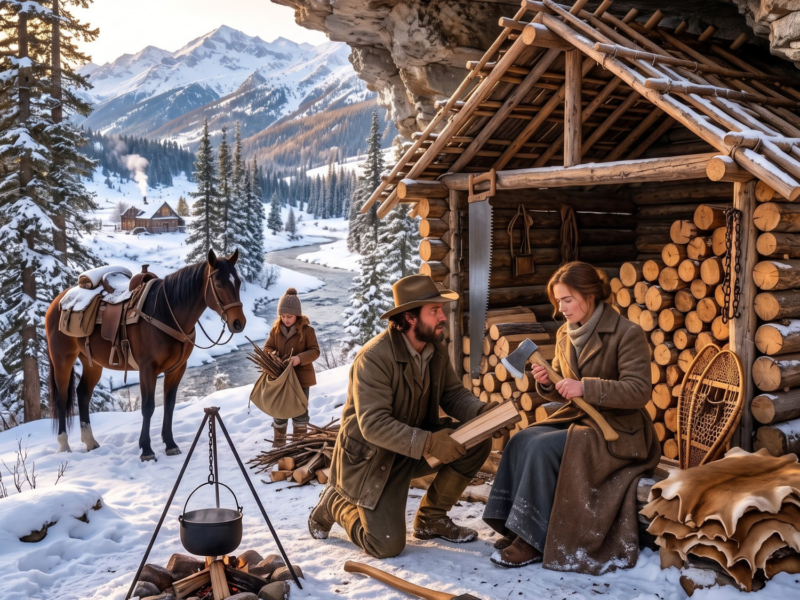
Evicted Before Winter, She Spent Her Last $11 on a Bent-Alder Arch—It Kept Her Firewood Dry All W…
The Blizzard and the Swede
The winter deepened into the brutal heart of January. A second massive storm system arrived in the third week, and this time, it was a proper, blinding blizzard.
Wind-driven, dry snow erased the valley landmarks for four straight days, piling massive, suffocating drifts against anything that stood vertical. Declan and Nadia tracked the blizzard the exact same way they had tracked the freezing rain: temperature gradients, wind direction, snow load on the cedar roofline, and daily wood consumption against the baseline figures Bess had been recording since October.
The results, when the storm finally exhausted itself and moved east over the peaks, confirmed what the freezing rain had only suggested. The valley reappeared beneath three feet of pristine new snow.
The shelter had not simply survived the blizzard. It had performed.
Because the limestone overhang shed the heavy snow, the roof never bore the crushing weight that collapsed sheds in town. Furthermore, fuel consumption over the four-day deep freeze had remained well below their most optimistic estimates. Because their stored wood was bone-dry, it burned clean, fast, and incredibly hot from the strike of the first match, rather than wasting a third of its thermal energy just driving off trapped internal moisture. The stove in their canvas tent produced real, sustained heat. The woodpile diminished at a slow, manageable rate.
Bess recorded everything. Her handwriting was already neater, more precise than her mother’s. Her columns of numbers lined up flawlessly. At seven years old, she understood implicitly, without ever being lectured, that a record was only useful if it was fiercely accurate. She treated that accuracy as a point of personal honor.
In the second week of February, a man arrived at the hollow in a psychological state that Nadia recognized instantly. It was the exact, hollow-eyed look she had worn the March her husband had died and her life had shattered.
His name was Per Lindqvist, a Swedish immigrant who had been working a stubborn placer claim north of the river. A chimney fire had taken his wooden tool shed in early January. Desperate, he had rebuilt his winter woodpile under a heavy canvas tarpaulin. But the January blizzard had violently stripped the tarp from its poles and carried it somewhere deep into the timber.
By February, Per was burning frozen, green wood. He was fighting his stove for two exhausting hours every single morning just to produce a smoky, sputtering heat that barely held the killing frost back from his cabin walls. His hands, gripping his hat, had the waxy, pale, careful quality of hands that had been very, very cold for a long time.
Declan looked at the broken man for a moment, then turned and looked at Nadia.
She had already reached into her coat and opened the black notebook to the wood inventory page.
They did not offer Per charity, which would have broken what remained of his pride. Instead, they told Per they were conducting an ongoing, highly specific study of wood moisture conditions at different elevations and distances from the river. They told him they desperately needed daily environmental observations from a claim exactly like his upstream to complete their comparison.
The explanation was thin enough that Per, a smart man, must have seen through it immediately. But he accepted it without comment, his eyes shining with unshed relief. The dignity of the framing mattered infinitely more than its credibility.
Per’s twelve-year-old son, Jonas, began walking down to the hollow each morning to deliver the temperature records. In exchange for this “vital data,” Declan and Nadia sent two massive armloads of perfectly dry, seasoned wood back with him on a sled every second day.
By the end of February, Per had accumulated enough dry fuel—stored in a brand-new, arched lean-to structure built with Declan’s help using the exact same alder and daub method—to see his family safely through to March without the suffocating anxiety that had been thinning his face all winter.
Jonas Lindqvist continued bringing the temperature records to Bess even after the arrangement had served its original, life-saving purpose. The boy seemed to find the mathematical work satisfying in itself, and he and Bess would sit on a crate, comparing columns of numbers with quiet, shared solemnity.









