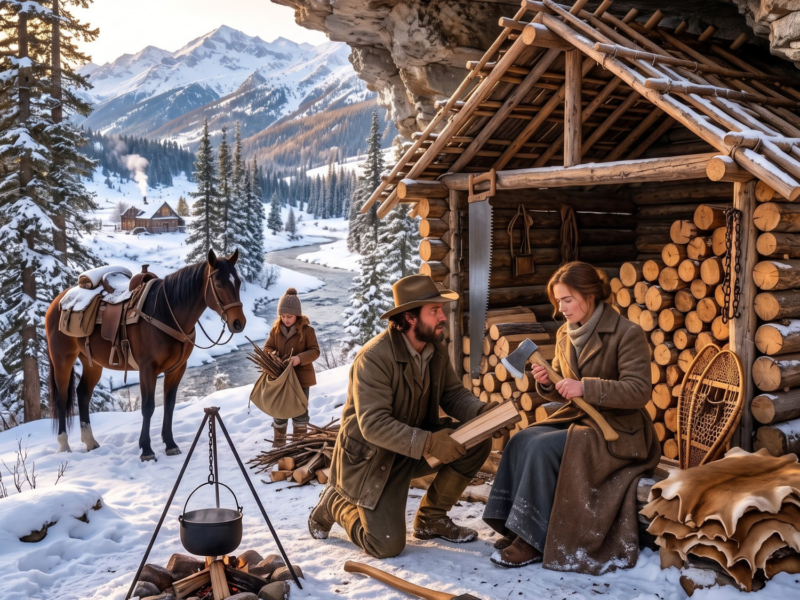
Evicted Before Winter, She Spent Her Last $11 on a Bent-Alder Arch—It Kept Her Firewood Dry All W…
The Language of Frost
The first hard frost arrived with a vengeance on a Thursday in late October.
By morning, the tall grass along the river bottom had turned a brittle, blinding white. A thin, crystalline skim of ice covered the still water in the bend below the hollow.
Declan was out of his bedroll and at the structure before the sun breached the eastern ridge. At first glance, the earthen walls had held perfectly. Then, he got closer, his breath pluming in the freezing air, and looked carefully.
Fine, pale cracks ran spiderweb-like across the entire north-facing section of the daub. They were narrow as a thumbnail edge, but they ran systematically in the direction of the worst cold. Worse, near the lower left corner where the earthen floor met the base of the wall, the clay had shrunk and pulled away from the willow framing in a continuous seam no wider than a knife blade.
He pushed his bare fingers into the gap. It was freezing cold, but not wet.
Declan did not curse. He did not tear the wall apart in a fit of perfectionism. He simply turned as Bess walked up the trail, her small hands clutching the leather notebook. He took the book, marked the compromised wall section with a charcoal pencil, and studied the vent positions against the exact way the frost had settled on the ground overnight.
The structure had not failed them. It had simply spoken. It had shown him precisely where to look.
For two nights after that, Declan checked the hollow exclusively after dark. Cold revealed its habits differently at night; it crept rather than struck. He observed that frost gathered near the north corner first. The upper walls stayed miraculously dry, venting perfectly, but the lower sections held the chill the longest.
The alder ribs were a triumph; they had held their arched curve without a single millimeter of shifting or sagging. The weakness was in the skin, not the bones. The daub had dried too fast in the arid wind and needed more fibrous material to bind it through the violent temperature swings of day and night.
He hiked to Agatha Prue’s barn and traded an hour of labor repairing a hinge for a large sack of coarse horsehair. He mixed fresh clay, more dry grass, fine ash, and the horsehair. The new mixture was incredibly dense, packing differently, acting as a flexible mortar that would be far slower to crack.
He rebuilt the north section over two grueling days and sealed the floor gap with a heavy second pass. That evening, he pulled a piece of split pine from the very bottom row of their storage stack and pressed it against his cheek. It felt exactly as dry and rough as it had two weeks earlier. The breath of the structure was working.









