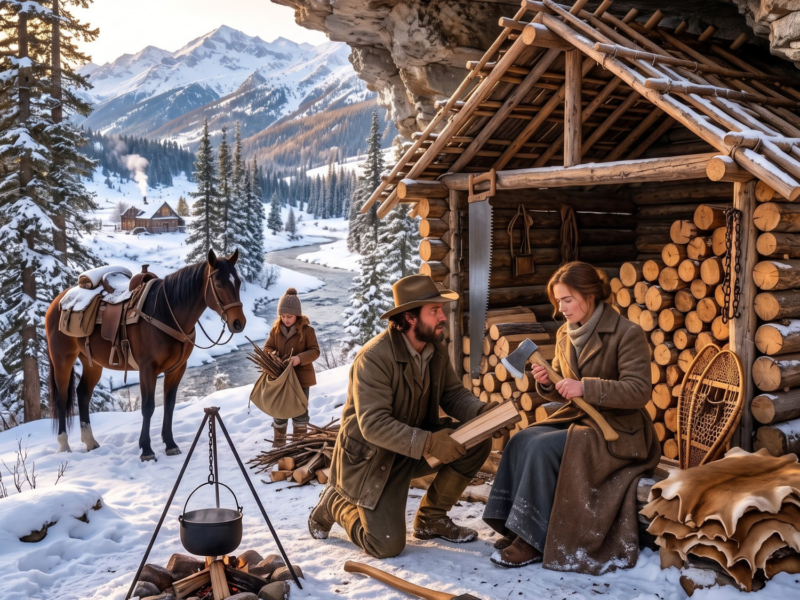
Evicted Before Winter, She Spent Her Last $11 on a Bent-Alder Arch—It Kept Her Firewood Dry All W…
The Ice Storm
The real, undeniable test arrived on December 4th.
The sky over the Selkirk Mountains turned the bruised, heavy gray of old pewter. The barometric pressure—which Bess had been religiously recording twice a day for three weeks—dropped in a single afternoon by a margin larger than it had moved in the entire previous month.
Bess noticed the impending violence first, not in the sky, but in the behavior of Fern. The usually placid mule paced anxiously along her picket line, pinning her ears back and flatly refusing her oats. Animals read weather through ancient, invisible channels that human instruments only clumsily approximated.
The storm did not come as snow, which would have been simpler, softer. It came as freezing rain.
Freezing rain was the terror of the high country. It coated everything in a suffocating shell. It found every microscopic gap in a roof. It turned loose, uncovered piles of survival firewood into solid, impenetrable blocks of ice that burned poorly, smoked wildly, and split only with bone-jarring difficulty.
By the first evening, the wooden fence posts along the trail below the hollow wore a thick, glassy shell of clear ice. High up on the ridges, the sharp, rifle-crack sounds of massive tree branches breaking under the accumulated weight echoed through the freezing fog.
Declan checked the shelter every four hours through the long, brutal night.
Each time, the routine was identical. Open the heavy canvas door. Step inside. Check the air temperature and humidity. Pull a piece of wood from a different section of the meticulously stacked cords. He would test the surface with his bare palm, feeling for the slickness of condensation. Then, he would strike two pieces of wood together near his ear, listening intently to the acoustic resonance.
He was listening for the sharp, bright crack of perfectly seasoned wood, praying he wouldn’t hear the flat, dead thud of timber that had absorbed atmospheric moisture. He recorded each result in the notebook himself by the light of a lantern, allowing Bess to sleep.
In the canvas tent pitched against the far, sheltered wall of the hollow, Nadia tracked the plummeting temperature through the night.
28 degrees. 24 degrees. 19 degrees.
The numbers moved steadily, mercilessly downward, while the freezing rain hissed like a nest of vipers against the limestone overhang above, and drummed relentlessly against the thick cedar bark Declan had layered over the top of the shelter’s roof in overlapping courses.
The freezing rain continued without pause for thirty-one hours.
When it finally stopped, the valley below lay entombed under a thick shell of ice that caught the morning light, turning the world into a glittering, blinding crystal landscape. It was a sight of breathtaking beauty, provided one could separate the aesthetic from the devastating damage it produced.
Shattered, heavy branches lay across every trail. A traditional, square-built woodshed on a property two miles up the valley had entirely lost its front wall, the nails shearing off under the immense, accumulated weight of the ice. Across the settlement, several families were waking up to chop their wood out of ice blocks, burning wet fuel that hissed, smoked, and gave back only a fraction of the heat they desperately needed to survive the plunging temperatures.
Declan walked up to the shelter, his boots crunching loudly on the ice. He opened the heavy door and stood absolutely still for a long moment.
The packed earth floor was bone-dry. The air inside the vaulted space carried nothing but the clean, sharp smell of cut pine and dry clay. There were no puddles. There were no dark, spreading tide marks of moisture on the lower walls. There was no creeping seam of dampness along the floorline. The vents had performed flawlessly, exhaling the dampness into the storm.
He pulled six pieces of split wood from different sections of the massive stack. Two from the bottom course. Two from the dead center. Two from the highest rows pressed against the back wall.
Every piece received the same physical check. Every piece gave back the exact same answer. The sound when he struck them together was a sharp, ringing, clean crack.
Whatever had fallen from the merciless sky for the past thirty-one hours had found its way around the curved, aerodynamic structure, guided by the limestone and the cedar, rather than through it.
Declan walked back to the canvas tent and handed the leather notebook to Nadia without speaking a word. She read his temporal entries, looked at the acoustic results, and took the pencil from him. Beneath his column of numbers, she wrote a single, definitive line:
Wood condition: Unchanged.









