He Wedged a Tiny A Frame Into a Crevice Before Winter and His Family Slept at 75°F While Town Hit
The Wisdom of the Accursed Mountains
Vukashin Radulovich was not a carpenter, nor a farmer, nor a timber framer, nor an eastern engineer. He was a dry-stone shepherd.
He had come from the Prokletije Mountains of Montenegro—a region the locals rightly called Prokletije, the Accursed Mountains. It was rugged, unforgiving, high-alpine country where the winter wind stripped the skin from a man’s face and the snow stayed until July. Everything Vukashin knew, he knew not from books or blueprints, but in his calloused hands.
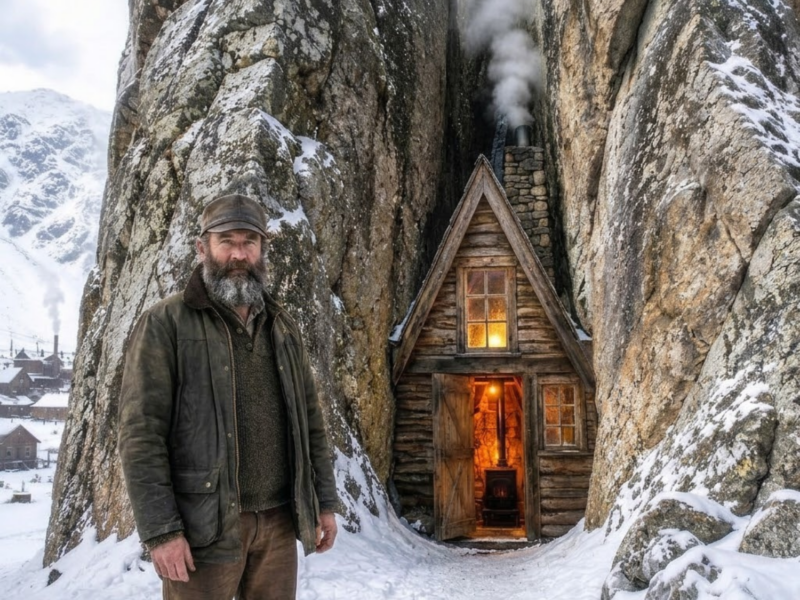
He knew the delicate, unyielding balance of unmortared limestone blocks. He knew the deep, stable thermal chambers of ancient rock shelters—natural hollows the shepherds of his homeland had utilized for centuries to cheat the frost. He knew how heavy sheep wool felt when it was tightly sealed against an alpine draft. And, above all, he knew the geometry of a natural mountain fissure: the exact way a crack in bedrock runs, tapers, and holds its structural integrity under pressure.
That knowledge came from the Katon, the traditional shepherd settlements of the nomadic and semi-nomadic tribes of the high Balkans. These were high-altitude villages built directly into the folds of the earth, where architecture and geology were treated as a single discipline.
The men around him in Butte treated stone as a foundation—something dead and inert to be built on top of. The Katon tradition saw the mountain itself as the primary building material. You didn’t plant a fragile wooden box against the weather and dare it to stand; you tucked your dwelling deep into the landscape and let the immovable mass of the earth take the brunt of the blow.
Vukashin understood a fundamental truth that the entire camp had completely backwards: Stone is not cold. Stone is a reservoir.
To him, that wasn’t a philosophical theory; it was a matter of basic survival. It was what you learned when a winter could kill an entire flock in a single night, and nobody was coming down the trail to help you dig them out.
And that hard-earned wisdom was about to be tested in a way he never expected, because his family had already spent one miserable Montana winter living in a house built the “American way,” and the experience had nearly finished them all.