He Wedged a Tiny A Frame Into a Crevice Before Winter and His Family Slept at 75°F While Town Hit
Geological Tension
The A-frame’s design was deceptively simple, but its mechanics were pure engineering genius.
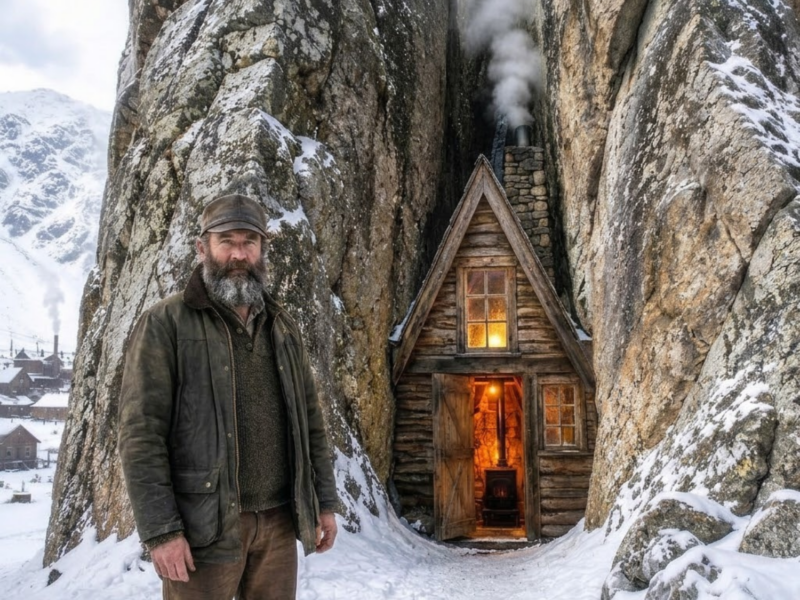
By wedging the ten-by-fourteen structure twenty feet deep into the natural taper of the granite crevice, Radulovich achieved something the camp’s critics failed to comprehend. The A-frame’s steep roof—climbing twelve feet to a razor-sharp ridge—was engineered so that its lateral braces leaned outward against the unyielding stone walls.
As the frame settled under its own weight, and later as heavy winter snow piled thick upon the roof, that downward vertical pressure drove the angled side braces harder and more securely into the rock face. The roof pushed out; the granite walls pushed back. Every pound of accumulated snow only tightened the structure’s grip.
The cabin could not shift. It could not blow away. It sat locked in a state of permanent, self-reinforcing geological tension.
While Silas Vance worried about sweating granite and Emmett Higgins sketched failing load vectors in the dirt, Radulovich had achieved a masterstroke of thermal economy. A standard cabin exposed eight hundred square feet of surface area to the weather.
Radulovich’s crevice A-frame exposed exactly one surface to the elements: the front-facing triangular facade, measuring ten feet wide and twelve feet tall. That was one hundred and twenty square feet. He had slashed his exposed surface area from eight hundred down to one hundred and twenty—an eighty-five percent reduction in exterior exposure.
At twenty-two degrees below zero, a standard wooden box was hemorrhaging tens of thousands of BTUs every hour into the dark. Radulovich’s crevice home lost barely twenty-five hundred.
Furthermore, he placed a single, small pot-belly stove at the very rear of the A-frame, pressed directly against the bare, exposed face of the granite bedrock forming the back wall. When the fire burned, it didn’t just heat the thin indoor air; it pumped thermal energy directly into the stone. The granite soaked up those BTUs like a vast, patient sponge, storing the heat deep within its dense crystalline matrix.
When the fire died down to glowing coals in the dead of night, the massive stone wall kept giving that heat back—slowly, steadily, radiating warmth from floor to ceiling hour after hour without burning a single additional stick of wood.
The paper calculations were airtight. But paper doesn’t freeze. Paper doesn’t kill. And Montana was about to deliver a winter that would test every single number to its absolute breaking point.