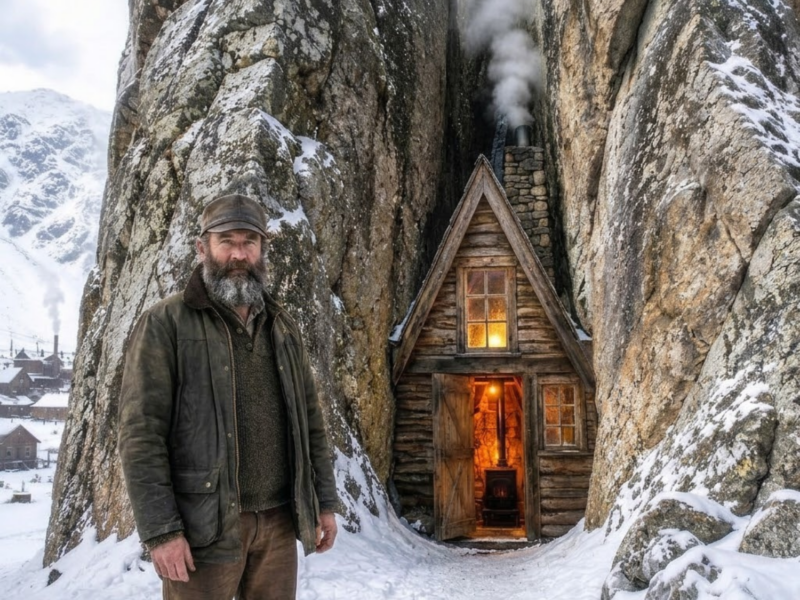
He Wedged a Tiny A Frame Into a Crevice Before Winter and His Family Slept at 75°F While Town Hit
The Legacy of Cold Creek
When the spring thaw finally broke the inversion’s grip, washing the gray slush down the gullies of Silver Bow County, Alonzo Whitfield did not issue the April citation.
Instead, he quietly used the discretionary authority of his office to formally reclassify the granite outcropping—not as federal mineral land subject to standard residential codes, but as a naturally existing geographical shelter. Legally speaking, the A-frame was exempted from the standard setback requirements. No fine was levied; no timber was touched. In the eyes of the county, the cabin in the crack was simply part of the rock.
Whitfield did not keep the discovery to himself. He documented the entire experiment in his regional reports—the exact dimensions of the fissure, the thermal mass calculations, the fuel consumption figures. He laid out the math in plain terms: this structure burned less than twenty percent of the cordwood a standard cabin required, and during the worst polar crisis in a decade, it held its interior nearly seventy degrees warmer than the freezing exterior.
Those reports traveled east. By March of 1902, they reached Chicago, where a Montenegrin-language newspaper, the Crnogorski Glasnik (The Montenegrin Herald), splashed the crevice-wedge design across its front page, complete with a detailed schematic for immigrant families working the industrial belts and mining towns of America.
The article didn’t just celebrate the design; it taught it. It explained how to find a granite fissure with the correct depth and angle, how to calculate the outward thrust of the A-frame ridge so the braces pressed firmly into the stone instead of snapping, and how to harness the earth’s natural heat capacity. It framed the whole thing as an ancient tradition of the Prokletije shepherds, adapted to the brutal realities of the frontier.
The response was swift. By the autumn of 1902, before the next freeze could grip the mountains, four different immigrant families across the mining districts of Butte and Anaconda went looking for deep rock fissures on the edges of their claims.
They abandoned the fragile balloon-frame construction that had nearly frozen them out, wedging their homes directly into the earth instead, leaning on the same thermal memory of Montana geology that had saved the Radulovich family.
The camp bosses and tradesmen who had laughed the loudest the previous winter watched them in silence. Those small, deeply embedded homes sailed through the subsequent winters with minimal fuel and absolute thermal stability.
Nobody laughed at Vukashin Radulovich anymore.
Today’s engineers pour massive concrete retaining walls and bury modern structures under deep earth berms to achieve those exact results. A century before building science caught up, a dry-stone shepherd did it with a cedar frame, a pocketknife, and a crack in the granite.
He didn’t fight the mountain. He simply let the rock hold the heat, and in return, the mountain held him.









