He Wedged a Tiny A Frame Into a Crevice Before Winter and His Family Slept at 75°F While Town Hit
The Sieve
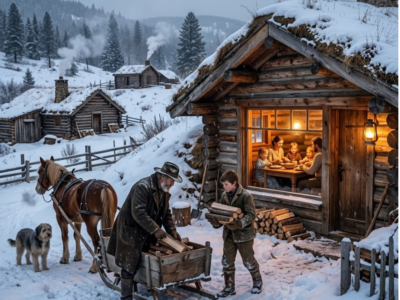
They had come to Butte the previous autumn, trusting the conventional wisdom of the mining camp. Vukashin, his wife Militsa, and their two young children, Peter and Jelena, had rented a standard timber-frame cabin out on the exposed flats—a conventionally built box of pine planks and lath, the kind every miner called home.
The locals knew how to build for Montana winters. That was the comforting assumption they had relied upon.
That assumption nearly killed all four of them.
The cold didn’t just seep into that cabin; it attacked it with predatory aggression. A few weeks into the freeze, Vukashin watched a neighbor step outside to break up frost-bound ground. The man swung his heavy steel pickaxe down, and on the very first strike, the tool head snapped clean off down the eye. The steel had gone completely brittle in the negative temperatures, snapping like a dry kitchen match.
Over at the assay office, things were little better. The temperature inside dropped so low that the iron gall ink froze solid in the ledger right there mid-column, the clerk’s steel-nib pen dragging to a permanent halt against a wall of black ice.
At the mine tipple, a shift worker hung his heavy wool coat on a wooden peg. It was damp from sweat when he left it; by the end of his shift, it had frozen so completely solid that when he tried to bend the sleeve to put it on, the fabric cracked with the sharp, terrifying sound of breaking glass.
Inside the cabin, the situation was desperate. Militsa slept with both children wrapped in heavy wool coats, their breath plumed white in the dark room. A ghostly lattice of frost crept across the interior walls like a malevolent vine, spreading wider while they watched.
The family huddled around a perpetually starving iron stove, feeding it cord after cord of expensive firewood, only to watch every ounce of that precious heat vanish straight out through the thin timber walls. They burned everything they could afford to buy or scavenge. It was never enough.
And that was the failure Vukashin couldn’t stop turning over in his mind. The problem was never a lack of fuel. It was never a lack of physical effort. They had done everything right, exactly the way the camp elders told them to do it.
The fatal flaw lay in the physics of the structure itself.
A free-standing box—four thin walls, a pitched roof—sat naked in the open air, daring the Montana winter to come and strip it bare. The winter took it, greedily, every single night.
A standard cabin presented more than eight hundred square feet of timber directly exposed to the freezing sky. Eight hundred square feet of continuous thermal hemorrhage. The wind coming off the Continental Divide never stopped; it swept across the pine cladding and tore away the microscopic boundary layer of warmed air that clung to the boards. Once that thin shield was stripped away, conduction did the rest, dragging heat straight out of the rooms through every plank and stud.
A roaring wood stove could throw off forty thousand British thermal units every hour. It sounded like an enormous fortune in heat. But heat always moves relentlessly toward equilibrium, flowing from warm to cold without pause. Those forty thousand units were in a desperate race from the moment they left the iron firebox. The stove pushed them in; eight hundred square feet of freezing timber pulled them out. The wood won every single night.
The geometry only made it worse. Stand-alone cabins do not heat evenly; they stratify cruelly. The air near the ceiling could climb to a stifling eighty degrees while the floor sat flat at twenty. Your head sweats while your toes go numb. You sit inches from a roaring fire and still cannot feel your feet.
The building envelope wasn’t a wall; it was a sieve. Thermal energy poured out of it into the vast, freezing sink of the Montana atmosphere, and no amount of cordwood could plug the holes. You could cut timber until your arms gave out; the house would still lose.
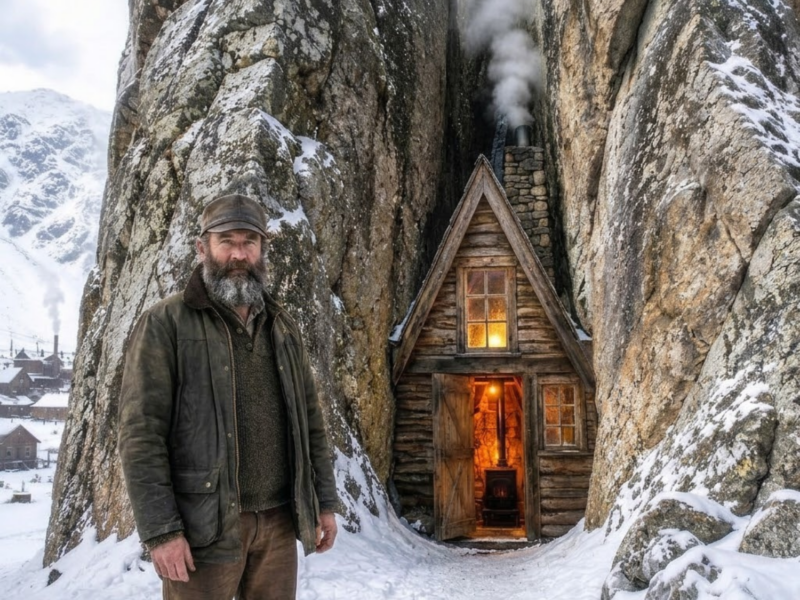
That left only two mathematical ways to change the outcome: drastically shrink the surface area facing the wind, and find something massive enough to hold the heat once you finally made it.
He had found the answer in a slab of granite.