He Wedged a Tiny A Frame Into a Crevice Before Winter and His Family Slept at 75°F While Town Hit
The Pocket in the Earth
The door swung inward, and the cold lost.
Outside, the air was twenty-two below zero, thick with a toxic copper haze. Inside, the temperature was a stable, deeply comfortable seventy-five degrees.
A wave of rich, dry heat washed over Whitfield’s face, carrying the earthy, comforting scent of wood smoke and roasted nuts. He stood frozen on the threshold, his mind rebelling against the simple physics of the space.
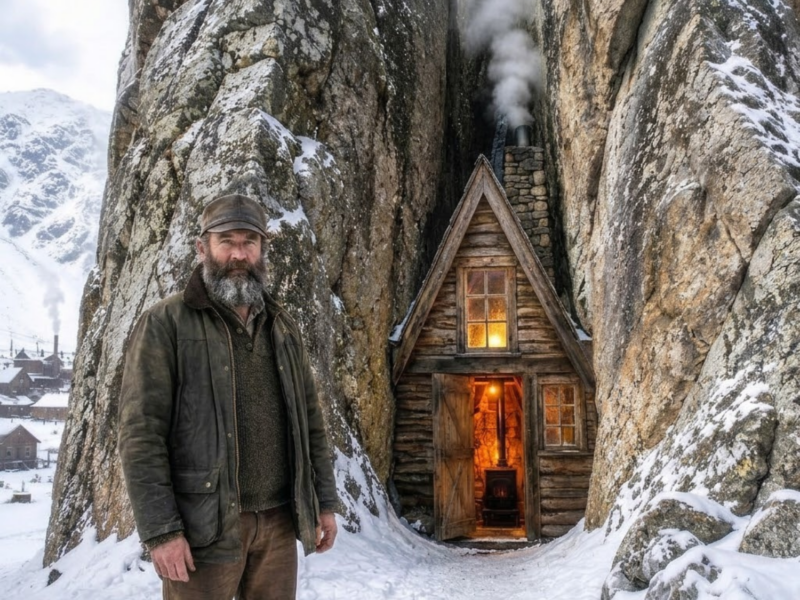
At a small wooden table near the center sat Militsa and the two children. A kerosene lamp burned brightly beside them, its flame steady and clean. They were not huddled under heavy coats; they were dressed in light linen shirts, completely relaxed, casually shelling a large wooden bowl of walnuts. The sharp, dry crack of shells splitting between their fingers echoed softly in the warm, quiet air—a sound of absolute domestic serenity in the middle of a polar disaster.
Further back, near the rear throat of the granite crevice, Vukashin stood calmly adding a single, small piece of split cedar to the pot-belly stove. The stove was not roaring out of control; it was simply radiating a steady, profound warmth directly into the massive stone wall behind it.
Slowly, in a daze, Whitfield pulled off his heavy leather glove. He reached out with his bare right hand and pressed his palm flat against the interior cedar wall near the entrance. It was completely dry—no condensation, no black mold, no creeping frost.
Then he walked to the very back of the cabin and placed his hand against the exposed granite face right beside the stove.
The stone was deeply, profoundly warm. It radiated thermal energy like a living heart. The mountain itself was heating the room.
The ultimate proof of the thermal stability sat on a small wooden shelf mounted directly to the stone wall: a large, heavy earthenware crock containing Militsa’s traditional kacamak—a dense cornmeal mush mixed with potatoes and rich cheese, prepared in celebration of Sveti Sava’s Day.
Kacamak required a sustained, perfectly even ambient temperature to stay pliable and warm; if the surrounding air fluctuated or dropped, the edges froze instantly, ruining the dish. In every other cabin across Butte that night, whatever food was left in stovetop pots had frozen solid before the fires could even burn down to embers.
Yet here, inside the crevice-mass envelope, the crock of kacamak remained piping hot, its surface steaming gently in the seventy-five-degree air, sustained hour after hour entirely by the geological battery of the granite walls.
Whitfield sank into a wooden chair offered by Vukashin. His hands were still trembling, but a cup of hot, strong coffee was pressed into his palms, and he let the heat climb back into his frozen core.
He looked around the room—at the dry cedar, at the children cracking walnuts, at the single small iron stove doing the work of an industrial furnace.
And Alonzo Whitfield understood something that humbled him to his bones. The 1897 Montana Dwelling Code had been written by men who understood nothing about the earth beneath their feet.
He stared at the warm granite wall for a long, quiet moment.
“You didn’t build a house against the wind,” he said softly, almost to himself. “You built a pocket in the earth’s thermal memory.”
Vukashin gave a slow, respectful nod. He didn’t gloat. He didn’t bring up the months of mockery from the camp, or the threats of citations, or the fine promised for April. He simply poured the inspector another cup of coffee and gave him a warm place to wait out the storm.