He Wedged a Tiny A Frame Into a Crevice Before Winter and His Family Slept at 75°F While Town Hit
The Great Inversion
Early in December, a massive high-pressure system stalled directly over the Continental Divide and stubbornly refused to move. It dragged a vortex of polar air down from the high north and dropped it into the Butte Hollow like an iron lid on a boiling pot.
The temperature plummeted. Then it stayed there.
Twelve consecutive nights. Twelve nights where the thermometer outside the assayer’s office locked dead at twenty-two degrees below zero Fahrenheit.
Worse still, the bitter cold brought a copper smoke inversion. The dense, frigid air trapped the thick, sulfurous exhaust from the valley’s roaring smelters close to the earth, hanging a toxic, freezing fog over the town that choked every lung and blotted out the pale winter sun.
The extreme cold altered the behavior of physical things. Kerosene lamps struggled to vaporize their fuel, their flames shrinking from bright gold to weak, sputtering blue halos. Even indoors, fires struggled to maintain momentum.
Inside the conventional balloon-frame cabins across the flats, the suffering was total and unmitigated. Families burned astronomical amounts of cordwood while their thin walls gave nothing back. Interior temperatures plummeted to six degrees above zero. Water froze solid in buckets sitting mere feet from blazing hearths. Men went to sleep in their heavy canvas work coats and laced-up work boots, shivering violently as convective currents stripped the warmth from their bodies.
The camp ground to a horrified halt. Nobody talked about ore grades, wage disputes, or the next big strike anymore. Every waking hour had devolved into a desperate, grinding struggle to keep the fires alive.
And Alonzo Whitfield, bound by the strict, unyielding duties of his office, had no choice but to ride his inspection circuit through the worst of it. Livestock regulations brooked no weather exceptions.
The ice was his primary enemy. A sheet of iron-hard glaze coated the slopes. Whitfield’s horse picked its way down a steep incline with the agonizing care of an animal that knew the ground could not be trusted.
Then a shoe caught. The iron struck a hidden ridge of ice at a fatal angle and tore free with a sharp crack that echoed across the empty valley. The horse went down hard, scrambled wildly to find its footing, and stood shaking on three legs, refusing to bear an ounce of weight on the injured hoof.
Whitfield dismounted instantly. The cold did not wait for hesitation; at twenty-two below, it bypassed the skin entirely and went straight for the human core, pulling warmth out like a dry pump.
He was miles from the main camp. The wind was picking up from the north, driving the freezing copper fog across the slope in slow, suffocating gray sheets. He touched his own cheek and felt nothing—absolute numbness. He knew what that terrifying sensory blackout meant. A man whose face stopped talking to him was running out of time.
Shelter. It had to be now, or not at all.
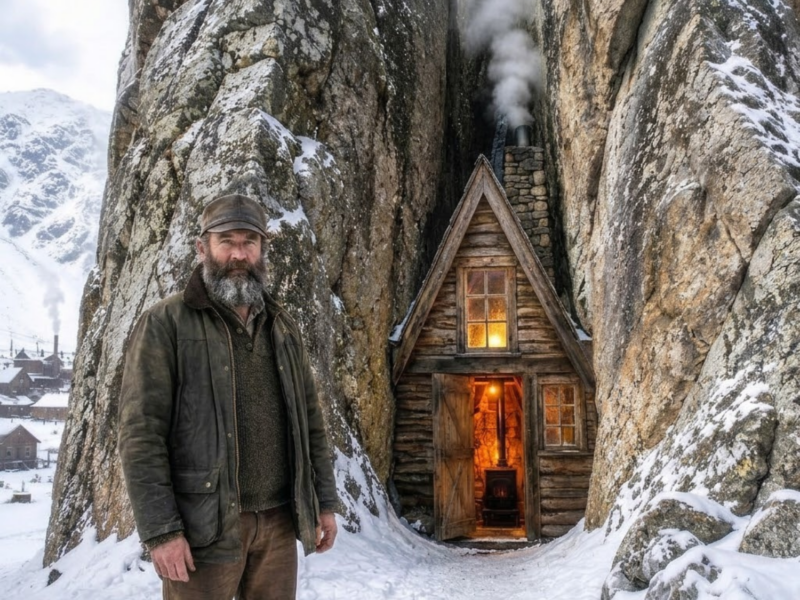
Through the roiling haze, he saw it: the dark, hulking shape of the granite outcropping, hunched against the hillside like an ancient sleeping animal. And with a jolt of bitter irony, he remembered the Montenegrin’s ridiculous wedge of a house—the very structure he had sworn to cite and tear down come April.
He dragged the limping horse toward the rock face. He expected a tomb. He honestly expected to find the family gone, or worse, frozen stiff in the dark, damp stone like specimens in a freezer.
Tying the shivering animal to a stunted scrub oak near the mouth of the fissure, Whitfield stepped out of the biting wind into the lee of the granite. The wind died instantly, swallowed by the stone. The sudden quiet was almost deafening.
He walked up to the heavy cedar door of the triangular facade. His fingers were so stiff and shaking so violently that he could barely coordinate his grip on the iron latch. Taking one last breath of the lethal, sulfur-choked air, he threw the door open, bracing himself for the grim tableau of winter’s victory.









