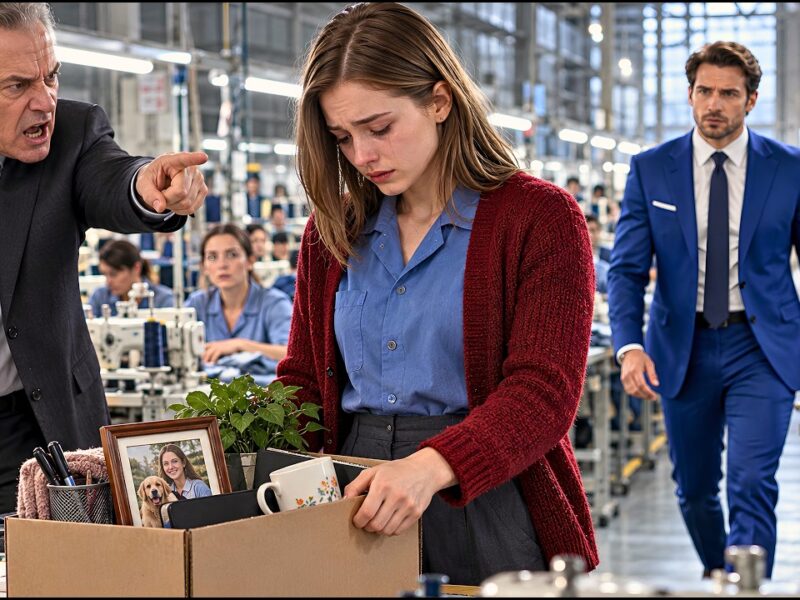
“I Understand… I’ll Pack My Things” She Said After Being Fired Without Warning—Then a CEO Stepped In
The Shipment
That evening, long after the plant had emptied and the machines had gone cold, Bram Toliffson walked out to Warehouse Bay 6. He intended to personally put a physical ‘HOLD’ tag on the pallets of Lot 14.
He flipped on the harsh overhead halogens.
The bay was entirely empty.
Bram stared at the bare, swept concrete floor. A cold dread began to pool in his stomach. He turned to the night dock supervisor, a young kid who immediately shifted nervously on his feet.
“Where is it?” Bram demanded.
“They went out Friday night, Mr. Toliffson,” the supervisor stammered. “11:40 PM. Mr. Rude called the transport order in himself. Paid a rush premium to the freight company.”
“Went out where?”
“Fourteen volunteer fire departments. All over the valley.”
Two hundred and twelve coats. Gone. Dispersed across hundreds of miles of rural North Dakota and Minnesota, in active service, long before Kora’s Monday morning retest had ever occurred.
Across town, Frankie noticed the change in routine right away.
“You’re early,” she said, climbing into the passenger seat of Kora’s aging Subaru at 3:15, her colorful backpack half unzipped. “Is it a holiday?”
“Work changed a little,” Kora said, forcing a bright tone, putting the car in drive. “That’s all.”
Frankie studied her mother’s profile the way observant seven-year-olds do: all at once, and much too closely. Then, possessing the mercy of a child, she let it go and began talking about a bald eagle she had read about in the library.
Their apartment in South Fargo was small, immaculately clean, and incredibly warm. The white refrigerator was command central. The calendar pinned to it read: Library Friday. Rent on the 1st. Dentist November 9th. Kora wrote absolutely everything down. A single mother surviving on a QA inspector’s salary couldn’t afford to forget a single detail that mattered.
They made grilled cheese sandwiches and canned tomato soup for dinner. When Kora reached for the ceramic cookie jar afterward, Frankie shook her head.
“I’m not really hungry for dessert,” Frankie said casually.
She said it lightly, but Kora heard the subtext anyway. Somewhere along the difficult journey of the past three years, her bright, observant daughter had learned how to read her mother’s financial anxiety. She had learned how to save money by pretending she didn’t want things.
After Frankie was asleep, tucked beneath a heavy quilt, Kora stood alone in the narrow hallway and slowly opened the hall closet door.
Seth’s turnout coat hung there. It was incredibly heavy, made of tan Nomex, the neon yellow reflective stripes dulled and scratched with heavy use. She had never washed it. Three years after the funeral, if she pressed her face to the collar, it still smelled faintly, acridly, of woodsmoke.
Some people checked the deadbolts on their doors at night to feel safe. Kora checked the coat.
She stood in the dark and she didn’t tell anyone about that afternoon. The test run. The strict company rule that personal cell phones had to remain locked in employee lockers while on the testing floor. The three missed calls she had found waiting on her screen at 4:10 PM, all from Seth’s fire station.
She violently closed the closet door before the rest of the memory could rush back in and drown her.
Across town, the lights were still blazing on the second floor of Toliffson Protective Apparel.
Bram Toliffson’s office consisted of a massive oak desk, a large window overlooking the highway, and a cheap canvas folding cot he pretended was only temporary. His leather overnight bag sat unpacked by the door, exactly the way it had sat for most of the last ten years. His dinner was a cellophane-wrapped turkey sandwich from the breakroom vending machine.
Four years ago, Anika had quietly given back her engagement ring. She hadn’t yelled. She hadn’t thrown things. She had simply stopped asking him what time he was coming home for dinner. He had never once argued with her version of events, because he knew she was right. He was married to his grandfather’s company.
The door opened. Glenn Rude walked in without knocking. He always had.
“You embarrassed me out there on the floor today, Bram,” Glenn said, taking a seat uninvited.
“You shipped two hundred defective turnout coats before the final testing protocols were complete, Glenn,” Bram said, his voice dangerously low.
“Friday’s initial test passed the parameters,” Glenn’s voice remained calm, adopting an almost paternal, gentle tone that made Bram’s skin crawl. “That Ostby girl has been looking for a fight since her husband died in that warehouse fire. Grief makes people incredibly rigid, Bram. They look for things to control. I was protecting your deadline.”
Glenn leaned forward, resting his elbows on his knees. “You explicitly stated you wanted Lot 14 shipped to the valley departments by the 31st. You looked me in the eye and said, ‘No excuses.'”
Bram opened his mouth to fire the man, and then closed it again. The words died in his throat. Because Glenn was entirely right. Bram had said exactly that.
At 9:30 that night, Kora’s cell phone buzzed on her nightstand. She looked at the screen. Norma Brekie.
“I saw them load it,” Norma whispered, her voice tight with anxiety, skipping any greeting. “Friday night. Lot 14. I was leaving late because my machine jammed, and I saw Glenn directing the forklift to the freight truck.”
Kora sat down heavily on the edge of the porcelain bathtub. “You were standing right there today on the floor, Norma. You watched him fire me for lying.”
“I know,” Norma exhaled a long, shuddering breath. “Dennis’s insulin is fully covered on my tier of the company insurance, Kora. I’m sixty years old. I couldn’t risk it. I’m so sorry.”
Kora desperately wanted to be angry. She wanted to scream at the woman for her cowardice. But she knew exactly what it felt like to do the terrifying, immediate math of survival in a hurry.
“I know you couldn’t, Norma,” Kora said softly. “It’s okay.”









