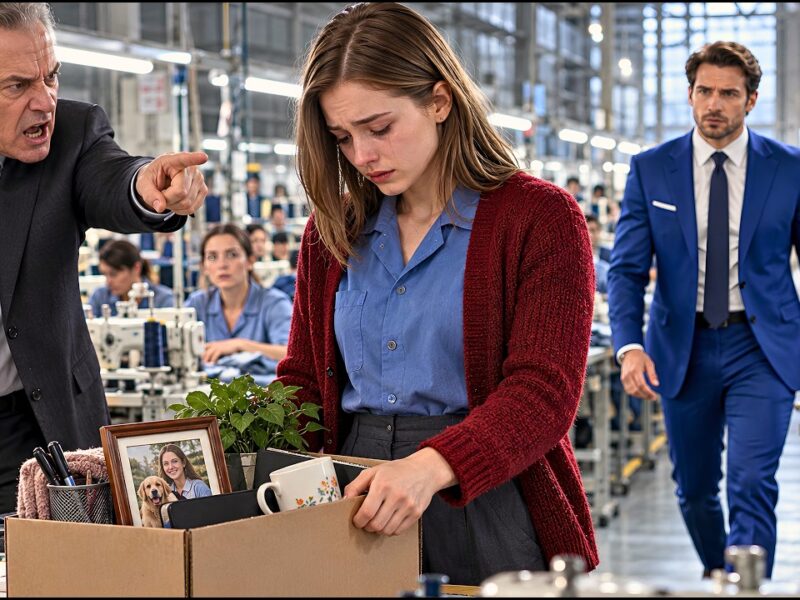
“I Understand… I’ll Pack My Things” She Said After Being Fired Without Warning—Then a CEO Stepped In
The Holdout
At dawn, the fierce wind finally died down to a whisper. The sun broke over the glittering white fields.
Bram’s cell phone buzzed in his coat pocket. He pulled it out, checking the screen. It was Vern Odigard, the grizzled Fire Chief of Hatton—the single fire hall that hadn’t returned any of Bram’s frantic voicemails all week.
Bram answered and put it on speakerphone so Kora could hear.
“I’ve got sixteen of your Lot 14 coats sitting in my lockers, Toliffson,” Vern’s voice boomed from the tiny speaker, sounding deeply unimpressed. “And we’re keeping them.”
“Vern, listen to me,” Bram said urgently. “Those coats are defective. They are a severe safety hazard in extreme heat conditions.”
“That’s funny,” Vern drawled. “Because Glenn Rude called me yesterday on my personal line. Glenn said that Ostby girl got herself fired for incompetence, and she’s just bitter. Said she’s trying to take the company down with her by inventing a fake recall. He told me to ignore your frantic messages and keep the gear in service.”
Kora went absolutely, terrifyingly still. The blood drained from her face.
Hatton was Glenn Rude’s hometown. And Glenn’s own twenty-one-year-old son, Tanner, rode as a volunteer on one of those trucks. Glenn was so pathologically terrified of admitting a production failure that he was willing to let his own son wear a defective coat into a fire.
The job interview in West Fargo the following Monday went exceptionally well for the first twenty minutes.
The hiring manager at the agricultural supply firm loved her answers to his situational questions, and he was deeply impressed by her pristine six-year portfolio of testing logs. He practically offered her the QA manager position on the spot.
Then, he politely stepped out of the office to make one quick, routine reference call to her former employer.
When he returned five minutes later, his warm smile had cooled by about ten degrees. The enthusiasm had vanished from his eyes.
“Your former supervisor, a Mr. Rude, mentioned a recent pattern of… insubordination,” the manager said carefully, tapping a pen on his desk.
“I refused to sign off on a protective coat that failed a thermal stress test,” Kora said firmly, refusing to blink.
The manager nodded politely. It was the specific, cowardly kind of nod that meant the job was already gone, and he was just waiting for her to leave the room so he could throw her resume in the trash.
Moorhead Manufacturing was the exact same story, only faster. Glenn had salted the earth.
That Friday afternoon, Frankie came home from school, walked into the kitchen, and dropped a brightly colored paper flyer directly into the recycling bin without saying a single word. She went straight to her bedroom and closed the door.
Kora fished the crumpled paper out of the bin. It was a flyer for the school’s Scholastic Book Fair, happening next week. Frankie loved the Book Fair more than her own birthday.
Kora walked to Frankie’s bedroom and opened the door. Frankie was sitting on the floor, intensely focused on tying her shoelaces.
“Don’t you want to go to the Book Fair, sweetie?” Kora asked gently.
“I already have plenty of books,” Frankie said, not looking up from her sneakers. Her voice trembled slightly.
Kora’s heart broke into pieces. She sat down heavily on the carpeted floor beside her daughter.
“Hey. Look at me,” Kora said softly. She waited until Frankie finally lifted her tear-filled eyes.
“Money is a grown-up problem, Frankie,” Kora said, her voice fierce with maternal protection. “Grown-up problems belong exclusively to grown-ups. I will handle the money. Your only job in this house is to be seven years old.”
Frankie thought about that for a long moment, sniffling. “Can I still be seven at the library?”
“Especially at the library.”
They went to the public library that evening, just like they did every Friday. Frankie fell asleep on the couch that night buried under four of her nine checked-out books about space exploration.
On Monday morning, a text message arrived on Kora’s phone from a number she didn’t have saved in her contacts.
GLENN RUDE. BIG IRON TRUCK STOP ON I-29. NOON. YOU SHOULD HEAR SOMETHING.
She almost didn’t go. She hated the man. But curiosity overrode her disgust.
Glenn was sitting in a cracked vinyl corner booth at the diner when she arrived. A cup of black coffee sat untouched in front of him. He looked ten years older than he had in the glass office two weeks ago. The arrogant swagger was gone, replaced by a gray, haunted exhaustion.
“I’m not here to fight with you, Kora,” Glenn said immediately as she slid into the booth across from him. “I’m here because you’re being used, and somebody finally ought to tell you the truth.”
He reached into his jacket, set his smartphone on the sticky Formica table, and pressed play on an audio file.
It was Bram Toliffson’s voice. It was a recorded voicemail. Bram’s tone was clipped, furious, and incredibly impatient.
“Lot 14 ships by the 31st, Glenn. I don’t care how you get it done. No excuses. Hit the deadline, or I’ll find someone who will.”
The clatter of dishes and the murmur of conversation in the diner seemed to drain away completely, leaving Kora suspended in a vacuum.
“He left that voicemail six weeks ago,” Glenn said, his eyes hollow. “He’s not rescuing you, Kora. He’s not the hero. He’s just cleaning up after his own mess. He knew exactly what he demanded. And you’re useful to him right up until the very last defective coat comes home and the liability is zero. Then, he’ll disappear.”
Glenn forwarded the audio message to her phone, tossed a crumpled five-dollar bill onto the table to cover the coffee, and walked out of the diner.









