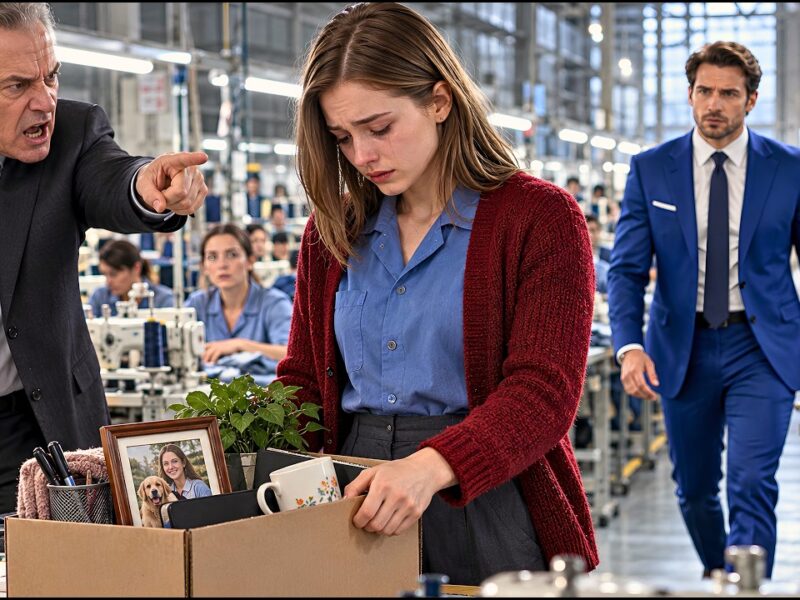
“I Understand… I’ll Pack My Things” She Said After Being Fired Without Warning—Then a CEO Stepped In
The Demonstration
Kora didn’t sleep a wink after Glenn walked down those stairs.
By morning, she had made a definitive decision. There would be no corporate lawyer. There would be no polite, formally drafted company recall letter. She would go to Hatton herself.
Thursday night was mandatory training night at the Hatton volunteer fire hall.
She drove to the plant and packed a portable seam-strength testing rig from her lab. It was a heavy steel frame featuring two vice-grips and a mechanical hand-crank to apply measured tension. She carried it out to the truck. Then, she packed one specific coat from Lot 14—one she had personally failed with her own hands during the initial recovery mission. It was one of the thirty-one defective coats they’d already retrieved from other stations. She had meticulously kept it aside as physical evidence, with the failed seam prominently marked with chalk, and the exact tension failure results recorded in her notebook.
Bram drove.
The rural highway north was pitch dark and arrow-straight. Twenty miles out from Hatton, Kora spoke, staring straight ahead at the headlights cutting through the night.
“Tonight, you do not speak for me,” she commanded.
“Okay,” Bram said softly.
“I mean it,” she turned to look at him. “Not one word.”
The Hatton fire hall sat at the very edge of the small farming town, illuminated by a single, buzzing orange sodium street light. Inside, it smelled intensely of diesel exhaust, damp canvas, and burnt, bitter coffee.
Two massive red trucks gleamed in the bays. A battered coffee urn hissed on a folding table. A dozen volunteer firefighters sat in cheap metal folding chairs, wearing muddy work boots and seed-company baseball caps, waiting for the training meeting to begin.
Vern Odigard, the Chief, stood at the front of the room with his massive arms crossed defensively.
Glenn Rude was already there, standing near the back wall. Word of their arrival had clearly gotten around the small town.
And in the second row, laughing easily at a joke a friend had just told, sat a young, handsome man with his father’s distinct, square jawline. Tanner Rude. He was wearing his brand new, heavy tan Lot 14 coat.
When Kora and Bram walked in, the laughter died instantly.
Glenn stood up from the back wall first. He didn’t need to raise his voice; he was a respected elder in this community.
“Most of you boys have known me since you were in diapers,” Glenn began, projecting an air of calm authority. “This young lady here, Miss Ostby, was let go from the plant for cause. The company is completely fine. These coats passed every legal requirement. You boys waited five years of fundraising for this new gear. And Toliffson’s has been making the safest coats in this valley for sixty years. I’m asking you to trust me on this.”
A few of the older heads in the room nodded in agreement. Trust was currency in a small town, and Glenn had a massive bank account of it.
Kora walked straight to the folding table at the front of the room. Her hands were ice cold, but her movements were precise. She set down the heavy steel testing rig with a loud metallic clank, and laid the marked coat right beside it.
“I’m not here to argue about my job,” she said, her voice ringing clear in the echoing concrete bay. “That’s between me and the company. I’m here about this.”
She picked up the coat and turned the heavy collar back violently so the entire room could see the seam.
“This is exactly where the outer Nomex shell meets the internal moisture barrier liner,” Kora explained, pointing to the stitching. “When a coat gets hot enough—when you’re pushing into a flashover—a good seam holds together. A bad one pulls apart.”
She touched the side of her own bare neck. “And this specific seam sits right here. Right where you can’t see it, and right where you won’t feel the failure until the superheated air hits your skin and it’s far too late.”
The room went completely, unnervingly quiet. You could hear the coffee urn hissing.
“I’ve personally tested thirty-one coats from this exact lot that failed catastrophically,” Kora said. “I haven’t tested yours. I’m not going to stand up here and tell you what I don’t know for a fact.”
She looked directly at Chief Vern Odigard. “But I would like to show you what I do know.”
She clamped the heavy collar of the sample coat into the steel jaws of the testing rig, locking it down tight. Then she stepped back, raising her hands.
“Chief,” Kora said calmly, “would you please turn the crank? I don’t want anyone in this room saying I pulled it too hard, or manipulated the test.”
Vern Odigard looked at her for a long, tense second. Then, his jaw set, he uncrossed his massive arms and walked over to the table. He grabbed the handle of the hand-crank.
He turned it slowly. Click… click… click.
The heavy Nomex fabric tightened between the clamps, stretching taut.
It held.
It held a second longer.
Then, with a sickening, tearing sound that echoed in the silent bay, the seam violently ripped open. The heavy thread snapped, exposing the inner layers. It opened the width of a fingertip. Then wider, revealing a thin, ugly, gaping line right where a man’s vulnerable neck would be exposed to five-hundred-degree heat.
Nobody spoke. The physical evidence was undeniable.
In the third row, a young volunteer named Dale stood up slowly. He couldn’t have been more than twenty years old. He unzipped his brand new Lot 14 coat, shrugged it off his shoulders, folded it carefully, walked to the front, and set it gently on the table right in front of Kora. He didn’t say a single word.
Then another man stood up and removed his coat. Then two more followed.
Then Vern Odigard himself took off his Chief’s coat and laid it heavily on top of the growing pile.
That was when Bram finally spoke. He did not speak to Kora. He stepped forward and addressed the room of firefighters.
“I set the impossible deadline that rushed this lot through production,” Bram said, his voice echoing with profound shame. “That order was entirely mine. And so is the fault.”
He paused, looking at the pile of gear. “By Monday morning, every single one of you will have safe, fully tested replacement gear, even if I have to personally drive across the state and borrow it from departments with spare equipment. Your new coats will cost you nothing. I am not asking anyone in this room to forgive me. I am only asking you to wear something that actually works.”
Glenn Rude stood very still near the back wall. He looked at the torn seam in the rig. He looked at the pile of surrendered coats. Then, he picked up his brown Carhartt jacket and walked out the side door without looking at his son, or speaking a word. A moment later, his truck engine started in the parking lot and sped away.
The pile on the table grew. Thirteen… fourteen… fifteen.
Only one coat remained in the room.
Tanner Rude hadn’t moved from his folding chair. His young face was flushed bright red, and his jaw was locked tight with humiliated anger.
“My dad has given his entire life to that plant,” Tanner spat, glaring at Kora. His voice cracked painfully on the last word. “Twenty-five years. And you come into his town, into his firehouse, and you do this to him in front of everybody he knows?”
Kora didn’t reach for the coat. She didn’t argue the safety specs. She didn’t defend herself.
“I’m not going to take it off your back, Tanner,” she said quietly, her voice full of empathy. “I’m just asking you to do one thing. The next time you’re completely alone at this station… just turn the collar back and look at the seam yourself. That’s all.”
Tanner held her gaze furiously for a moment. Then he looked away, staring at the concrete floor.
Outside, under the buzzing orange street light, the cold bit hard through Kora’s jacket. Bram loaded the fifteen heavy coats into the bed of the pickup truck. When he finished, he came back and stood beside her on the sidewalk.
“That,” Bram said softly, his breath pluming, “was the bravest thing I have ever seen anyone do.”
Kora shook her head, watching her own breath. “Not me,” she said. “Dale. He was the very first one to stand up and take his coat off in front of all his friends and his Chief. That takes real courage.”
Bram looked at her. It was the exact same way he had looked at her standing in the loading dock door on that very first morning.









