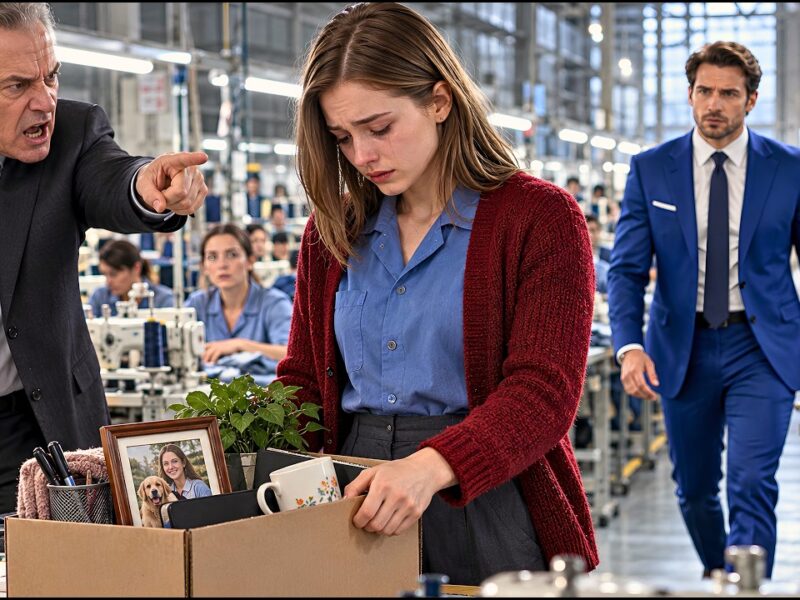
“I Understand… I’ll Pack My Things” She Said After Being Fired Without Warning—Then a CEO Stepped In
The Fire
Two nights later, at 2:07 AM, an old, balloon-frame farmhouse caught fire four miles outside the Hatton city limits. It went up like dry tinder.
At 3:40 AM, Kora’s cell phone lit up vibrantly on her nightstand, buzzing violently. She grabbed it. It was Norma Brekie. Norma’s sister lived in Hatton.
“Kora,” Norma’s voice was shaking uncontrollably through the speaker. “Tanner Rude is in an ambulance. They’re taking him Code 3 to the burn trauma unit in Fargo.”
The details filtered in through the morning news. The farmer’s name was Halvorson. He was eighty-one years old, and in a panic, he had run back into his blazing, smoke-filled house to save his golden retriever. Tanner Rude, arriving on the first engine, had breached the house alone, found the old man unconscious on the floor in the mudroom, and heroically carried him out through a wall of flame.
Halvorson lived. So did the dog.
Tanner came out alive, but he had sustained severe second-degree burns down the entire right side of his neck.
Right along the collar line.
The doctors in the burn unit said he would fully recover with skin grafts, but he would absolutely bear thick, permanent scars for the rest of his life.
Kora drove to the Fargo hospital that morning. She didn’t go to gloat. She didn’t go to be proven right. She went because the profound, sickening guilt of being right was tearing her apart, and she just couldn’t stay away.
Glenn Rude was standing alone in the sterile, fluorescent-lit hallway outside the burn unit ICU. He was still wearing yesterday’s clothes, rumpled and smelling of stale smoke. When he saw Kora step out of the elevator, he looked at her with a look of pure, unadulterated hatred, as if she had personally struck the match and set the fire herself.
Then, he turned his face to the blank cinderblock wall and refused to acknowledge her presence.
She walked back to her car, drove home, and sat in the parked Subaru in the apartment lot for twenty minutes, staring blankly at the steering wheel.
If I had pushed harder, she tortured herself. If I had just physically walked over and taken the coat off his back in the firehouse…
Arless Moe found her crying silently on the apartment stairs an hour later. The retired teacher sat down heavily next to her on the cheap carpet.
“Honey,” Arless said gently, putting a comforting arm around Kora’s shaking shoulders. “You cannot carry other people’s bad choices home with you in a cardboard box. You tried that once already. It’s far too heavy.”
Two days later, Norma called again, whispering from a bathroom stall at the plant.
“The corporate insurance adjusters were in Bram’s office all morning,” Norma reported. “They brought in that slick defense lawyer from Minneapolis. The rumor is they want to settle a massive medical payout with the Rude family quietly. Pay all the hospital bills. Have Glenn sign a non-disclosure paper. Nobody talks to the press. And they specifically want you kept completely out of the negotiations. You’re classified as a ‘former employee with a grievance.'”
Kora hung up the phone. She sat in her kitchen and waited for her phone to ring. She waited for Bram to have the courage to call and tell her the cowardly plan himself.
It didn’t ring.
He came to the apartment in person that night instead.
Frankie was already asleep in her room. Kora and Bram sat at the small, scratched kitchen table under the harsh yellow overhead light.
“Is it true?” she asked, cutting straight to the bone.
“The insurance company advised it,” Bram said, exhausted, violently rubbing his eyes with the heels of his hands. “They said a public trial would bankrupt us. A quiet settlement protects the company from total liquidation. And it protects Glenn from criminal negligence charges.”
“I haven’t asked what the lawyers advised. Have you said yes to it?”
“I haven’t said no.”
Kora leaned forward, her voice dropping to a fierce, terrifying whisper. “Bram. If you pay that family blood money to stay quiet, then next year, the next crew of volunteers in the next small town puts on a turnout coat that hasn’t earned their trust. And nobody tells them why they shouldn’t trust it.”
“We are recalling the lot, Kora.”
“Money does not buy back the right to know what happened,” Kora said, tears welling in her eyes. “Nothing does. I am trying to actually fix this broken system. You are just trying to control the PR damage. That is fundamentally different.”
Bram stood up too fast. The legs of his chair scraped harshly against the linoleum floor.
“I’ve done absolutely everything you asked of me!” he shouted, his frustration finally boiling over. “I drove across the state. I humiliated myself in front of my customers. I offered you your job back. And every single time I try to do the right thing, you treat it like a trap waiting to spring!”
He grabbed his heavy wool coat from the back of the chair and stormed toward the front door. He didn’t finish the sentence.
He didn’t have to. It was exactly, precisely how he had left Anika four years ago. Running away when the moral complexity became too heavy to carry. He knew it before he even reached the freezing parking lot.
Bram sat in the driver’s seat of his truck for forty minutes with the engine turned off. He watched his own breath fog the cold windshield, staring at the illuminated window of Kora’s apartment on the second floor.
Then, he opened the truck door, climbed the freezing stairs again, and knocked.
When she opened the door, he didn’t try to push his way inside. He stood on the welcome mat.
“You were right,” Bram said, his voice thick with emotion. “I was trying to be the CEO and decide how this disaster ends from an office, rather than standing next to you while it burns down.” He swallowed hard. “There will be no quiet settlement. I’ll call the State Fire Marshal’s office myself first thing in the morning. Every single lot of gear we ship this entire year gets an independent, third-party review.”
“That could easily cost you the primary state contract,” Kora warned softly.
“It probably will,” he said, offering a sad, resigned smile.
She stepped aside and opened the door wide, letting him in out of the cold.
A small, sleepy voice came from the dark hallway. Frankie stood in her footed pajamas by the open hall closet. The door had drifted open on its hinges. Seth’s heavy tan turnout coat hung there in the deep shadows, smelling of ash.
“Mama?” Frankie asked, rubbing one eye. “Was Daddy’s coat a good one?”
Kora opened her mouth to speak, but absolutely nothing came out. Her throat seized. Behind her, Bram didn’t say a single word. He understood that some profound questions were simply not his to answer.
Kora walked to her daughter, picked her up, and carried her gently back to bed, singing softly until Frankie fell back asleep.
When Kora came back out to the hallway, Bram was standing there, staring at the open closet, intentionally not touching anything.
Kora reached in and carefully took Seth’s heavy coat off the wooden hanger. She turned the thick Nomex collar back, exposing the stitching.
Inside, written in faded, black permanent marker, Seth had proudly written his own last name. And right under it, small and slightly crooked, was a single, tiny letter: F.
“It stands for Frankie,” Kora whispered, tracing the letter with her thumb, a tear finally escaping and tracing down her cheek. “He wrote it there so she’d be with him. On every single dangerous call.”
Bram stared at the faded ink for a very long time, his eyes shining. “My father did exactly this,” he said softly.
Kora held the collar tightly between her thumbs. And then, for the very first time in three agonizing years of holding the secret, she said the truth out loud.
“The day the warehouse collapsed on Seth’s crew… I was running a stress test in the lab,” her voice was steady at first, until it violently wasn’t. “Company lab rules. Personal phones go in the lockers. No exceptions.”
She looked up at Bram, her face crumpling in profound, ancient grief. “When I came out of the lab an hour later, I had three missed calls. At 4:10 PM. All of them from the dispatch desk at his station.”
Bram didn’t move a muscle.
“I picked running one more stupid, meaningless fabric test over being there for my husband’s last afternoon on earth,” she whispered, burying her face in the heavy coat. “And then, three years later, that exact same company fired me for caring too much about the tests.”
Bram didn’t offer a hollow platitude. He didn’t tell her it wasn’t her fault, because logic doesn’t cure grief. He didn’t try to fix it. He just stepped forward, wrapped his arms around her, and held her tightly in the narrow hallway beside the open closet, until her shoulders finally stopped shaking.









