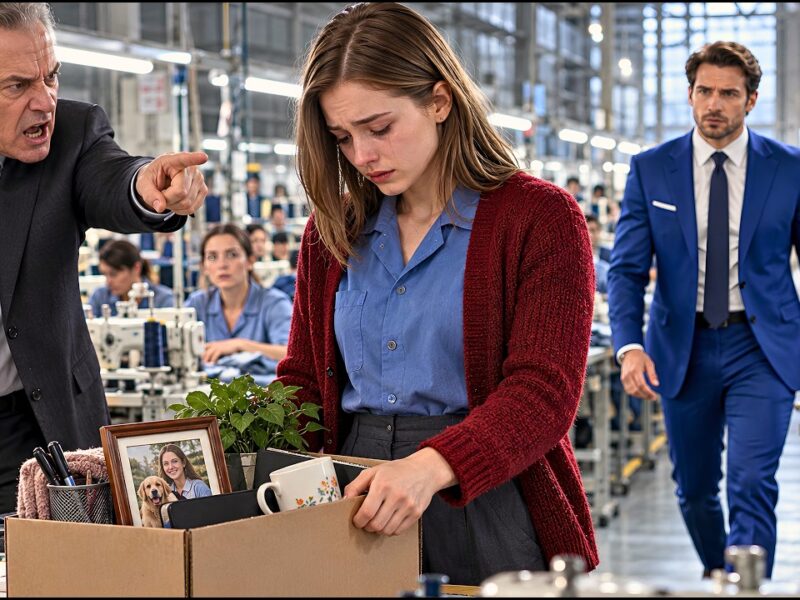
“I Understand… I’ll Pack My Things” She Said After Being Fired Without Warning—Then a CEO Stepped In
The Valley
The land of the Red River Valley was punishingly flat and endless. Giant concrete grain elevators stood on the distant horizons like massive, brutalist church steeples. They drove through Casselton, Hillsboro, Portland—small, proud agricultural towns where the volunteer fire hall was also the municipal polling place, the Friday night bingo hall, and the host of the annual pancake breakfast.
The first Fire Chief they visited did not want to give anything back.
He was a burly farmer with a thick mustache, and he stood in the bay of the Casselton firehouse with his arms aggressively folded across his chest.
“Five years,” the Chief grumbled, glaring at Bram. “Five years of community pie sales and car washes to buy these coats for my boys. First new thing my guys have ever had that wasn’t a ragged hand-me-down from a city department.”
“You’ll get brand new ones, Chief,” Bram promised, his voice steady and respectful. “At absolutely no cost to the department. I give you my personal word.”
The Chief snorted skeptically. He turned his gaze to Kora, looking her up and down. “And you? You’re backing his word?”
“I don’t promise anything,” Kora said flatly. “I haven’t checked them yet. Let me check.”
She walked over to the metal rack where the heavy tan coats were hung. She didn’t use a magnifying glass. She didn’t use any tools. She simply took the collar of the first coat, turned it back sharply, bent the heavy Nomex seam between her thumbs, and ran her bare fingertips along the stitching. She felt the tension in the thread the exact way some people read Braille.
She worked rapidly down the line. Good coats were tossed to the left pile. Bad ones were tossed to the right.
Bram stood by the truck and watched her work. He realized, with a sudden pang of deep embarrassment, that he had not stood on his own sewing floor and watched an inspector work in years. He signed multimillion-dollar contracts for these coats. But she knew exactly what was inside them. She knew their anatomy.
By the third day on the road, they had developed a silent, efficient routine.
Bram practically lived on lukewarm gas station burritos and black coffee. Kora ate carefully packed sandwiches from home and pretended not to notice his horrific diet.
On the third morning, as they merged onto Highway 81, she silently handed him a brown paper bag. Inside was a turkey sandwich on wheat bread, a crisp Honeycrisp apple, and a homemade chocolate chip cookie.
He took it slowly, looking at the bag carefully as if it might be a psychological test.
“It’s a sandwich, Bram,” Kora said, staring out the window at the passing snow-covered fields. “Not a contract.”
He almost smiled.
In the cab of the truck, Kora kept her meticulous testing notes in a spiral-bound notebook. The pages were bristling with brightly colored plastic tabs.
“Blue tab means the coat passed,” she explained, organizing the pages on her lap. “Red means it failed the stress test. Yellow means I’m unsure and I’m sending it back to the lab for a machine pull.”
Bram glanced over at the colorful tabs. “Frankie set that system up, didn’t she?”
“She did,” Kora said softly. “She uses them for her second-grade school projects. She told me that grown-ups need bright colors too, or they forget things that are important.”
Bram was quiet for a long mile, the tires humming against the cold asphalt.
“My dad used to write names inside the collar,” Bram said quietly, his eyes fixed on the road ahead. “The very first turnout coat he ever made, he wrote the firefighter’s name inside the collar in his own handwriting with a permanent marker. He always said that if you knew exactly whose neck the coat was for, you’d sew the seam better.”
He looked out at the endless, frozen fields. “We got too big. We stopped doing that a long time ago.”
Kora didn’t answer him. She turned her head and stared out the passenger window, thinking about another turnout coat, hanging in another dark closet, with a small, crooked letter ‘F’ written in marker on the collar.
Thirteen fire halls in four days. They recovered one hundred and ninety-six coats. The vast majority of them were structurally sound. But thirty-one of them had the exact same fatal flaw in the collar seam. Thirty-one coats that would have failed catastrophically in a flashover.
They were leaving the Mayville fire hall at dusk on the fourth day when the wind suddenly came up out of the west.
It wasn’t snow falling from the sky. It was snow actively moving. The brutal wind was lifting the powdery snow directly off the harvested fields and pouring it horizontally across the highway until the hood of Bram’s truck completely disappeared into a terrifying whiteout.
Highway 200 was officially closed by the State Patrol within the hour.
They spent the night stranded in the Mayville fire hall. They sat at a folding table with three bored volunteers, a constantly brewing coffee urn, and a greasy deck of playing cards that was missing the seven of clubs.
At 8:00 PM, Kora used the station’s landline to call home, so Frankie could say goodnight to Pickles the cat.
After assuring her daughter that she was safe, Frankie asked a question. “Is the coat man there?”
Kora hesitated, glancing across the room at Bram, who was shuffling the cards. She held out the receiver. He took it, looking confused.
“Hi, Frankie,” Bram said into the phone.
“Do you know any stories?” Frankie’s voice was tiny and tinny through the receiver.
Bram smiled. So, sitting in a freezing fire hall in the middle of a blizzard, the CEO of Toliffson Protective Apparel told a seven-year-old girl a story. He told her about his grandfather, Sig Toliffson, an immigrant tailor who stood outside a burning grain elevator in 1962 and watched the brave local volunteers go inside wearing cheap canvas coats that caught fire at the cuffs. He told her how his grandfather went home that very night, furious, and started sewing vastly better, fire-resistant coats on his wife’s own kitchen table.
“Did they work?” Frankie asked.
“They did,” Bram said, his voice thick with pride. “They worked perfectly. He kept making them until he was eighty years old.”
Across the room, Kora listened to the exchange, her coffee going cold in her hands. Something hard and frozen inside her chest gave a little, shifting like ice on a river. She didn’t want it to. She aggressively tried to freeze it back in place.
Later, after the local volunteers had dozed off on cots set up by the idling firetrucks, Kora and Bram sat alone on a wooden bench in the dark, cavernous truck bay, listening to the wind howl violently at the massive corrugated steel doors.
“Why did you really come to my door that night?” she asked quietly into the dark. “You’re a CEO. You could have just sent a lawyer with a non-disclosure agreement and a check.”
He didn’t answer right away. He stared at the gleaming red bumper of the fire engine.
“It wasn’t only about recovering the defective coats,” he admitted softly. “I watched you put that badge on Glenn’s table. You didn’t say one single word in your own defense. You didn’t argue. You didn’t beg for your job. You just set it down like your integrity mattered infinitely more than your paycheck did.”
He looked down at his hands. “I haven’t been able to stop thinking about it.”
Kora didn’t answer him. But she didn’t move away from him on the bench, either.









