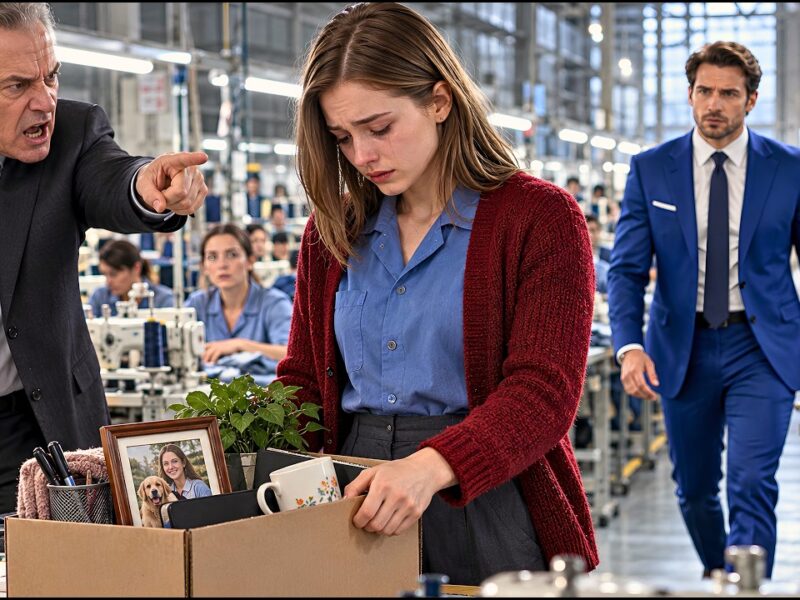
“I Understand… I’ll Pack My Things” She Said After Being Fired Without Warning—Then a CEO Stepped In
The Reckoning
Two days later, Kora called the burn unit at the hospital to ask the floor nurse how Tanner was doing.
The nurse cheerfully reported that the skin grafts were taking well and he was improving rapidly. Then, she casually added something else.
“Oh, and his firefighting gear is gone from the patient belongings bin,” the nurse said, checking her chart. “His father, Glenn, signed the bag out late last night and took it home.”
Kora’s stomach dropped like a stone into an icy lake.
Without that specific, fire-damaged coat, the Fire Marshal had no physical evidence. Nobody could legally prove what had catastrophically failed and caused the severe burns to that boy’s neck. It would be her unverified word against Glenn’s pristine, twenty-five-year reputation again.
That evening, her phone buzzed on the kitchen counter. It was an unknown number.
GLENN RUDE. PLANT. 6:00 AM TOMORROW. COME ALONE, PLEASE.
Kora showed Bram the text message that night. Every protective instinct in his body demanded he march into the plant with her.
“I’ll be in my truck in the parking lot,” Bram said instead, respecting her fierce independence. “I won’t come inside the building unless you call my phone.”
At 5:55 AM, the massive production floor of Toliffson Protective Apparel was full. It was the morning shift change. Operators from both lines were mingling on the floor, holding Styrofoam coffee cups, chatting loudly over the hum of the idling machines.
Glenn Rude stood alone by the massive fabric cutting table in the center of the room. Folded carefully over his arm was a charred, soot-stained turnout coat. Tanner’s coat.
The cavernous room went completely, dead quiet the absolute moment Kora Ostby walked through the double doors.
Glenn stepped forward. He spoke to her first, his voice so low and broken that only she could hear it.
“Tanner woke up from the painkillers last night,” Glenn whispered, a tear escaping his eye. “He looked right at me through the bandages, Kora, and he said two words. He said, ‘You knew.’”
Glenn’s voice broke completely on a sob. “I haven’t slept a minute since.”
Then, Glenn turned his back to Kora and faced the sprawling production floor.
“I shipped Lot 14 out to the departments before the mandatory retesting was done!” Glenn shouted, his voice echoing off the high steel rafters, loud enough for every single employee to hear clearly. “I was terrified of missing the CEO’s deadline, and I was even more terrified of admitting to the front office that I’d signed off on a bad batch too early to save money.”
He turned back and looked straight at Kora. “I fired Kora Ostby because she wouldn’t lie to cover my mistake. And I told the Hatton Fire Chief—a town I’ve lived in my entire life—that she was just a bitter widow. And I almost killed my own son because of my pride.”
He spread the charred, soot-stained coat across the cutting table. He deliberately turned the collar back for the entire floor to see.
The seam was violently ripped open. The edges of the Nomex were scorched a brittle, ugly brown where the superheated air had penetrated the shell.
He held the coat out. Not to the shift managers, not to HR. He held it out to her.
Kora stepped forward and took the heavy coat with both hands.
At her sewing machine in the second row, Norma Brekie stood up. She looked terrified, but she stood tall.
“I saw them load that freight truck on Friday night,” Norma called out, her voice echoing. “And I kept my mouth shut because I was scared of losing my insurance.”
Then, a young cutter at the next table stood up. Then two more seamstresses. Then a few more, until half the floor was standing in silent solidarity.
Kora pulled her phone from her pocket and sent one single word to Bram in the parking lot.
COME.
Bram walked in through the loading dock doors a minute later. The crowd parted for him.
Glenn walked up to the CEO and handed him a sealed white envelope. His formal resignation.
“I already called the State Fire Marshal’s office this morning,” Glenn said, his voice exhausted but remarkably peaceful. “I’m driving down there to give them a sworn statement this afternoon. All of it. I’ll take whatever charges they bring.”
Bram looked at the man who had taught him how to ride a bike without training wheels. The man who had carried his father’s casket. Then, he held out his hand.
Glenn took it. They shook firmly. Neither of the men tried to hide their tears from the watching factory floor.
Epilogue: Inspected By
The State Fire Marshal’s rigorous investigation officially confirmed the catastrophic safety failure in the thread tension. Glenn Rude’s resignation became permanent, and he quietly moved out of state, never managing another production line again.
Toliffson Protective Apparel paid every single one of Tanner Rude’s agonizing medical bills and skin-graft surgeries openly, writing the checks without demanding a single confidentiality agreement in return. Every turnout coat shipped to any department that year was recalled and replaced with meticulously tested gear at the company’s sole expense.
And one Monday morning, standing in front of the exact same production floor that had watched her carry a sad cardboard box out the door, Kora Ostby’s firing was officially, publicly reversed.
An independent oversight panel, formed in the wake of the scandal, hired her as the absolute Head of Quality Assurance. Bram deliberately stepped completely out of every single executive decision regarding her performance reviews, her department budget, and her pay scale, removing any conflict of interest.
Kora had set only one, non-negotiable condition of her own before signing the contract.
“I have the absolute authority to stop any lot, at any time,” she told the board. “Any lot. No matter how much it costs, and no matter whose executive deadline it is.”
The panel agreed unanimously.
What came next between Kora and Bram was slow, careful, and beautifully ordinary.
It was sharing bowls of hot soup at a small cafe on Broadway. It was taking long, quiet walks along the frozen banks of the Red River, their breath hanging in the air together. It was drinking terrible concession-stand coffee in the freezing lobby of the local ice rink while Frankie wobbled joyfully through her beginner skating lessons.
Frankie was cautious at first.
One afternoon, she brought home a crayon drawing from art class titled My Family. It featured Mom, Frankie, and Dad, drawn heroically in his yellow fire helmet. Halfway home in the car, Frankie quietly crumpled the drawing up and shoved it in her pocket.
At bedtime that night, as Kora tucked her in, Frankie finally asked the heartbreaking question hiding underneath the crumpled paper.
“Mom? If I like Bram… will I forget Daddy?”
Kora sat on the edge of the bed and gently smoothed her daughter’s hair. “No, baby. Loving someone new doesn’t ever change how much you remember someone old. You don’t replace them. You just make your heart a little bigger to make more room.”
Then, a month later, Bram broke his very first promise to Frankie.
He had sworn he would leave work early to come to Frankie’s second-grade winter choir program. But a critical seam-sealer machine went down catastrophically on the second shift, halting the entire line, and as CEO, he stayed to manage the crisis. By the time he sprinted into the school gym, breathless and sweating in his suit, it was entirely empty. The folding chairs were already being stacked.
The next day, sitting in Kora’s kitchen, he frantically started talking about planning a massive, expensive weekend outing to a waterpark in Minneapolis to make up for his absence.
“She doesn’t need a bigger apology, Bram,” Kora said gently, pouring him a cup of coffee. “She just needs a true one.”
So, Bram walked into the living room, knelt down on the carpet in front of Frankie, looked her right in the eyes, and told her the plain truth. He told her he had wrongly chosen managing the plant over attending her program, that it was a terrible decision, and that he was incredibly sorry. He didn’t offer a toy, and he didn’t ask her to say it was okay.
Three weeks later, at the school’s Class Reading Night, Bram arrived ten minutes early. He folded his long, suited frame uncomfortably into a tiny plastic chair built for an eight-year-old, and listened with rapt attention as Frankie proudly read her entire four-page report on the nesting habits of bald eagles. Every single page.
On a rainy Saturday, Frankie handed him a heavy, flat cardboard box from a discount store. It was a cheap, particle-board bookshelf for her growing collection of library books.
“I’m actually terrible at this,” Bram admitted, staring at the bag of wooden dowels and confusing diagrams.
“That’s okay,” Frankie said confidently, patting his arm. “I’ll read you the instructions.”
They accidentally put the second shelf in completely upside down. They laughed, took it entirely apart, and fixed it together. Kora leaned against the doorframe, watching them. It wasn’t the fixing of the shelf that made her heart swell. It was how effortlessly Bram allowed himself to be unsure, to be a student, in front of her daughter.
That winter, Bram finally stopped sleeping at the plant. The canvas folding cot was donated to the Hatton fire hall for the exhausted overnight crew.
On a quiet Sunday in March, Kora came out of the kitchen with a plate of toast and stopped dead in her tracks.
Frankie stood in the hallway with the closet door wide open. She had dragged Seth’s heavy tan turnout coat off its sturdy wooden hanger. It pooled around her small, slippered feet like a massive, protective tent.
She looked up at Bram, who was standing nearby holding his car keys. “Do you know how to check if a coat is good?” Frankie asked him.
Bram didn’t answer. He looked over at Kora. This sacred question had never been his to answer.
Kora set the plate down on the hall table. For three years, she had been quietly terrified of this exact moment. She walked slowly into the hallway and knelt on the carpet beside her daughter and the heavy coat.
They checked it together on the hallway floor. Collar to cuff. Every single heavy Nomex seam. Kora showed Frankie exactly how to bend each seam aggressively between her small thumbs, feeling for weakness. Frankie did it with her tongue poking out between her teeth, taking the job very, very seriously.
When they reached the final reflective cuff, Kora sat back on her heels.
“It was a good coat,” Kora whispered, fighting tears. “It did everything it was engineered to do to keep him safe.”
Frankie looked up, her brow furrowed in innocent confusion. “Then why did Daddy’s heart stop?”
“Baby, it wasn’t the coat,” Kora said, pulling Frankie into a fierce hug. “It wasn’t anybody in the world being careless.” She swallowed hard, letting go of the burden she had carried for three years. “And it wasn’t anybody’s job to save him.”
She was saying the last part entirely to herself.
She found a black permanent marker in the kitchen drawer. She walked back, turned the heavy collar back, and under Seth’s name and the small, crooked ‘F’, she wrote in careful, block letters: INSPECTED BY: K.O.
That night, Frankie asked if Daddy’s good coat could live in her own closet instead of the hallway. It hangs there still.
One year after the terrible morning in the glass office, it was October again.
Toliffson Protective Apparel had indeed lost the massive state contract, and the company was still slowly, painfully climbing out of that financial hole. But the volunteer fire departments across the tri-state area trusted the brand again with their lives. Because when a Chief had a question about safety, they could bypass sales and call Kora Ostby directly. And inside every single new collar that left the shipping dock, there was now a printed line: INSPECTED BY:, with a real, human signature written in ink underneath it.
Norma Brekie confidently ran a brand new, open-door safety grievance line on the production floor without fear of retaliation. Arless Moe had officially named herself the Honorary Chief Inspector of Frankie’s math homework.
Tanner Rude’s neck had healed beautifully, leaving a pale, jagged scar that he proudly didn’t bother to hide with a turtleneck. He was back riding the trucks on Hatton’s volunteer crew, wearing a coat that Kora had personally stress-checked by hand.
In late August, a postcard had arrived at the plant addressed to the QA department. The message was brief: I bent the collar like you said. Thank you. T.R.
Glenn Rude worked a quiet, part-time job stocking shelves at the local farm supply store in Hatton. Now, when the fire pager went off in the middle of the night, Glenn drove the slow, heavy water tanker truck for the volunteers, staying safely back from the flames. He had never asked a single person in town to forgive him. He simply showed up and did the work.
On Seth’s birthday, Kora and Frankie drove to the cemetery and placed bright yellow sunflowers on his grave. They sat in the grass and talked to him for a while about school and the changing leaves. Then, they went home and baked his favorite tater tot hotdish for dinner, making sure to put entirely too much cheese on top, exactly the way he liked it.
Bram came over for supper afterward. Only supper. He knew the morning belonged entirely to the two of them, and he never once tried to make it otherwise or insert himself into their grief.
In late October, the Hatton Fire Hall held its annual chili and soup supper to raise funds for the expensive extrication equipment the department still couldn’t afford.
Bram stood behind the serving line, ladling spicy chili into bowls while wearing a borrowed, flour-dusted apron. Frankie manned the dessert table, aggressively selling slices of cherry pie and making change from a metal cash box like a seasoned banker.
Chief Vern Odigard tapped a metal spoon against his ceramic coffee cup to quiet the noisy bay.
“Toliffson’s replaced all our gear this year,” Vern announced into a microphone, his voice booming over the crowd. “For absolutely free. And they sent a lady who personally checked every single stitch to make sure my boys come home to their families.”
The whole hall erupted in genuine, thunderous applause. Kora, standing near the chili pots, wanted nothing more than to sink through the concrete floor in embarrassment.
Near the end of the serving line, Glenn Rude walked in from the cold. He had his farm store cap clutched tightly in his hands. He didn’t ask for a microphone. He didn’t try to make a grand, redemptive speech to the crowd.
He walked up to the soup line. “Could I buy a bowl of chili from you, Kora?” he asked quietly, his eyes fixed on the ladle.
Kora looked at the broken, humbled man for a long moment.
“Yes, Glenn,” she said gently, filling a bowl. “You could.”
They sat across from each other at the same long, crowded folding table. They didn’t say much to each other. They didn’t need to. It was enough.
Later, outside in the parking lot, standing under the exact same buzzing orange street light as that terrible night with the seam-testing rig, the autumn cold came down clean and sharp.
Bram turned to face her, his breath pluming in the air.
“I love you,” Bram said.
Just that. No elaborate corporate plan behind it. No timeline. He wasn’t asking her for a ring, or a promise, or anything at all. It was just a fact.
Kora looked up into his tired, kind eyes.
“I love you too,” she said, pulling her coat tighter against the wind. “And I want you to know something important, Bram. I didn’t go back to work at that plant because of you. And I didn’t fall in love with you because you graciously gave me my job back.”
She reached out and took his cold hand, her voice softening. “I fell in love with you because you finally learned how to stay.”
Back at the apartment, Frankie fell asleep on the living room couch, completely exhausted, with a few stray crumbs of pie crust still clinging to her favorite sweater. Bram gently scooped her up and carried her into her bedroom, tucking her under the heavy quilt.
Then, acting out of old, ingrained habit, Bram walked to the entryway, reached for his heavy wool coat, picked up his keys, and started quietly gathering his things to leave.
A sleepy, muffled voice came from the dark bedroom doorway.
“You don’t have to pack your things,” Frankie mumbled, rubbing her eyes. “You can just come back tomorrow.”
Kora leaned against the kitchen counter and laughed. And then, somehow, she was crying a little bit, too.
Bram looked at the little girl standing in the doorway, his keys dangling uselessly from his hand. He slowly dropped them onto the entryway table.
“I’ll be here,” Bram promised.
And he was. Because that was exactly who he was now.
Kora stood in the kitchen and thought about the terrified, desperate woman who had walked out of that glass room exactly one year ago. A cardboard box balanced on her hip, completely devoid of any idea how she would possibly hold her daughter’s fragile world together for another month.
Now, she had her good name back. She had incredibly important work that she had actively chosen. She had a bright daughter who felt safe enough to sleep deeply again. And she had a man standing in her hallway who understood, finally, that simply showing up mattered vastly more than being impressive.
The next Tuesday morning, it was sleeting violently, identical to that terrible day a year ago.
Kora carried the old, battered cardboard box down the apartment stairs to the curb. It was the same box that had once held a chipped mug, a framed photograph, and a calendar covered in purple stars. She flattened the cardboard with the heel of her boot and set it neatly out with the morning recycling.
She stood there on the sidewalk for a moment in the biting cold, letting the sleet hit her face.
Then, she turned and walked back inside, climbing the stairs to the warm apartment where Bram had arrived early to drive Frankie to school, the way he reliably did every single Tuesday.
Now, the two of them were sitting at the kitchen table, engaged in a highly serious, fierce debate about whether pancakes legally counted as a vegetable serving if you put enough blueberries inside them.
A year ago, the phrase I’ll pack my things had meant a devastating retreat, a forced exit from a place that had callously turned her away.
Now, standing in her kitchen listening to them laugh, there was absolutely nothing left in her life to pack away in a box. And there was absolutely nowhere else on earth she would rather be.









