Medieval Survival In Winter — Why Their Villages Remained Warm Against All Odds
The Woven Fortress
Elara pulled the heavy wooden shutters closed, plunging the interior of their cottage into shadows, save for the orange glow of the central hearth.
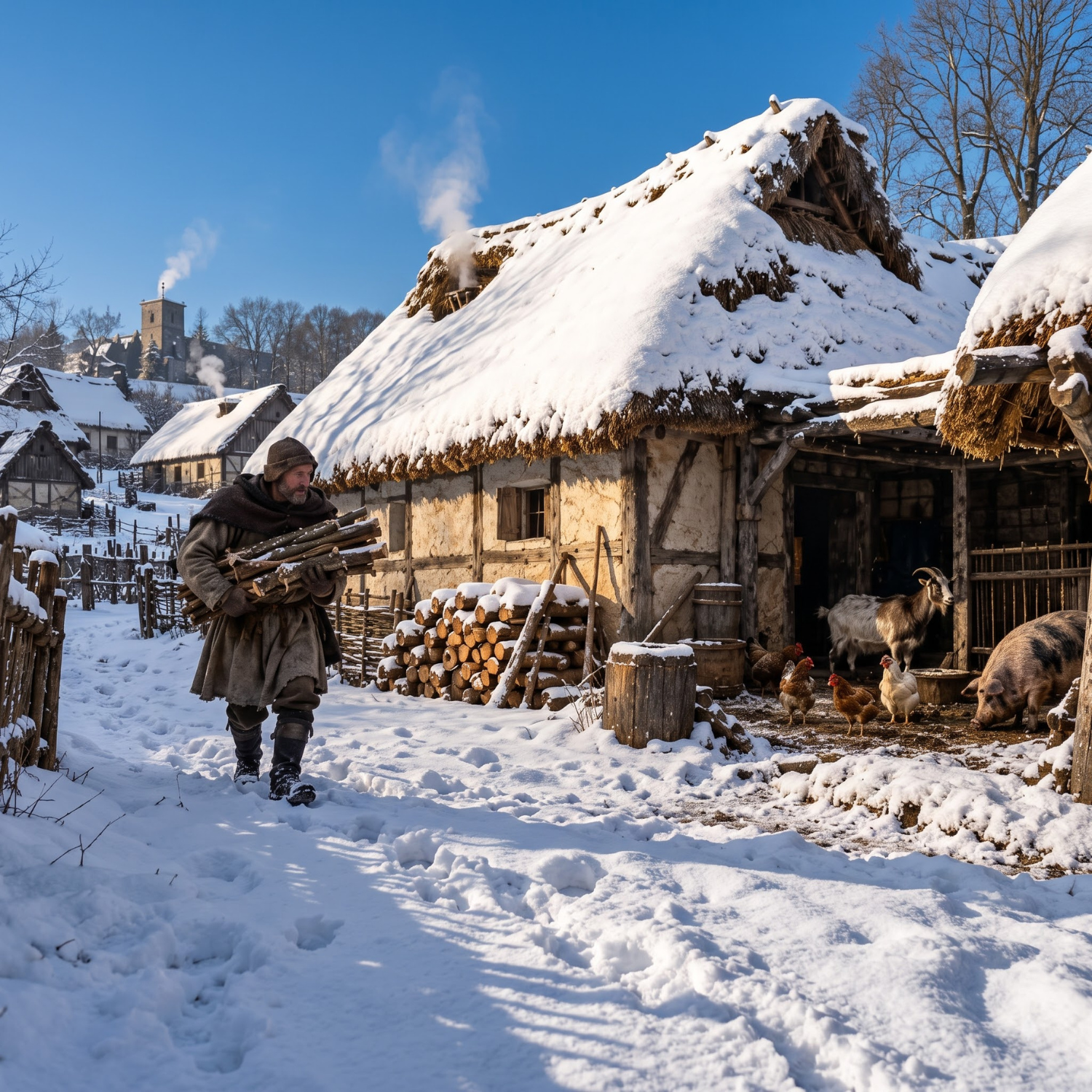
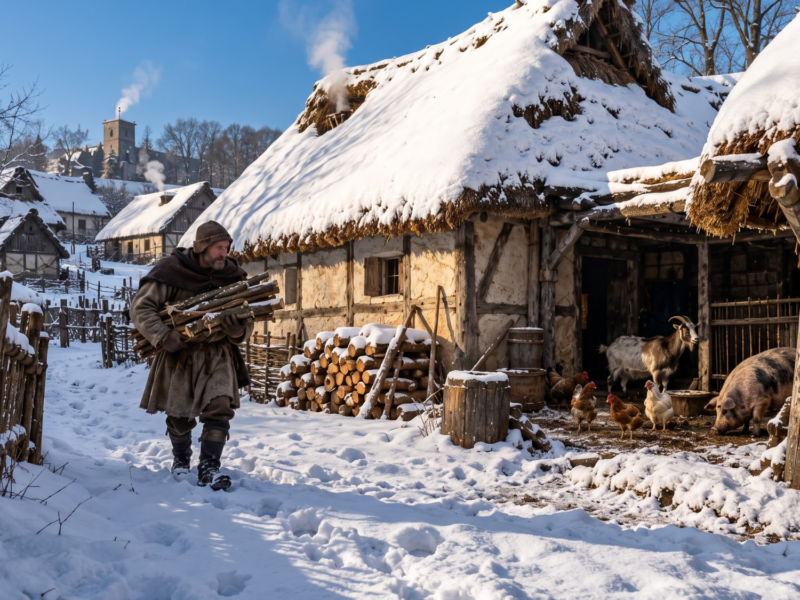
Their home, known as a longhouse, was not a place to escape nature; it was a vessel designed to harness it. It measured thirty feet in length, built upon a skeleton of massive cruck beams—great curved timbers of oak that arced from the soil to the roof ridge in a single, unbroken sweep. Between these ribs, Kaelen had woven thin strips of hazel and willow, a skeletal lattice known as wattle. Over this, they had smeared daub—a thick, visceral paste of river clay, straw, and cattle dung. Cured by the summer sun, it had hardened into a windproof shell.
Above them, the roof was a masterpiece of engineering. Layers of overlapping reeds, meticulously thatched and steeply pitched, shrugged off the torrential rains and held the heat of the house captive. In the stone-rich lands of France, men might build with mortar and rubble, and in the deep snows of Germany, roofs were pitched even steeper to shed the crushing weight of snow, but here, the thatch was their crown and their shield.
The house was one single room. There was no privacy, but privacy was a luxury that produced no heat.
“Bring her in, Bran,” Elara called out to her eldest son.
The timber door groaned open, and a blast of arctic air swept in, quickly followed by the heavy, lumbering forms of their two oxen, a milk cow, and three pigs. In the longhouse, the beasts lived just a wattle partition away from the family. It was an arrangement born of pure necessity. The animals were safe from the wolves that howled in the timberline, safe from desperate thieves, and most importantly, they were living furnaces. The immense body heat radiating from the cattle measurably raised the temperature of the human living quarters. The air was thick with the scent of damp wool, manure, and earth, but to Elara, it was the smell of survival.
At the center of their universe lay the hearth. It was an open fire built upon a platform of flat stones directly on the floor. There was no chimney. The towering stone flues of the wealthy manors were a century away from reaching the peasantry. Instead, the smoke rose lazily into the rafters, filtering through the thatch or escaping through a small, louvered opening in the roof—a smoke hole that Kaelen could adjust with a pole to control the draft.
To aid the draw, Kaelen had fashioned a hood of timber and daub suspended above the flames, funneling the worst of the gray plumes upward. Yet, a constant, oppressive haze hung at head-height. The smoke stung their eyes and settled deep in their chests. (Centuries later, the skeletal remains of villagers like Elara would show the dark, scarred evidence of this lifelong exposure).
But the fire was life. As the night deepened, Elara carefully banked the coals beneath a mountain of gray ash. The fire must not die. Relighting it in the dead of winter with nothing but flint, steel, and numb fingers was a desperate struggle. If a household’s fire went out, they were forced to trudge through the snow to a neighbor’s door, begging to borrow a burning ember in an iron pot.
As she tucked her youngest daughter, Lyra, into a bed of straw covered in coarse blankets, Elara listened to the wind clawing at the thatch. The house was holding. The first line of defense was secure.