Medieval Survival In Winter — Why Their Villages Remained Warm Against All Odds
The Lord of Misrule
The Church understood the darkness. The calendar of the faith was a psychological map designed to navigate the abyss of winter.
For the four weeks leading up to Christmas, the village observed Advent. It was a solemn period of fasting and restricted diets. While it was framed as spiritual purification, it served a profound agricultural purpose. By fasting in December, the village stretched its precious food stores, conserving the salted meats and hard cheeses during the darkest, most stagnant part of the year.
But as the days reached their absolute shortest, the restriction shattered into glorious excess.
Christmas arrived, heralding a twelve-day reprieve from labor. From December 25th to the Epiphany on January 6th, the grinding machinery of feudal life ground to a halt.
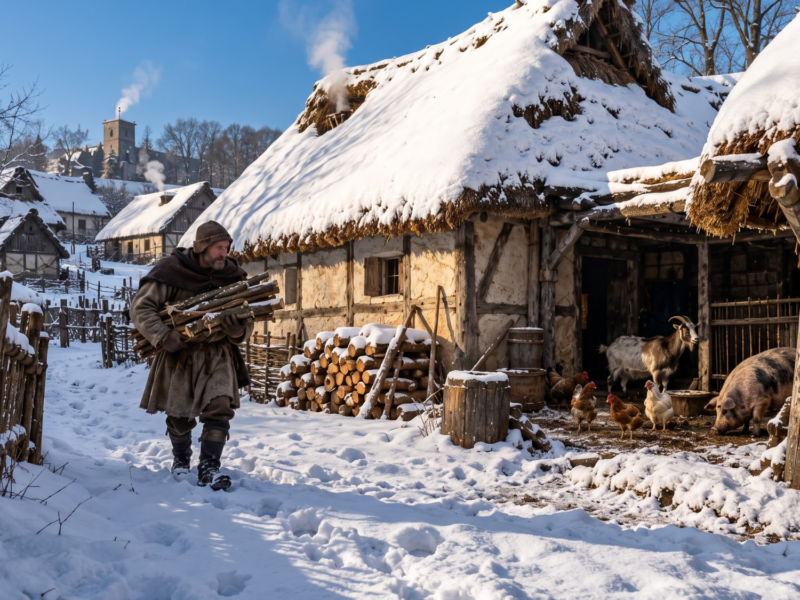
Kaelen hauled a massive section of an oak trunk into the house—the Yule log. Placed at the back of the hearth, it was lit on Christmas Eve and meticulously tended to burn slowly, steadily, for the entire twelve days. It was a beacon of light in the heart of the dark.
The manorial custom of Oakhaven required the baron to provide a feast for his tenants. It was a legally binding obligation, recorded in the manor’s rolls with exact precision. As a herdsman, Kaelen was owed a massive loaf of white wheat bread and a large dish of roasted venison. Even his sheepdog was written into the law, receiving its own coarse loaf of bread on Christmas Day.
For twelve days, the world turned upside down.
Laughter echoed in the smoky longhouse. Villagers engaged in mumming, donning bizarre masks of animal skulls and straw, moving from door to door in the snow, performing bawdy plays and singing in exchange for cups of strong ale and sweet cakes.
In the village square, they appointed the “Lord of Misrule”—a lowly peasant chosen to preside over the festivities. For a few brief, shining days, the poorest man wore a mock crown, commanding the revelers and playfully mocking the rigid social hierarchy that bound them the rest of the year.
It was a vital release valve for the soul. The twelve days of Christmas broke the agonizing monotony of winter. It provided a beacon to look forward to in November, and a memory to carry them through the bitter, lean months of February and March.
On Twelfth Night, they feasted one last time, drinking the last of the special strong ale. The next morning, the Yule log was nothing but white ash, the Lord of Misrule was a peasant once more, and the grim reality of survival resumed.









