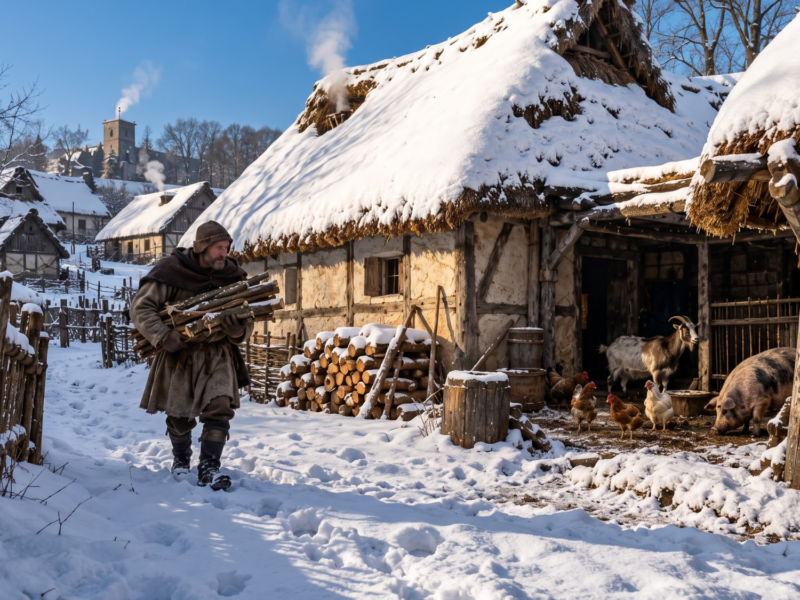
Medieval Survival In Winter — Why Their Villages Remained Warm Against All Odds
The Rains of Ruin
For years, the system held. The wattle kept out the wind, the salt preserved the flesh, the wool held the heat, and the ale kept away the sickness. It was a masterpiece of human resilience.
But a system is only as strong as the world it is built upon.
In the spring of 1315, the sky turned the color of bruised iron, and the rain began to fall.
It rained through May. It rained through June. The rivers swelled, choking the fields in freezing mud. The hay, which needed the fierce summer sun to dry, lay rotting in the meadows, turning into a black, foul-smelling slime.
Elara watched from the doorway of the longhouse, a knot of pure terror tightening in her chest.
When autumn arrived, there was no harvest. The grain had rotted on the stalk, turning black with toxic ergot. Because the hay had failed, Kaelen was forced to slaughter almost the entire herd of cattle. But without the grain, there was no bread. Without the sun, the salt pans on the coast flooded, and the price of salt skyrocketed beyond their reach. The meat they slaughtered could not be preserved; it spoiled in a matter of days.
The wet, freezing conditions brought the murrain—a horrific cattle disease that swept through Northern Europe, wiping out eighty percent of the livestock that had survived the initial culls.
The winter of 1315 was not a test of their engineering. It was an apocalypse.
The price of grain rose so sharply that it became a myth. The granaries, raised on their staddle stones, sat empty. The ale soured, then ceased to be brewed at all. The rushlights burned out, and there was no fat left to make more.
Elara and Kaelen boiled bark and shoe leather. They dug through the snow for frozen, rotting roots. The Great Famine had begun.
It rained again in 1316, doubling the nightmare. Chroniclers in the great cities wrote of horrors that broke the mind—of parents abandoning children in the forests, of the dead stripped of their wool in the streets, of the unspeakable, whispered rumors of cannibalism in the deepest, most desperate hamlets.
By the time the weather finally broke and recovery began in 1322, between ten and fifteen percent of Europe lay dead. The survivors, generationally weakened and malnourished, would face a far more terrifying reaper—the Black Death—just three decades later.
Epilogue: The Architects of the Earth
The Great Famine proved a terrifying truth: the medieval winter system was not inherently fragile. It was, in fact, incredibly robust. But it was entirely dependent on the grace of the earth to provide the raw materials. When nature withheld the grain, the hay, and the sun, all the engineering in the world amounted to nothing.
But in the years before the rain, and in the years that followed the recovery, the system worked.
In ordinary years, Elara’s house held its heat. The banked embers glowed safely through the long, sixteen-hour nights. The salted beef and the hard cheese lasted until the spring thaw. The lanolin-rich wool deflected the biting winds. And the Lord of Misrule danced by the light of the Yule log, chasing the shadows of despair away.
Surviving the dark ages was never merely a matter of luck, nor was it simple, brutish endurance. It was the result of thousands of brilliant, quiet decisions made months in advance. It was skills passed from mother to daughter, father to son, practiced with desperate precision every year.
It was an overlapping symphony of architecture, agriculture, and faith, refined over centuries to master a season that, without their brilliance, would have killed them all.









