Medieval Survival In Winter — Why Their Villages Remained Warm Against All Odds
The Law of the Woods
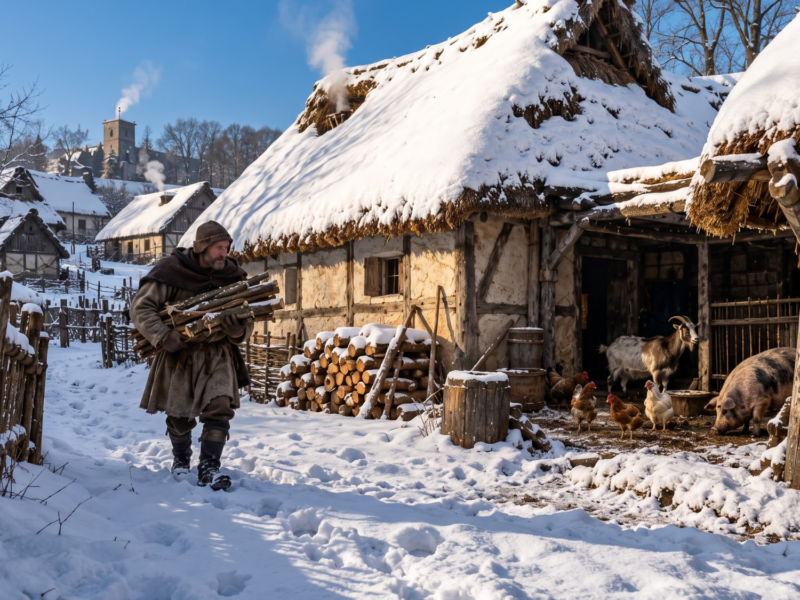
The next morning, Kaelen prepared to enter the forest.
The fire needed wood, but the forest did not belong to them. The sprawling woods of Oakhaven were the hunting reserve of the local baron, governed by draconian Forest Laws. Every branch taken was a matter of high legal consequence, debated in the manorial courts.
Kaelen slung a rope over his shoulder. He was exercising estovers, specifically firebote—the ancient, customary right of the peasantry to gather deadwood.
“Mind the bailiff,” Elara warned, handing him a skin of ale.
“I only take what has fallen, or what I can snap by hand,” Kaelen grunted. “I know the law.”
The tension in the village was palpable. The bailiffs patrolled the woods, ever watchful for a peasant who dared to fell a living tree or cut undergrowth that protected the lord’s deer. In wetter regions to the north, families exercised turbary rights, cutting bricks of peat from the bogs to burn. But here, they relied on the dead branches of the oaks. If a lord ever revoked these customary rights, the village would freeze. The woodland was a battlefield of legal privileges, where a single misstep meant a crippling fine or a severed hand.
While Kaelen braved the bitter cold of the woods, Elara began the daily labor of brewing.
She stood over a massive iron cauldron, mashing malted barley into hot water. Almost no one in the village drank plain water. The rivers and wells were teeming with invisible sickness. Though they did not understand the science of pathogens, they understood the results.
Instead, they drank ale.
It was thick, murky, and only lightly fermented, resembling a liquid bread. It was highly caloric, delivering a vital two hundred calories a pint. For a man like Kaelen, swinging an axe in the freezing woods, he required four thousand calories a day just to keep his body from consuming its own muscle.
Brewing was women’s work, an endless cycle of boiling and fermenting, because the unhopped ale would sour in less than a fortnight. Elara brewed a “small ale,” weaker in spirit, for Bran and little Lyra to drink throughout the day, reserving the stronger batches for the grueling nights and upcoming feast days. The lord in the manor might drink imported wine or sweet, honey-fermented mead, but the blood of the peasantry was thick with barley ale.









