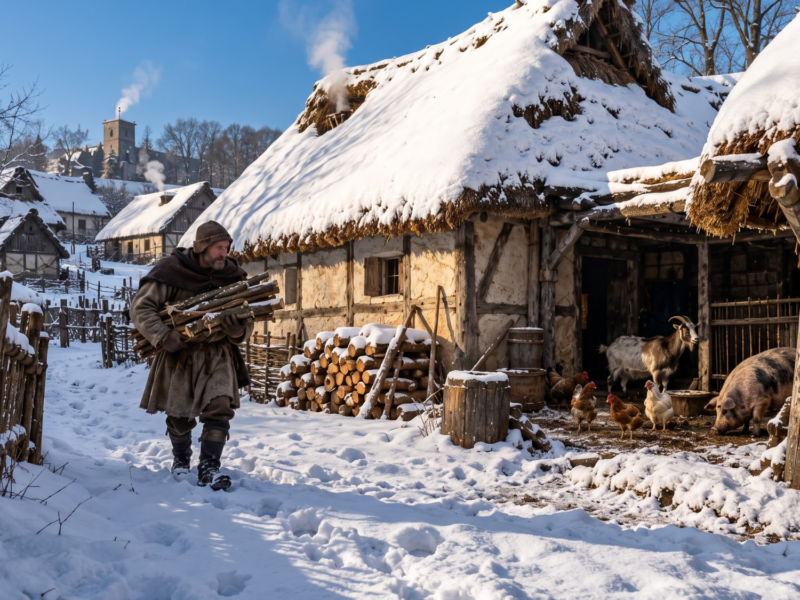
Medieval Survival In Winter — Why Their Villages Remained Warm Against All Odds
The Calculus of Blood
The heat of the hearth was nothing without fuel, and keeping the bodies around it alive required food. Both were products of a brutal calculus solved months ago.
As Elara sat by the embers, she thought back to June. The hay harvest. The entire village had swung long scythes in unison, a communal army fighting against time. They had turned the grass under the sun, praying to God for dry days, before carting it into the lofts.
The amount of hay dictated the terms of life and death. If Kaelen had kept too many cattle alive, the hay would run out by February. The beasts would slowly starve, collapsing in the snow, leaving the family without plow power for the spring. If he kept too few, they would not have the breeding stock to recover. In the upland hills, when the hay ran dangerously low, Elara knew shepherds who were forced to chop branches of holly, feeding the prickly, evergreen leaves to their sheep as a desperate, final resort.
The deadline for this terrible mathematics was November 11th. Martinmas.
By the Feast of St. Martin, the hay was tallied, the autumn grain was sown, and the judgments were made. The pigs, which had spent the autumn exercising their pannage rights—fattening themselves on fallen acorns and beechnuts in the lord’s forest—were brought home.
It was a day of blood and bounty. The old ox, the barren ewes, and the fattest pigs were slaughtered. The air in Oakhaven had tasted of copper and woodsmoke. Nothing was wasted. Blood was drained and mixed with oats to make black puddings. The fresh Martinmas beef was roasted for a rare, gluttonous feast, accompanied by the hiring fairs where laborers traded contracts for the coming year.
But the bulk of the meat had to be preserved.
Elara looked up into the smoky rafters of the longhouse. Hanging from hooks were slabs of bacon, pork, and beef. The constant smoke from the open hearth slowly drew the moisture from the flesh, curing it. Beside them hung barrels of meat packed densely in dry salt or submerged in heavy brine. Salt was astronomically expensive, a luxury they bled their savings for, but without it, the meat would rot, and bacteria would claim their winter stores.
In clay pots along the wall, fish and eggs sat submerged in sharp vinegar. In a sealed wooden cask, cabbage harvested in the autumn had been salted and pounded until it fermented, turning into a sour, sharp kraut that would keep until Easter.
Outside, raised on stone footings called staddle stones to keep the damp and the rats at bay, stood the village granaries. The grain was the anchor of their existence. It had been winnowed and dried meticulously, for damp grain would sprout, heat, or grow toxic mold. Even so, Elara constantly fought a war against the granary weevils that sought to devour their bread before it could be baked.
The milk from their single cow had long dried up for the winter, but its summer bounty was saved. Over a hundred pounds of hard cheese and tightly packed crocks of butter—sealed from the air—sat in the coolest corner of the house.
The winter system was a puzzle of preservation. Every calorie had been trapped, salted, smoked, or fermented.









