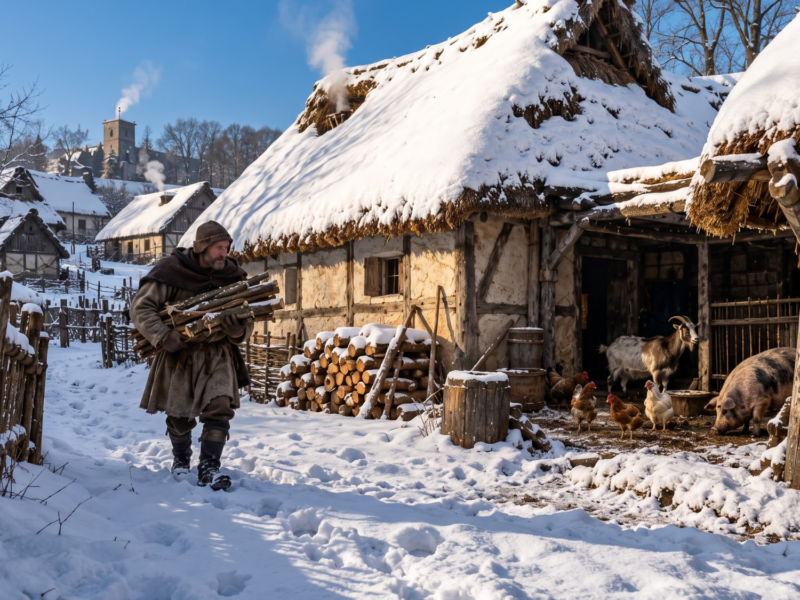
Medieval Survival In Winter — Why Their Villages Remained Warm Against All Odds
Armor of the Sheep
By December, the true cold set in. It was a damp, creeping frost that sought to crack bones.
When Bran returned from checking the granary, his clothes were dusted with a fine, dry snow. He did not shiver, thanks to the layered logic of medieval clothing.
Beneath it all, Bran wore a shift of undyed linen. It was soft against the skin, designed to absorb sweat and the natural oils of the body, sparing the outer garments from needing constant washing. Over the linen, he wore a thick tunic of wool, and over that, a heavy woolen cloak. His legs were bound in woven wool hose, and a dense cowl protected his neck and head.
The wool was a miracle of nature. Elara had woven the cloth herself, purposefully leaving the sheep’s natural lanolin oil in the fibers. The fabric was then “fulled”—soaked and beaten repeatedly until the fibers matted together into a dense, felt-like barrier. The lanolin shed the snow and light rain, while the trapped air within the fibers held Bran’s body heat close.
“Leave the cloak by the hearth,” Elara instructed as Bran shook off the snow.
Wool was magic, but it had a vulnerability. If it became thoroughly soaked, the water displaced the trapped air, and the fabric became an icy death trap. Drying wet wool by the fire was a rigid rule of winter survival.
Bran kicked off his shoes. They were simple, turn-shoe leather—sewn inside out and then reversed so the smooth hide faced outward against the mud. To insulate his feet against the frozen ground, Elara had packed the insides with dry straw and raw fleece.
They owned no bright colors. Dyes like madder red or woad blue were expensive, so their clothing was the natural brown, gray, and off-white of the sheep they sheared. They had only their working clothes, and perhaps one slightly cleaner set for the Sabbath.
As the sun plummeted beneath the horizon by mid-afternoon, the claustrophobia of the longhouse closed in.
Elara struck a spark and lit a rushlight. She had spent the autumn gathering tall reeds from the marsh, meticulously peeling away the outer bark to expose the soft, spongy pith. She had soaked these piths in the leftover mutton fat from the Martinmas slaughter.
Placed in a crude iron holder, the rushlight hissed and cast a dim, flickering yellow glow over the room. It smelled faintly of roasted meat and smoke. Each rush burned for perhaps twenty minutes. It was a poor light, casting long, wavering shadows, but it cost them nothing but time. Tallow candles made of rendered fat were better, but still smelled foul. The clean, bright burn of beeswax candles was a treasure reserved entirely for the altars of God and the tables of the nobility.
Some wealthier yeomen stretched boiled, scraped animal horns thin enough to cover their windows, letting in a translucent, milky daylight while blocking the wind. But Elara had only solid wooden shutters.
Trapped in the dim, smoky halo of the rushlight, huddled mere feet from the hearth, the family passed the endless evenings. Elara spun wool on a drop spindle. Kaelen mended leather harnesses. The proximity was absolute. The psychological weight of the dark was a physical burden, pressing down on their minds.
To survive the winter, the mind needed as much engineering as the body.









